
 Search Articles


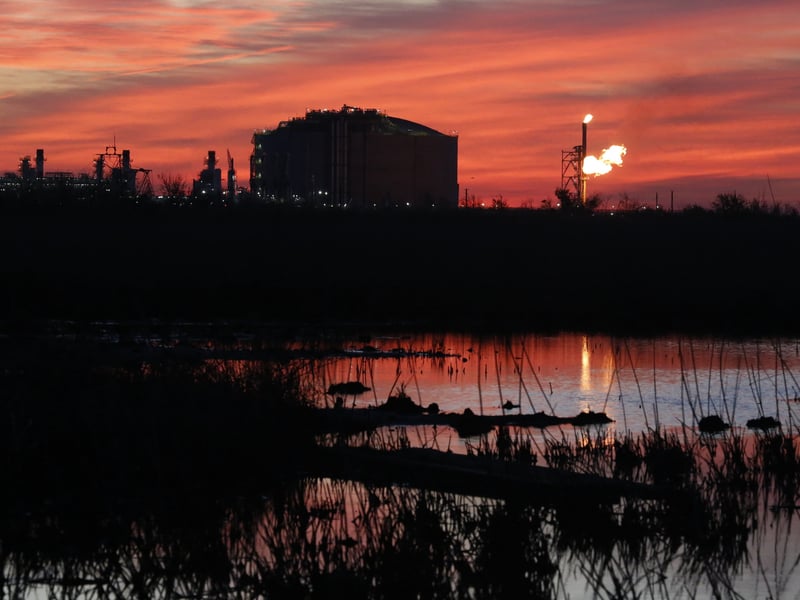
WASHINGTON (CN) — A D.C. Circuit Court of Appeals panel heard arguments Monday over a proposed liquefied natural gas export facility on the Gulf Coast in Louisiana that activists say would produce over 100 million tons of carbon dioxide and nitrogen dioxide emissions.
The $10 billion project would be one of the largest liquified natural gas export projects if the D.C. Circuit allows construction to move forward. According to Commonwealth LNG, the company that would run the plant, construction could start in the first half of 2024 and operations could begin in 2027.
Environmental group Healthy Gulf argues in its challenge that the Federal Energy Regulatory Commission failed to consider the significant impact of additional greenhouse gas emissions in Cameron Parish, Louisiana, a community already inundated with liquified natural gas projects: There are three liquefied natural gas terminals already operating in Southwest Louisiana; four additional terminals approved by the Federal Energy Regulatory Commission; and an eighth project undergoing review that would only be two miles from the Commonwealth plant.
The project would also have an adverse impact on the local community, where many residents are low-income or people of color, which faces above-average rates of cancer, asthma and other serious illnesses, the group argues. It would release nearly 3.6 million tons of carbon dioxide equivalents and 550 tons of nitrogen dioxide, along with other greenhouse gases each year of its expected 30 years of operation.
“This is the equivalent of around 700,000 new cars on the road and would increase Louisiana’s total greenhouse gas emissions by nearly two percent,” Nathan Matthews, a Sierra Club attorney representing the activists, wrote in the group’s opening brief. “FERC estimated the Terminal’s greenhouse gas emissions would have a total social cost of nearly $3.6 billion through 2050.”
A three-judge panel, made up of U.S. Circuit Judges Karen Henderson, Florence Pan and Bradley Garcia — a Ronald Reagan appointee and two Joe Biden appointees, respectively — appeared surprised by energy regulators’ determination that these impacts weren’t significant enough to consider alternatives.
In an exchange between Judge Pan and Federal Energy Regulatory Commission attorney Susanna Chu, Pan asked why, if the threshold for emissions to be considered significant was 100,000 metric tons, the Commonwealth project, which would produce 36 times that amount, didn’t meet the threshold.
Chu said the commission was still grappling with a final number at which to set the threshold, adding that the 100,000-metric ton limit was temporary and had since been withdrawn.
“That’s astounding,” Pan said. The judge asked whether a project like Commonwealth — which would increase national emissions by 0.6% on its own — would only be considered significant if it increased by 20%, 50% or even 100%.
Chu declined to consider the hypothetical, instead repeating that the commission had made no determination and pushing back on the idea that global climate change impacts could be attributed to a single project.
On Monday, Matthews argued that in its environmental analysis the Federal Energy Regulatory Commission wrongfully determined that the project would only have an incremental impact on the area’s air quality and failed to consider the cumulative impacts in addition to those of completed and proposed projects in the area.
He said environmental regulations were meant to defend against “death by a thousand cuts,” and while the Commonwealth project’s emissions may fly under the radar on days with the worst air quality, it would likely be the worst polluter other days.
The attorney also noted that the federal regulatory commission determined the project would have significant “visual impacts,” like noise and light pollution and reduced enjoyment of nearby beaches. But the commission concluded that the project was in the public interest nonetheless as an export facility.
According to Matthews, the commission decided against three alternative designs that could have either lowered emissions, reduced land use or implement carbon capture.
Each were rejected over concerns they would increase the plant’s footprint, increase air pollution or were unfeasible, according to the Federal Energy Regulatory Commission’s analysis.
The project also stirred concerns surrounding rising sea levels, since the plant would be built along the west bank of the Calcasieu ship channel on the coast of the Gulf of Mexico — an area that may lose up to 40% of its land in the next 50 years, according to the state’s Coastal Protection and Restoration Authority. The report prompted a 2017 effort to maintain and restore the shoreline by reducing land loss by 27% over the next half century.
Cameron Parish has been devastated by hurricanes repeatedly since Hurricane Audrey killed over 390 people in 1957, with further destruction caused by Hurricanes Rita, Ike and Laura in 2005, 2008 and 2020.
As climate change continues to intensify these storms — last week, scientists proposed a sixth category to measure hurricanes — the region is likely to suffer worse impacts.
 Follow @Ryan_Knappy
Subscribe to our free newsletters
Our weekly newsletter Closing Arguments offers the latest about ongoing trials, major litigation and rulings in courthouses around the U.S. and the world, while the monthly Under the Lights dishes the legal dirt from Hollywood, sports, Big Tech and the arts.