
 Search Articles


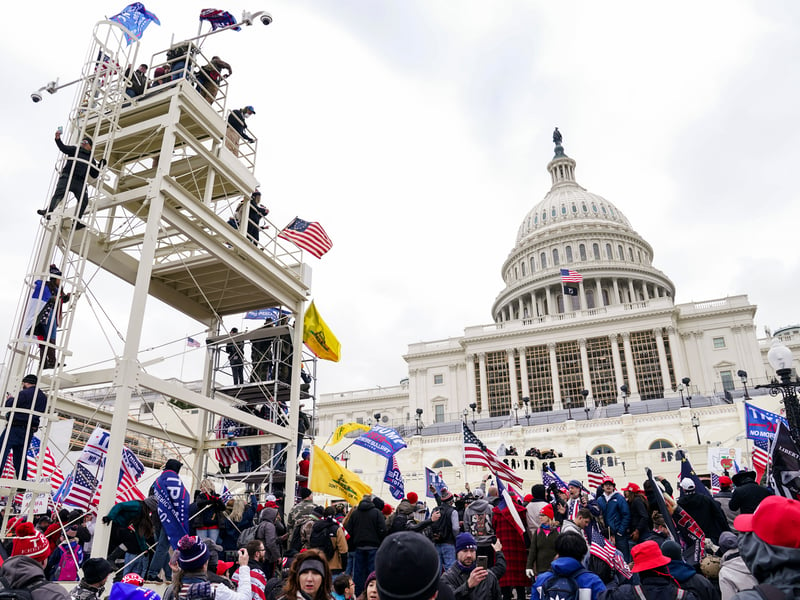
WASHINGTON (CN) — A D.C. Circuit panel on Friday affirmed a United States Capitol Police officer’s obstruction conviction after that officer, Michael Riley, deleted messages to a Capitol rioter in which he urged the rioter to delete posts and messages taken on Jan. 6, 2021.
A 25-year veteran of the Capitol Police, Michael Riley was working that day and was even one of the first officers to respond to pipe bombs found at the RNC and DNC.
A jury had convicted Riley of obstruction of an official proceeding — and specifically, for document destruction — after he deleted messages sent to Capitol rioter Jacob Hiles. U.S. District Judge Amy Berman Jackson, a Barack Obama appointee, in April 2023 sentenced Riley to 120 days of home incarceration for that crime.
A fisherman from Virginia, Hiles had posted videos from the riot, including from inside the Capitol. In his message to Hiles, Riley indicated that he agreed with his politics.
On Friday, a three-judge panel of the D.C. Circuit rejected Riley’s argument that prosecutors failed to establish that future criminal charges against either man were foreseeable and that his deletions therefore obstructed investigators by removing evidence.
That panel was made up of Circuit judges Cornelia Pillard, Michelle Childs and Bradley Garcia — two Barack Obama appointees and a Joe Biden appointee, respectively.
On Jan. 7, 2021, Riley posted on Facebook that rioters who assaulted officers, committed property damage and broke into the Capitol should be criminally charged. He further warned that “if we don’t send a message, it will surely happen again.”
Within an hour of that post, Riley saw that Hiles — one of his Facebook friends — had posted a video from the Capitol.
In the video, Hiles claimed that he and thousands of others had been funneled into the building. Riley messaged Hiles, describing himself as an officer who “agrees with your political stance."
Riley warned Hiles that the riot was being investigated and that anyone who entered the building would be charged. He advised him to take down his video from inside the Capitol.
Over the next week, the pair exchanged hundreds of messages discussing the FBI’s investigation.
Later that month, on Jan. 20, Hiles said he’d been interviewed by the FBI and that investigators were especially curious about the pair’s communications. Riley deleted all their messages the following day, including two phone calls with Hiles.
After deleting the messages, Riley then sent a final text to Hiles. He said that a friend had showed him video of Hiles “smoking weed” and “acting like a moron” inside the Capitol, that he did not believe his story of being pushed into the building and that he felt foolish for believing Hiles. He explained those were the reasons he deleted the messages.
Soon after, the Capitol Police Office of Professional Responsibility informed Riley that a disciplinary complaint had been filed against him. A grand jury later charged him with two counts of obstruction, one for deleting his messages and another for warning Hiles to delete his videos.
Riley argued that Justice Department prosecutors failed to prove intent to obstruct because they did not identify a foreseeable Jan. 6 grand jury proceeding or identify how the deleting of messages would interfere.
Writing for the panel on Friday, Pillard rejected those arguments. She said that version of events clearly contradicted the case record and that as a Capitol Police officer, Riley knew about the pending grand jury.
“Riley was a veteran Capitol Police officer [who was] concededly aware of the role of grand juries in the criminal process," Pillard wrote. “His own messages showed he expected felony prosecutions of unauthorized entrants into the Capitol building.”
Riley could reasonably foresee that a grand jury would be empaneled to approve felony charges, Pillard wrote — and Riley knew his deletions would limit the available evidence against him. Indeed, by the time Riley deleted his messages, one already had been empaneled.
Ultimately, a grand jury approved two obstruction charges against Riley: one for deleting his messages and another for tipping off Hiles.
At trial, a jury convicted Riley of the first obstruction charge but could not reach a verdict on the second one.
After oral arguments in Riley’s appeal in March 2024, the Supreme Court ruled 6-3that a federal law underpinning obstruction charges for Capitol rioters should be narrowed to only apply to evidence destruction. The clause, Section 1512(c)(2), generally bars obstructing official proceedings and had become a staple of Jan. 6 prosecutions.
Riley filed a post-argument brief citing that decision, Fischer v. United States .
The panel disagreed with his analysis.
“If anything, Fischer affirms that Riley’s offense — destroying evidence pertinent to a grand jury investigation — is exactly the type of conduct covered by section 1512(c),” Pillard wrote.
 Follow @Ryan_Knappy
Subscribe to our free newsletters
Our weekly newsletter Closing Arguments offers the latest about ongoing trials, major litigation and rulings in courthouses around the U.S. and the world, while the monthly Under the Lights dishes the legal dirt from Hollywood, sports, Big Tech and the arts.