
 Search Articles


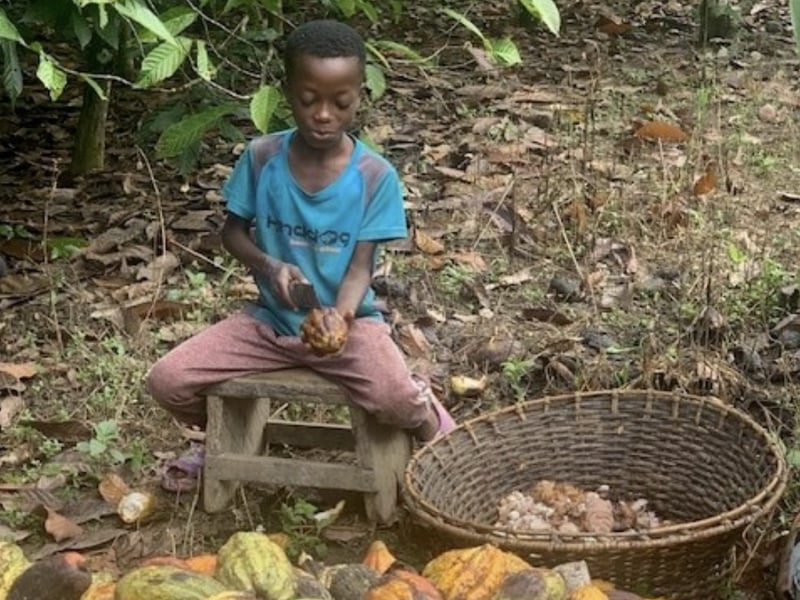
WASHINGTON (CN) — A D.C. Circuit panel on Tuesday dismissed a class action against seven major chocolate companies, including Hershey, Nestlé and Mars, for sourcing cocoa in part from the Ivory Coast, where child labor and modern-day slavery run rampant.
The eight named plaintiffs, each a citizen of Mali, were forced to work as children on cocoa farms in the Ivory Coast after being promised well-paying jobs in remote areas of the West African country, before eventually finding their way back home after months or years.
The three-judge panel found the plaintiffs had failed to clearly demonstrate the causal connection between the chocolate importers’ “supply chain venture” and the specific plantations.
“The plaintiffs in this case deserve the greatest sympathy, and the people who took away their childhoods deserve the greatest condemnation,” U.S. Circuit Judge Justin Walker wrote in the court’s opinion. “But the plaintiffs did not plausibly allege a connection between those people and the importers. The plaintiffs, therefore, lack standing to sue the importers.”
They filed their class action in the U.S. District Court for the District of Columbia against Nestlé, Cargill, Mondelēz, Hershey, Olam, Barry Callebaut and Mars, accusing them of violating the Trafficking Victims Protection Reauthorization Act.
Under the statute, victims can seek damages against any person who knowingly benefits from a venture that violates federal slavery and human trafficking laws.
Walker, a Donald Trump appointee, was joined on the three-judge panel by Chief U.S. Circuit Judge Sri Srinivasan and U.S. Circuit Judge Patricia Millett, two Barack Obama appointees.
“The plaintiffs’ first mistake is their failure to clearly — or even coherently — define the ‘venture’ in which the importers allegedly participated,” Walker wrote. “Is it the World Cocoa Foundation — an association of the importers themselves, without ‘any individual or entity that injured’ the plaintiffs? Or are the importers ‘in a venture with each other and their cocoa supplies,’ who ‘were responsible for the forced labor and trafficking’ of the plaintiffs? The complaint does not clarify.”
Walker further explains that the lead plaintiff, Issouf Coubaly, did not plausibly allege that the small farm he was forced to work on at 15, Guezouba, supplied any of the importers named as defendants.
Nor did he allege that the farm supplied an intermediary company that then supplied any of the importers, instead stating that the farm was in an area of the Ivory Coast that “was primarily supplying cocoa to defendants Nestlé, Cargill and Olam.”
U.S. District Judge Dabney Friedrich, a Trump appointee, granted the companies’ motion to dismiss the suit in May 2021, finding that the plaintiffs’ general “industry-wide allegations” lacked the specificity necessary to link their injuries to any of the defendants. The plaintiffs then appealed to the D.C. Circuit.
Terry Collingsworth, of International Rights Advocates and lead counsel for the plaintiffs, called the panel’s decision disappointing in an emailed statement Tuesday.
“The court rewarded the chocolate multinational defendants, including Nestlé, Mars, Hershey, Mondelēz and Cargill, for concealing their cocoa supply chains such that former child slaves are unable to link a specific company to the farms in [the Ivory Coast] where they were enslaved,” Collingsworth said. “The former child slaves never were able to obtain discovery to obtain the information they needed to meet the court’s standard.”
He added that the plaintiffs are currently considering potential next steps following Tuesday’s decision.
Walker wrote that the plaintiffs’ case relied heavily on the fact that the importing companies buy nearly 70% of all Ivorian cocoa and argues that it is “more likely than not” that the farms they were forced to work on were tied to one or more of the importers.
“To show standing at the motion-to-dismiss stage, the plaintiffs needed to plausibly allege specific facts showing that the importers source cocoa from the farms where they worked — either directly or through intermediaries,” Walker wrote. “It’s not enough to allege only that some importer might (or might not) have bought cocoa from a farm at a time that a plaintiff might (or might not) have been forced to work there.”
The chocolate companies did not respond to a request for comment.
The D.C. Circuit delayed its consideration of the appeal until it ruled in a similar case, Doe 1 v. Apple Inc., in which former child cobalt miners alleged that American tech companies had violated the same human trafficking statute by participating in a supply-chain venture that supplied them with cobalt from mines in the Democratic Republic of Congo.
There, the D.C. Circuit held that the plaintiffs had standing but failed to state claim under the trafficking statute.
Walker noted that, while both cases seem alike on the surface, the cobalt miners had plausibly alleged the tech companies had sourced cobalt from the suppliers that preyed on their forced labor.
The leading anonymous plaintiff, James Doe 1, had identified the mine where he worked, the company that owned and controlled the subsidiary that operated the mine and plausibly alleged that the company ultimately supplied cobalt to each defendant.
 Follow @Ryan_Knappy
Subscribe to our free newsletters
Our weekly newsletter Closing Arguments offers the latest about ongoing trials, major litigation and rulings in courthouses around the U.S. and the world, while the monthly Under the Lights dishes the legal dirt from Hollywood, sports, Big Tech and the arts.