
 Search Articles


WASHINGTON (CN) — The Justice Department struggled to justify President Donald Trump’s effort to widely bar transgender people from serving in the U.S. military to a D.C. Circuit panel on Tuesday.
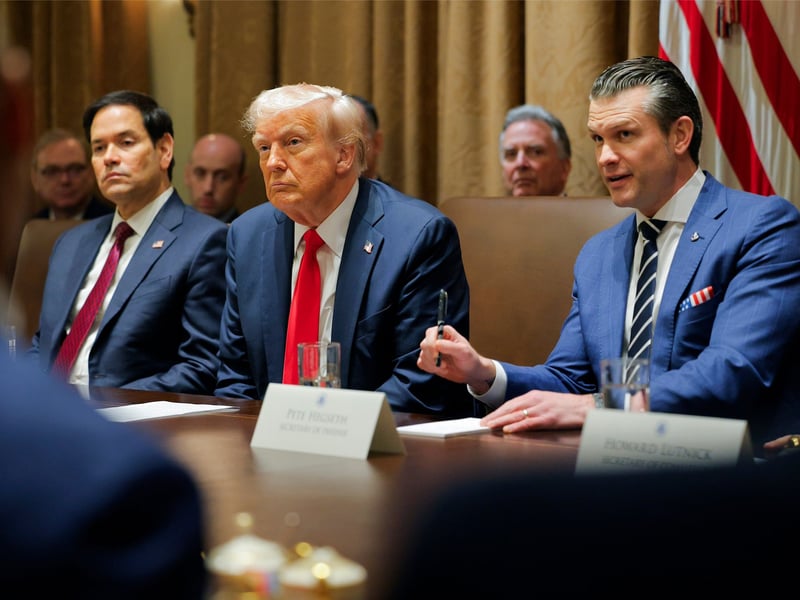
Secretary of State Pete Hegseth’s Feb. 26 policy — created at Trump’s instruction per his “Prioritizing Military Excellence and Readiness” executive order — would effectively disqualify all trans people from service unless they receive an exception.
Both Trump’s order and Hegseth’s policy focus on concerns that people diagnosed with or who have a history of gender dysphoria are unfit for and unable to meet the rigorous standards necessary for military service.
U.S. District Judge Ana Reyes, a Joe Biden appointee at the U.S. District Court for the District of Columbia, blocked enforcement of the policy on March 18, ruling the mandate was “rushed and reached a preordained result,” wasn’t based on analysis and was undermined by Hegseth and Trump’s public statements referring to it as a total ban.
The three-judge panel grilled Justice Department attorney Jason Manion about how the Trump administration could characterize the policy as anything less than a categorical ban on all trans people actively serving and trying to enlist.
U.S. Circuit Judge Cornelia Pillard said the policy was “clearly banning all trans people.”
The Barack Obama appointee noted that former Secretary of Defense James Mattis’ 2018 plan — which the administration asserts Hegseth’s policy mirrors — disqualified trans people from service, but grandfathered in those already serving. There was no such clause in the new policy.
“You said it’s not a trans ban because it allows people who identify as trans to serve in their birth sex,” Pillard said. “Your argument that this is not a ban on trans service is that you can serve as a trans person, as long as you don’t serve as a trans person?”
Manion pushed back, arguing that the policy was more targeted and would only impact people diagnosed with gender dysphoria, “which is marked by significant clinical distress, the impairment of functioning that applies in social, occupational and other important areas.”
He asserted there was a clear error in Reyes’ finding that the policy should be blocked because it was primarily based on animus for a minority group.
Manion pointed to the 2017 Supreme Court case Trump v. Hawaii, where the high court upheld a narrowed version of Trump’s Muslim travel ban, ruling that the ban has a “sufficient national security justification,” derived from expert analysis.
Pillard was unconvinced, calling the military ban a “far cry” from the travel ban, considering the lack of further justification provided beyond a distaste for trans people.
U.S. Circuit Judge Gregory Katsas, a Trump appointee, expressed concern that the policy would have ripple effects for current soldiers who develop gender dysphoria while serving.
He asked Manion what would happen to those people, but Manion was unable to provide an answer.
Katsas further pressed Manion on the standards for people with gender dysphoria to receive a waiver for continued service — they must show 36 consecutive months of stability, show they have not tried to transition and declare they’re willing to serve in their sex assigned at birth.
Katsas noted the standards are much higher than for those seeking to enlist, who would only be required to show they had been stable for 18 months.
Shannon Minter of the National Center for Lesbian Rights, who represents the plaintiffs in the case, argued that the government had clearly not met the standard necessary to support the policy.
U.S. Circuit Judge Neomi Rao, a Trump appointee, pressed Minter on how the panel could uphold Reyes’ order, considering it granted universal relief in a case originally brought by 14 active-duty service members.
Minter said that if the panel were to tailor Reyes’ order to just apply to the 14 plaintiffs, it would create an unworkable situation, especially if they are then deployed overseas.
“They’re going to be serving as an exception to a policy that declares them, by virtue of their identity, to be categorically unfit,” Minter said. “They’re going to have to disclose that to the people they’d be working with, like ‘Hey, I’m a plaintiff in this case, otherwise I’d be subject to administrative separation.’”
Manion argued the panel should defer to the military’s decision and find that leaving Reyes’ order in place amounted to an irreparable harm to the executive branch.
He said that military readiness was a “core presidential power,” a likely nod to the Supreme Court’s immunity decision in Trump v. United States .
The case is expected to reach the Supreme Court, giving the justices the opportunity to limit or uphold the executive’s discretion over the nation’s military.
 Follow @Ryan_Knappy
Subscribe to our free newsletters
Our weekly newsletter Closing Arguments offers the latest about ongoing trials, major litigation and rulings in courthouses around the U.S. and the world, while the monthly Under the Lights dishes the legal dirt from Hollywood, sports, Big Tech and the arts.