
 Search Articles


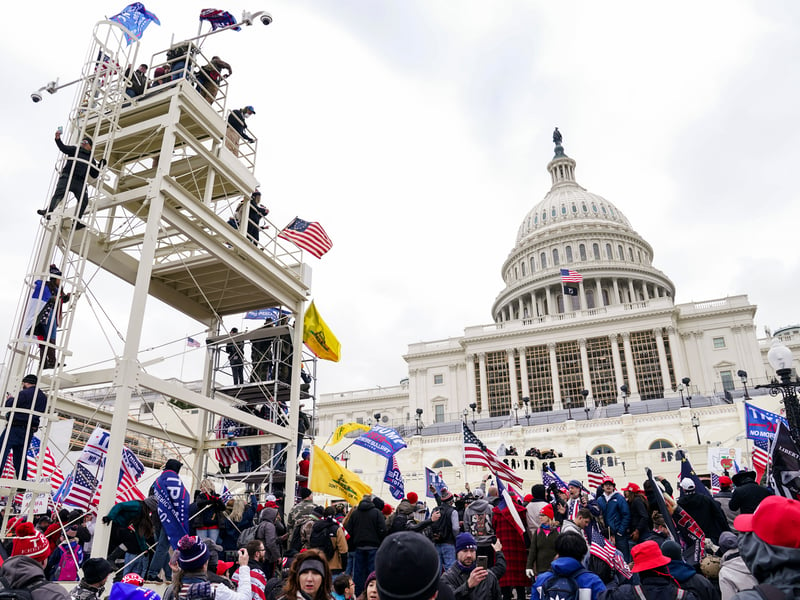
WASHINGTON (CN) — A D.C. Circuit panel grappled on Tuesday with defining a “deadly and dangerous weapon” and “serious bodily injury” as the terms relate to pepper spray used against police officers at the U.S. Capitol riot on Jan. 6, 2021.
Three defendants, Peter Schwartz, Jeffrey Scott Brown and Markus Maly, challenged the sentence enhancements imposed on them for using pepper spray against a line of officers inside the tunnel at the Lower West Terrace.
U.S. District Judge Amit Mehta sentenced Schwartz — who also threw a folding chair at officers inside the tunnel — to 14 years in prison while Brown got 4 and a half years and Maly got 6 years.
A three-judge panel on Tuesday appeared skeptical of their argument that evidence didn’t support the heavier sentences.
In one exchange Maly’s public defender Benjamin Schiffelbein said the requirements don’t include “fleeting injuries,” even if they cause severe pain.
While Metropolitan Police officer Christopher Boyle testified at trial that pepper spray could cause a 9 out of 10 on the pain scale, Schiffelbein argued, the officer never specifically said he suffered such pain at the hands of the defendants, who say that they sprayed above their heads.
“So if you spray in a group you get lucky,” U.S. Circuit judges Patricia Millet responded, noting that even a “10 out of 10” temporary injury would be horrible.
U.S. Circuit Judge Brad Garcia, a Joe Biden appointee, added that if the panel were to rule in favor of the defendants, the judges would need to clarify the test for what specific time period an injury lasts is enough to warrant an enhancement.
Schiffelbein said one factor in that calculation is the type of weapon used, and highlighted that pepper spray is already commonly used by law enforcement.
“This is pepper spray that was used consistent with how police officers use pepper spray every day in this country, and how courts condone that use of force because it doesn’t cause serious bodily injury,” Schiffelbein said.
Justice Department attorney Peter Andrews defended the enhancements. Officers testified in Jan. 6 trials that pepper spray caused both extreme and lingering pain — in some cases it lasts for over two weeks.
He rejected the idea that the defendants spraying above the officers’ heads foreclosed the enhancements and compared the action to firing a gun near an officer’s head and missing. The potential for injury was enough, as the jury found in this case, Andrews said, particularly at the site of the most “barbaric fighting” that day.
Dennis Boyle of firm Boyle Jasari represented Schwartz before the panel and argued that the thrown folding chair, in addition to pepper spray use, still doesn’t rise to the level necessary for the enhancements, and certainly not for nearly 10 more years in prison than Brown.
Millett, a Barack Obama appointee, challenged the notion that the folding chair was not a threat. The judge half-joked that if someone threw a chair at her head, it would injure her.
Boyle responded that the chair was “more like debris than a weapon” and would not have been able to cause significant injuries, especially against well-armored riot police.
The panel pushed Andrews on a secondary argument raised by Boyle: that the search of Schwartz’s telephone amounted to a Fifth Amendment violation, essentially by forcing Schwartz to turn over incriminating evidence.
Millett said a phone is the modern equivalent of a diary, and by forcing Schwarz to open his phone via a fingerprint, law enforcement officials were “accessing the mind through the thumb.”
Andrews said there was probable cause to seize the phone due to the FBI’s ongoing investigation into Schwartz, and said the fingerprint was similar to finding a written-down password.
U.S. Circuit Judge Judith Rogers, a Bill Clinton appointee, rounded out the panel.
The Justice Department’s Jan. 6 prosecution, the largest in its history, has been upended by Donald Trump’s overwhelming electoral victory. Trump’s repeated promises on the campaign trail to pardon Jan. 6 defendants, albeit on a “case-by-case” basis, has opened up a legal avenue for rioters facing either trial or sentencing to delay their cases into 2025 in the hopes of receiving relief from the incoming president.
The president-elect was not mentioned during Tuesday’s arguments, nor was the possibility of pardons. The appeals originated in May 2023, well before the 2024 primaries began.
According to the Justice Department’s newest monthly update on the Capitol riot cases released Wednesday, 1,561 individuals have been charged in connection with the riot. In the 46 months since Jan. 6, 1,028 of those defendants have received sentences; 645 got prison terms and 143 would spend their terms in home detention.
 Follow @Ryan_Knappy
Subscribe to our free newsletters
Our weekly newsletter Closing Arguments offers the latest about ongoing trials, major litigation and rulings in courthouses around the U.S. and the world, while the monthly Under the Lights dishes the legal dirt from Hollywood, sports, Big Tech and the arts.