Search Articles


WASHINGTON (CN) — A D.C. Circuit panel ruled on Friday that President Donald Trump could not unilaterally block immigrants from seeking asylum and deport asylum-seekers already in the country by declaring an “invasion” at the southern border.
The three-judge panel ruled 2-1 that Congress clearly did not give the Executive the power to remove immigrants from the country outside of the usual removal procedures and protections set in the Immigration and Nationality Act.
U.S. Circuit Judge Michelle Childs, a Joe Biden appointee, wrote in the court’s opinion that while the president could suspend entry into the United States — as Trump and former President Joe Biden used Title 42 to temporarily close the border during the Covid-19 pandemic — that entry authority did not extend to removals.
“We conclude that the INA’s text, structure and history make clear that in supplying power to suspend entry by presidential proclamation, Congress did not intend to grant the Executive the expansive removal authority it asserts,” Childs wrote. “The proclamation and guidance are thus unlawful to the extent that they circumvent the INA’s removal procedures and cast aside federal laws affording individuals the right to apply and be considered for asylum or withholding of removal protections.”
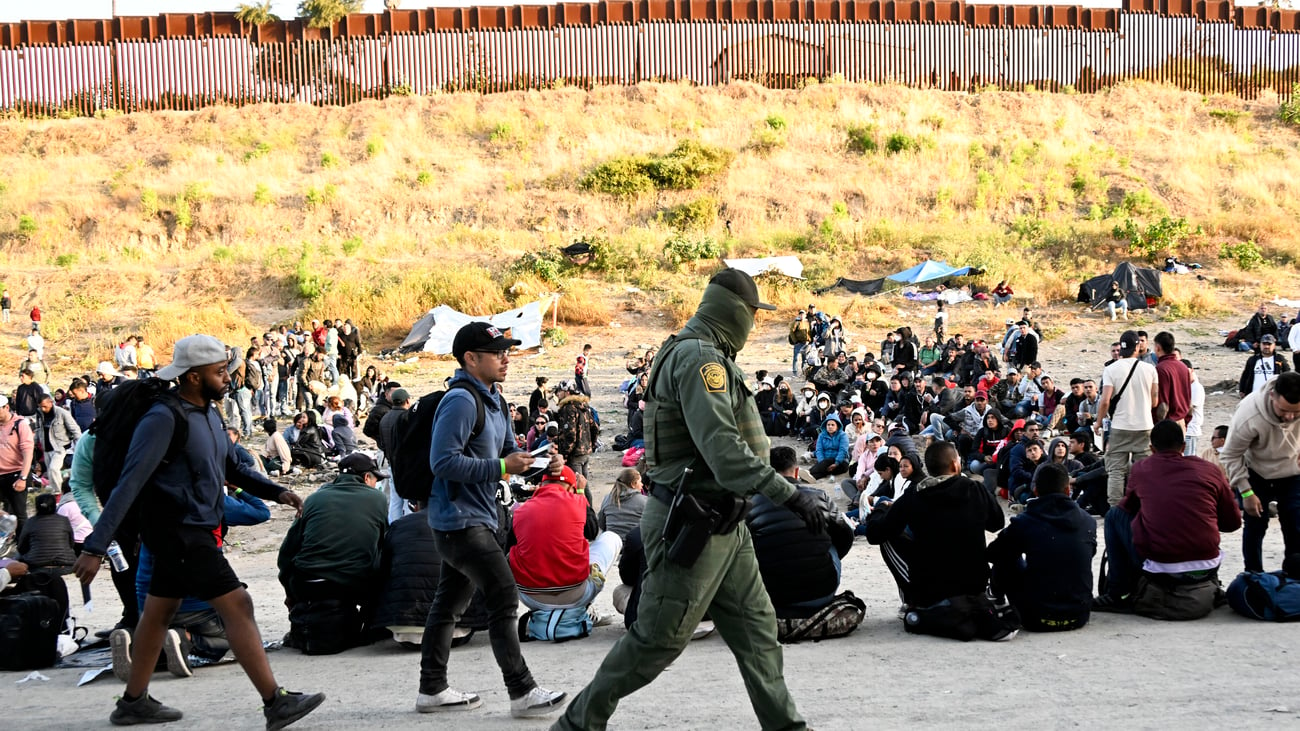
On the first day of his second term, Trump issued the proclamation, “Guaranteeing the States Protection Against Invasion,” barring anyone who crosses the southern border outside ports of entry or without required documents from seeking asylum or withholding of removal.
Trump cited his authority under 8 U.S. Code Section 1182(f), which allows the chief executive to suspend entry of noncitizens deemed “detrimental to the interests” of the nation.
Childs noted the statute governs entry, not “removal,” and said the omission shows Congress’ intent.
“Past practice drives the point home,” Childs wrote. “The Executive branch has for decades acknowledged the limits of the authority Section 1182(f) confers to suspend ‘the entry’ of foreign individuals: No prior president has used it to enhance the Executive’s removal power.”
Childs added that presidents of both parties — including Trump and his first term “muslim ban” — have invoked the provision at least 90 times over the past four decades, each time to restrict entry.
Childs, joined by U.S. Circuit Judge Cornelia Pillard, a Barack Obama appointee, rejected the Justice Department’s argument that the court’s 2021 ruling in Huisha-Huisha v. Mayorkas applied to Trump’s invasion proclamation.
The case centered on the Public Health Services Act and the Centers for Disease Control and Prevention’s Section 265 authority over public health threats, not presidential immigration authority, Childs wrote.
Friday’s decision affirms U.S. District Judge Randolph Moss’ decision granting summary judgment against the Trump administration.
In Moss’ July 2 opinion, the Obama appointee acknowledged the “enormous challenges” facing the executive in addressing illegal immigration and the “overwhelming backlog” of asylum claims but said those concerns do not justify bypassing the INA or the president’s enumerated powers under Articles II and IV.
A coalition of immigrants’ rights groups and 13 asylum-seekers filed the challenge in February, calling Trump’s action an “extreme presidential overreach” and warning it could lead to the deportation of asylum-seekers, including families and unaccompanied children, to countries where they face persecution or torture.
The plaintiffs fled persecution in Afghanistan, Ecuador, Cuba, Egypt, Brazil, Turkey and Peru. Six have already been deported despite their asylum claims, while seven remain in the United States and are protected by Moss’ order.
U.S. Circuit Judge Justin Walker, a Trump appointee, both concurred and dissented in the ruling. He agreed that the Executive cannot remove immigrants to countries where they face persecution and that the proclamation cannot strip them of removal protections.
Instead, Walker wrote that Moss lacked the authority to issue a class action injunction that could apply to millions of plaintiffs without standing.
He asked whether inhabitants on North Sentinel Island, an isolated island 700 miles off the coast of India, “have standing in today’s case?”
“No,” Walker wrote. “Without knowing the United States exists, they can’t even form vague ‘some day’ intentions to enter, let alone provide ‘concrete plans, or indeed even any specification of when the some day will be.’”
He drew up a hypothetical individual from the island, Bob, who is persecuted for his anti-isolationist beliefs and flees in hopes of seeking asylum in the United States. Whenever Bob makes that decision, he would fall into Moss’ class, Walker said, adding that he felt the class should ultimately be narrowed.
 Follow @Ryan_Knappy
Subscribe to our free newsletters
Our weekly newsletter Closing Arguments offers the latest about ongoing trials, major litigation and rulings in courthouses around the U.S. and the world, while the monthly Under the Lights dishes the legal dirt from Hollywood, sports, Big Tech and the arts.