
 Search Articles


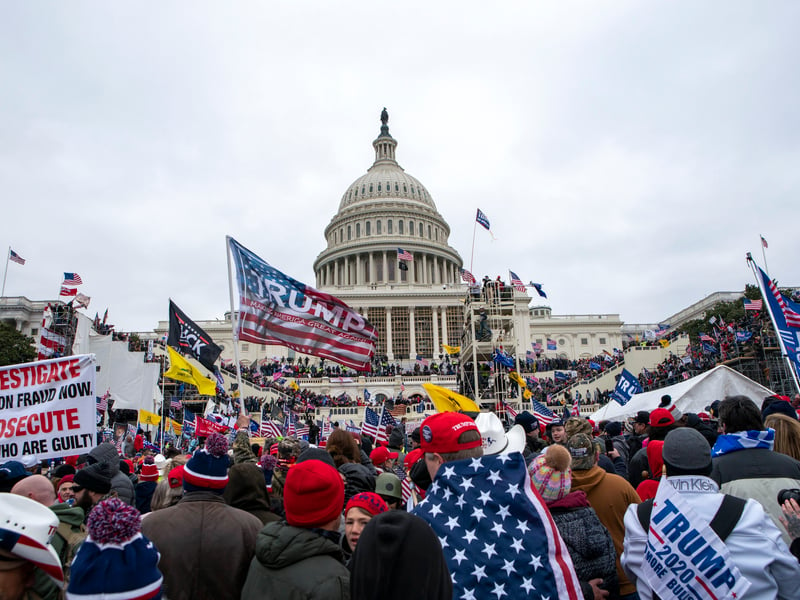
WASHINGTON (CN) — A D.C. Circuit panel rejected a Jan. 6 defendant’s appeal of a federal judge’s resentencing on Friday, finding that the additional 60 days of prison time for parading in the U.S. Capitol did not amount to double jeopardy.
James Little, a 54-year-old truck driver from North Carolina, argued that the resentencing order — unrelated to the more common resentencings for rioters convicted of a staple obstruction charge narrowed by the Supreme Court — violated his Fifth Amendment right not to be punished twice for the same offense.
The three-judge panel found Little’s position that the new sentence imposed additional punishment after he had completed part of his original split sentence and upended his “expectation of finality” unpersuasive.
U.S. Circuit Judge Florence Pan, a Joe Biden appointee, wrote in the panel’s opinion that by appealing his original sentence of 60 days in prison and three years on probation, Little had waived any such expectation.
“‘Long-established constitutional doctrine makes clear that, beyond the requirement that punishment already exacted must be fully credited, the guarantee against double jeopardy imposes no restrictions upon the length of a sentence imposed upon re-conviction,’” Pan said, citing the 1969 Supreme Court case *North Carolina v. Pearce. *
Little had served a 60-day prison term and 18 of his total 36 months of probation when a different D.C. circuit panel sided with him in August 2023. That panel found that a defendant cannot be sentenced to both incarceration and probation for a petty offense, and remanded the case to U.S. District Judge Royce Lamberth of the District of Columbia.
Little pleaded guilty to one count of parading inside a Capitol building, but Lamberth said at the January resentencing he felt Little had shown no remorse and shamelessly tried to “misinterpret or misrepresent what happened” on Jan. 6.
Lamberth, a Ronald Reagan appointee, then resentenced Little toa total of 150 days in prison with 60 days credited for time served from the first sentence and 30 days credited for probation served. Following Lamberth’s order, the D.C. Circuit granted Little’s request that his second sentence be stayed pending his current appeal.
Pan addressed Little’s contention that a 1987 D.C. Circuit case, United States v. Fogel, should have precluded Lamberth from changing his final sentence. In that case, Pan noted, the district court increased Fogel’s sentence after realizing it “made a mistake” in the original pronouncement.
The D.C. Circuit held that a court cannot increase a defendant’s sentence on its own and by doing so without warning, the court had wrongfully compelled fogged to “live in a continuing state of anxiety and insecurity.”
“Little, by contrast, chose to appeal his sentence — he thereby precipitated and consented to any state of uncertainty,” Pan said.
The Biden appointee said that Little’s argument that he was only challenging a defect of his original sentence — that the term of imprisonment and probation was unlawful — and did not waive his expectation of finality in its length was also unpersuasive.
“We are unaware of any precedent that supports curbing out special treatment for certain types of legal arguments challenging a sentence,” Pan wrote, again citing Pearce . “When a defendant successfully challenges his or her sentence or conviction, the prior sentence is ‘wholly nullified and the slate wiped clean.’”
With that “clean slate,” Pan said, the district court can impose whatever legal sentence it deems proper, including one longer than the original.
Pan was joined on the panel by U.S. Circuit Judge Justin Walker, a Donald Trump appointee who also appeared on the original appeals panel, and U.S. Circuit Judge Harry Edwards, a Jimmy Carter appointee.
At oral arguments in September, Josh Carpenter, a North Carolina federal defender, argued that Lamberth’s second sentence arbitrarily doubled the original term and exceeded the maximum penalty of six months for the petty offense parading charge.
He argued that while the resentencing process fixed the problematic split sentence on paper, Little could not “relive” the 18 months he has spent on probation.
Assistant U.S. Attorney Reuven Dashevsky argued that it would be “uncontroversial” that probation and incarceration can be credited against each other. He asserted that Supreme Court precedent holds that a sentence only needs to avoid exceeding the maximum possible sentence.
The panel sided with Dashevsky.
“The new sentence was lawful because the district court provided credit for the time that Little had served on the original sentence — both in prison and on probation — and neither the original sentence nor the new sentence exceeded the statutory maximum,” Pan wrote.
 Follow @Ryan_Knappy
Subscribe to our free newsletters
Our weekly newsletter Closing Arguments offers the latest about ongoing trials, major litigation and rulings in courthouses around the U.S. and the world, while the monthly Under the Lights dishes the legal dirt from Hollywood, sports, Big Tech and the arts.