
 Search Articles


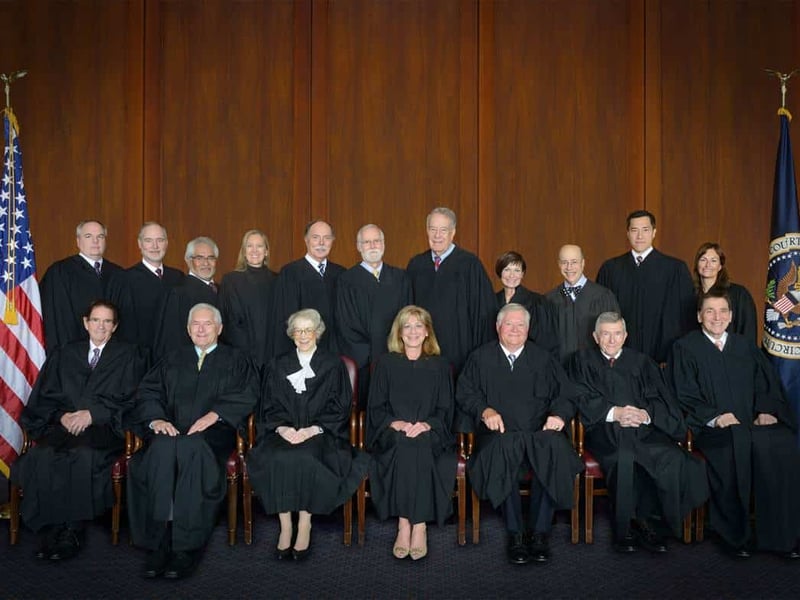
WASHINGTON (CN) — The United States’ oldest active federal judge cannot challenge her suspension from hearing cases at the U.S. Circuit Court for the Federal Circuit on Constitutional grounds, a D.C. Circuit panel ruled Friday.
The three-judge panel ruled that 98-year-old Pauline Newman can only challenge her suspension — for refusing to cooperate with a mental fitness probe in 2023 — at the Judicial Conference of the United States, the only entity specifically empowered to review her suspension.
Newman, a Ronald Reagan appointee, is the oldest federal judge not to have taken a form of semi-retirement known as senior status.
Under the Judicial Council Reform and Judicial Conduct and Disability Act of 1980, U.S. Circuit Judge Bradley Garcia wrote that in-house circuit councils can investigate and take action against their fellow judges, including suspending them from new cases.
Garcia, a Joe Biden appointee, said the panel precluded most of Newman’s constitutional arguments but noted such issues should be reviewed by the Judicial Conference, which functions as an administrative body.
“ The seeming absence of a judicial forum to address Newman’s as-applied constitutional claims itself raises constitutional concerns,” Garcia said. “Judge Newman presents substantial arguments that her suspension — which has now lasted nearly two years, with a third year recommended — threatens the principle of judicial independence and may violate the separation of powers.”
Federal Circuit Chief Judge Kimberly Moore launched an inquiry into Newman’s mental fitness in March 2023 after observing signs of cognitive and physical impairment. Newman refused, arguing the medical exams and records requests were unlawful.
A special committee for the Federal Circuit suspended her from new case assignments for one year, and the Federal Circuit’s Judicial Council later extended the suspension. The council will review it again in September.
Each circuit court has its own judicial council; in the Federal Circuit, it consists of the court’s 11 active judges. Before Newman’s suspension, she was the 12th member, but her absence left only 11 to hear recent arguments on Trump’s “Liberation Day” tariffs.
Newman sued in the U.S. District Court for the District of Columbia in May 2023, arguing the Judicial Council violated her due process rights by ignoring “stark” conflicts of interest and refusing to transfer her case to another circuit.
U.S. District Judge Christopher Cooper ruled in February 2024 that the D.C. Circuit decision in McBryde v. Committee to Review Circuit Council Conduct & Disability Orders of the Judicial Conference of the United States held that Congress intended for claims like Newman’s to be heard exclusively by the Judicial Conference.
Garcia, joined by U.S. Circuit judges Patricia Millett and Cornelia Pillard, both Barack Obama appointees, upheld Cooper’s ruling.
Newman raised three constitutional claims: that the 1980 statute’s case-suspension provision is facially unconstitutional; that its application unlawfully removed her from office; and that her colleagues violated her due process rights. She argued impeachment was the only valid method of removal.
In McBryde , the D.C. Circuit reviewed similar statutory and constitutional challenges to judicial council sanctions. There, it ruled the statute explicitly precluded the judge’s statutory claims and precluded the appellate court from reviewing the as-applied constitutional claims.
“In the Act’s legislative history, we discerned ‘clear and convincing’ evidence of Congress’s intent to channel review of as-applied challenges to the Judicial Conference alone and away from federal courts,” Garcia wrote.
Newman argued the Supreme Court effectively overruled McBryde in its 2018 decision, SAS Institute Inc. v. Iancu , which she said held that explicit statutory bars cannot preclude judicial review of claims alleging an agency has exceeded its authority.
The panel disagreed, noting SAS applied McBryde’s principles to a differently worded preclusion provision and only proceeded because the court found the bar didn’t clearly cover the challenge at issue.
In closing, the panel emphasized that its decision did not address the merits of Newman’s constitutional claims — noting she raised “important and serious questions” whether the statute complies with due process — and that it is unable to overrule McBryde or consider if it was correctly decided.
In an emailed statement Friday, John Vecchione of the New Civil Liberties Alliance, representing Newman, indicated the judge was considering the next steps.
“We are evaluating the opinion but it is interesting that the court ended with a thoughtful discussion of the seriousness of Judge Newman’s position and avenues of possible redress, as well as a critique of its own precedent,” Vecchione said.
 Follow @Ryan_Knappy
Subscribe to our free newsletters
Our weekly newsletter Closing Arguments offers the latest about ongoing trials, major litigation and rulings in courthouses around the U.S. and the world, while the monthly Under the Lights dishes the legal dirt from Hollywood, sports, Big Tech and the arts.