
 Search Articles


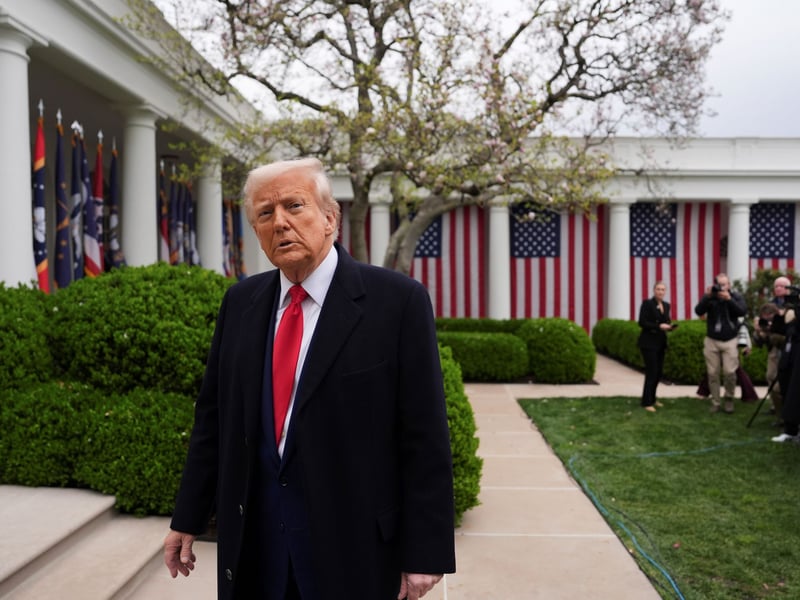
WASHINGTON (CN) — The full D.C. Circuit ordered the reinstatement of two independent officials atop the National Labor Relations Board and the Merit Systems Protection Board on Monday, reversing President Donald Trump’s terminations a second time.
In an en banc decision, the D.C. Circuit ruled 7-4 to vacate a divided panel’s ruling last Monday that allowed Trump to remove Merit Systems Protection Board Chair Cathy Harris and National Labor Relations Board member Gwynne Wilcox.
The Merit Systems Protection Board reviews disputes from federal workers, while the National Labor Relations Board resolves hundreds of unfair labor practice cases every year.
The full court is scheduled to rehear the case on May 16. As part of Monday’s decision, the court denied 6-5 the government’s request for a 7-day emergency stay to allow it to petition the Supreme Court.
In a per curiam order, the appellate court noted that the court is still bound by two landmark Supreme Court cases, Humphrey’s Executor v. United States and Wiener v. United States, which limit the president’s ability to remove officials on multi-member adjudicatory boards like the two in question.
The panel found that the Supreme Court has instructed lower courts to adhere to that precedent since those 1935 and 1958 cases, even when limiting their breadth in more recent cases like Seila Law v. Consumer Financial Protection Bureau and *Collins v. Yellen. *
“The government has not demonstrated the requisite ‘strong showing that [it] is likely to succeed on the merits’ of these two appeals,” the judges wrote. “Nor has it demonstrated irreparable injury because the claimed intrusion on presidential power only exists if Humphrey’s Executor and Wiener are overturned.”
Chief U.S. Circuit Judge Sri Srinivasan joined the majority but noted that he would grant the requested stay to bring the case before the Supreme Court.
Trump appointed three of the four dissenting judges in his first term: U.S. Circuit judges Neomi Rao, Justin Walker and Gregory Katsas. U.S. Circuit Judge Karen Henderson was appointed by George H.W. Bush.
Rao, joined by Walker, Henderson and Katsas, wrote in her dissent that the government’s appeal was likely to succeed.
“The Constitution vests all executive power in a single president,” Rao wrote. “The president has both the power and the responsibility to supervise and direct executive branch officers. To carry out this responsibility, the president must be able to remove officers at will.”
She added that the for-cause removal protections for Harris and Wilcox are likely unconstitutional because they interfere with the president’s authority. Two federal judges determined Trump’s two-sentence termination letters provided no justification and were likely illegal.
Rao further critiqued the en banc majority’s decision to effectively reinstate Harris and Wilcox, noting that such injunctions were likely an overreach of the two federal judges’ authority, and was also an overreach at the appellate level.
“These orders effectively reappoint officers removed by the president and direct all other executive branch officials to treat the removed officers as if they were still in office,” Rao said. “Although the injunctions are nominally directed at subordinate executive officials, their purpose and effect are to restrain the president’s exercise of his constitutional appointment and removal powers.”
Henderson wrote in her dissent that the appeals court should have granted a stay and sent the case to the Supreme Court.
“We do the parties (especially a functioning executive branch) no favors by unnecessarily delaying Supreme Court review of this significant and surprisingly controversial aspect of Article II authority,” Henderson said. “Only the Supreme Court can decide the dispute and, in my opinion, the sooner, the better.”
The case has become a key challenge against Trump’s efforts to reshape the federal government under the “unitary executive theory,” in part by removing en masse top government officials he deems disloyal or a potential hurdle to his agenda.
Wilcox, confirmed in September 2023, was the first Black woman to serve on the National Labor Relations Board and as its chair. She was also the first member to be removed by a president since the body’s creation in 1935. The five-member board lacked a quorum after her removal.
Cathy Harris, confirmed to the Merit Systems Protection Board in 2022 and as chair in March 2024, is a gay woman. She worked on sexual harassment and LGBTQ rights cases as a lawyer with Kator Parks, and was an assistant district attorney for the New York County District Attorney’s Office.
 Follow @Ryan_Knappy
Subscribe to our free newsletters
Our weekly newsletter Closing Arguments offers the latest about ongoing trials, major litigation and rulings in courthouses around the U.S. and the world, while the monthly Under the Lights dishes the legal dirt from Hollywood, sports, Big Tech and the arts.