
 Search Articles


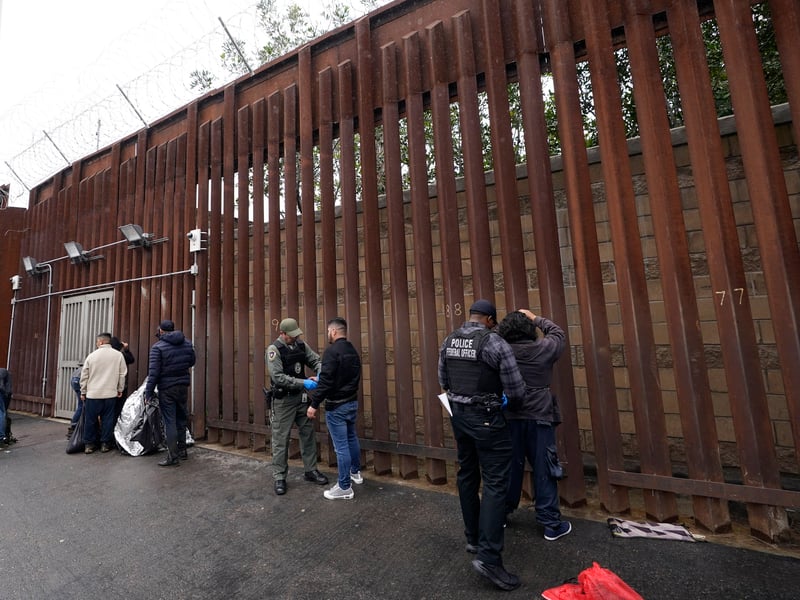
WASHINGTON (CN) — A D.C. Circuit panel seemed skeptical Monday of the Justice Department’s position that President Donald Trump could unilaterally block immigrants from seeking asylum and deport asylum-seekers already in the country by declaring an “invasion” at the southern border.
The three-judge panel heard the government’s appeal of U.S. District Judge Randolph Moss’ preliminary injunction blocking the removals based on his finding that Trump’s Jan. 20 proclamation did grant him the authority to replace longstanding immigration rules created by Congress in the Immigration and Nationality Act.
On the first day of his second term, Trump issued the proclamation “Guaranteeing the States Protection Against Invasion,” which effectively prevented anyone who crosses the southern border without going through a port of entry, or crosses without certain documentation, from applying for asylum or withholding of removal.
In Moss’ July 2 opinion, the Barack Obama appointee acknowledged the “enormous challenges” the executive faces in stemming illegal immigration and in dealing with the “overwhelming backlog” of asylum claims but said it does not justify circumventing the INA or the president’s enumerated powers under Article II and Article IV.
A coalition of immigrants’ rights groups and 13 asylum-seekers brought the challenge in February, calling Trump’s move an “extreme presidential overreach” and warning that all asylum-seekers, including families and unaccompanied children, could be deported and put at risk of persecution or torture.
The immigrants have fled persecution in Afghanistan, Ecuador, Cuba, Egypt, Brazil, Turkey and Peru. Six of them have already been deported despite their asylum claims, while the remaining seven immigrants are still in the United States and thus protected by Moss’ order.
Justice Department attorney Drew Ensign argued the proclamation issued as a response to a “crisis” at the southern border, in the same way Trump and former President Joe Biden used Title 42 to temporarily bar entry and expedite removals during the Covid-19 pandemic.
Ensign maintained that the D.C. Circuit upheld the president’s discretion to deny asylum applications in a 2021 challenge against the Title 42 policy, Huisha-Huisha v. Mayorkas , where a three-judge panel affirmed that power, so long as immigrants are not removed to countries where they’d face persecution or torture.
U.S. Circuit Judge Cornelia Pillard, also an Obama appointee, noted the issue in Huisha-Huisha was that Title 42, a public health statute, conflicted with the INA’s removal protections, and the panel had to determine which statute controlled during a public health emergency.
“Here, the emergency is one that’s contemplated by the INA and, rather than allowing people to come across with impunity, they come across and they actually face removal provisions,” Pillard said. “Why is that not a distinction between this case and Huisha-Huisha? ”
“Whereas [the Centers for Disease Control and Prevention] is an agency, it has only those powers granted by Congress and nothing further,” Ensign replied. “Here, the context is, these are powers that are granted to the president, who has inherent Article II authority to expel aliens. It’s a fundamental aspect of sovereignty.”
U.S. Circuit Judge Michelle Childs, a Biden appointee, said she understood the president’s discretionary power over asylum applications can only be on “the back end,” meaning the president has the discretion to deny certain applications but not to unilaterally bar all asylum applications.
Lee Gelernt, of the American Civil Liberties Union and arguing on behalf of a class of asylum-seekers, argued that the government was trying to override the asylum protections Congress crafted in the INA.
“[The INA] is an internally coherent statute which Congress has put together the pieces,” Gelernt said. “What’s ultimately happening here is that the administration doesn’t like the way Congress has put together the pieces, but Congress has put together the pieces.”
Gelernt argued the government’s position effectively allows the president to place a bar that “wipes away everything that Congress has done” in creating asylum protections in the INA. He added that the panel should not grant too much weight to the Huisha-Huisha decision, considering the Supreme Court’s decision not to review the case in 2023.
He noted the Trump administration’s wider mass deportation campaign has effectively neutered other avenues immigrants can seek relief from, such as a withholding of removal order blocking an immigrant’s repatriation to a country where they fear they’d be persecuted or the similar United Nations Convention Against Torture.
The government’s practice of removing immigrants instead to third countries — such as Uganda, Eswatini, Ghana and Liberia — where they have no connections or where they may be quickly returned into the custody of their home countries, makes any withholding order toothless.
“The reason we are making such a big deal about asylum is that largely the whole ballgame now is asylum,” Gelernt said. “I fear that even if people are given withholding, they’re going to be sent to far-flung places all over the world. That’s why asylum is so essential beyond even any protections that withholding of removal or the Convention against Torture would give.”
U.S. Circuit Judge Justin Walker, a Trump appointee and the author of the court’s opinion in Huisha-Huisha , rounded out the panel.
 Follow @Ryan_Knappy
Subscribe to our free newsletters
Our weekly newsletter Closing Arguments offers the latest about ongoing trials, major litigation and rulings in courthouses around the U.S. and the world, while the monthly Under the Lights dishes the legal dirt from Hollywood, sports, Big Tech and the arts.