
 Search Articles


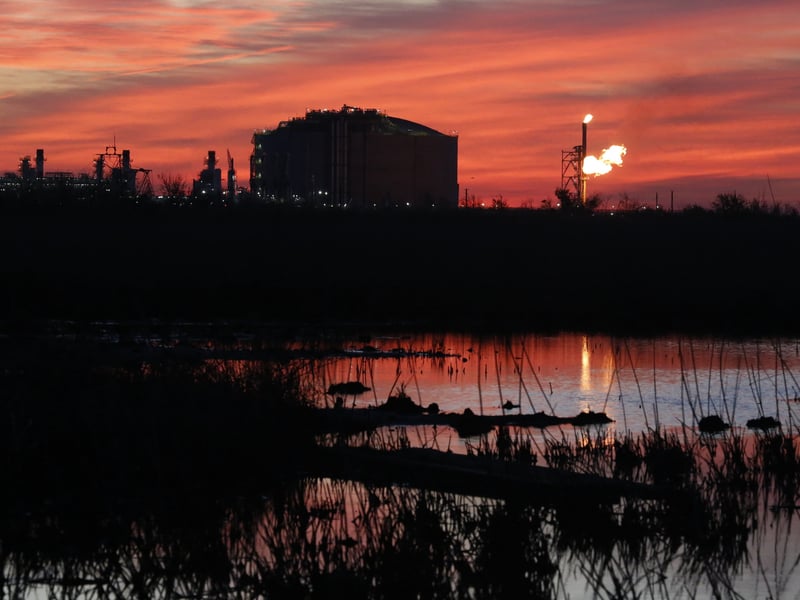
WASHINGTON (CN) — A D.C. Circuit panel ruled on Tuesday that the Federal Energy Regulatory Commission must explain why it failed to analyze the environmental impacts of a proposed liquefied natural gas export facility on the Gulf Coast, but allowed the project to go forward.
The project, proposed by Commonwealth LNG, would create a new facility in Cameron Parish, Louisiana, near the entrance to the Gulf of Mexico. Environmental groups who challenged the project say it would produce over 100 million tons of carbon dioxide and nitrogen dioxide emissions.
Activist groups Healthy Gulf, the Center for Biological Diversity, the Louisiana Bucket Brigade, the Sierra Club and the Turtle Island Restoration Network challenged the $10 billion project, which would be one of the largest liquefied natural gas export projects.
U.S. Circuit Judges Bradley Garcia, Florence Pan and Karen Henderson — two Joe Biden appointees and a George H.W. Bush appointee, respectively — ruled unanimously that the commission had not adequately explained it’s failure to determine the “environmental significance” or cumulative impact of the project’s emissions.
Garcia, writing the panel’s opinion, remanded the case for the commission to address the issues with its environmental analyses but declined to vacate the commission’s authorization of the project, which was scheduled to begin construction in the first half 2024 and begin operations in 2027.
“We think it ‘reasonably likely’ that, on remand, the commission can redress the defects in its GHG-emissions and cumulative-effects analyses and still authorize the project,” Garcia wrote. “Moreover, vacating the authorization would ‘needlessly disrupt’ Commonwealth’s construction plans and commercial operations.”
Healthy Gulf argued in its challenge that the commission failed to consider the significant impact of additional greenhouse gas emissions in Cameron Parish, a community already inundated with liquified natural gas projects.
There are three liquefied natural gas terminals already operating in Southwest Louisiana, four additional terminals approved by the Federal Energy Regulatory Commission and an eighth project undergoing review that would only be two miles from the Commonwealth plant.
The project would also have an adverse impact on the local community — where many residents are low-income or people of color — which faces above-average rates of cancer, asthma and other serious illnesses, the group argued. It would release nearly 3.6 million tons of carbon dioxide equivalents and 550 tons of nitrogen dioxide, along with other greenhouse gases each year of its expected 30 years of operation.
During oral arguments in February, Sierra Club attorney Nathan Matthews argued that the project would equate to 700,000 new cars on the road and would increase Louisiana’s total greenhouse gas emissions by nearly two percent.
According to the environmental analysis conducted by the commission, the project would result in an annual increase of 3.2 million metric tons of carbon dioxide. Despite that calculation, the commission explained to the court that it could not determine the emissions as significant because the commission had not developed a methodology to determine “discrete resource impacts.”
The commission estimated that “social cost” of the project’s emissions up to 2050 would range from approximately $900 million to $5.5 billion, which the environmental groups noted it also did not use to determine significance.
Garcia found that the commission had failed to explain its departure from an approach it took in a similar case in 2021, Northern Natural Gas Co. v. FERC, where the commission compared a project’s foreseeable emissions to the United States total emissions to determine they were insignificant.
In that case, the commission found the project would only increase national emissions by 0.000006%. Meanwhile, Garcia noted, the Commonwealth project would increase national emissions by 0.06%, and increase Louisiana’s emissions by 1.7%, as pointed out by the activist groups.
By failing to address the activists’ argument or explain why Northern Natural’s logic would not apply, Garcia found that failure a “straightforward violation” of the Administrative Procedure Act.
The question of whether that logic applied to the case was not at issue before the court, Garcia said, remanding the case to a lower court to answer.
Garcia found that the commission had also failed to assess the cumulative impacts of nitrogen dioxide emissions by making the determination that the project’s incremental effects were insignificant and thus its cumulative effects were too. The commission based that conclusion on the finding that the project would not emit enough nitrogen dioxide in an hour to exceed the “significant impact level.”
“That’s a non sequitur,” Garcia wrote. “On the commission’s view, the cumulative effect of a project’s emissions would never be deemed significant unless the project’s incremental emissions were already significant on their own.”
He explained that such an approach would “eviscerate” the reason agencies are required to conduct a distinct cumulative effect analysis, which is meant to account for collectively significant impacts that build up from “individually minor” actions.
Garcia remanded for the commission to either explain how the use of the one-hour limit was proper or use a different methodology to assess the project’s cumulative emissions.
While the panel largely sided with the environmental groups, it did agree that the commission had adequately considered three alternatives to the project: replacing the export terminal’s simple-cycle power plant with a combined-cycle power plant; eliminating one of the six LNG storage tanks; or mandating the use of carbon capture and sequestration.
The panel found the commission had adequately met its obligations and reasonably rejected the alternatives.
 Follow @Ryan_Knappy
Subscribe to our free newsletters
Our weekly newsletter Closing Arguments offers the latest about ongoing trials, major litigation and rulings in courthouses around the U.S. and the world, while the monthly Under the Lights dishes the legal dirt from Hollywood, sports, Big Tech and the arts.