
 Search Articles


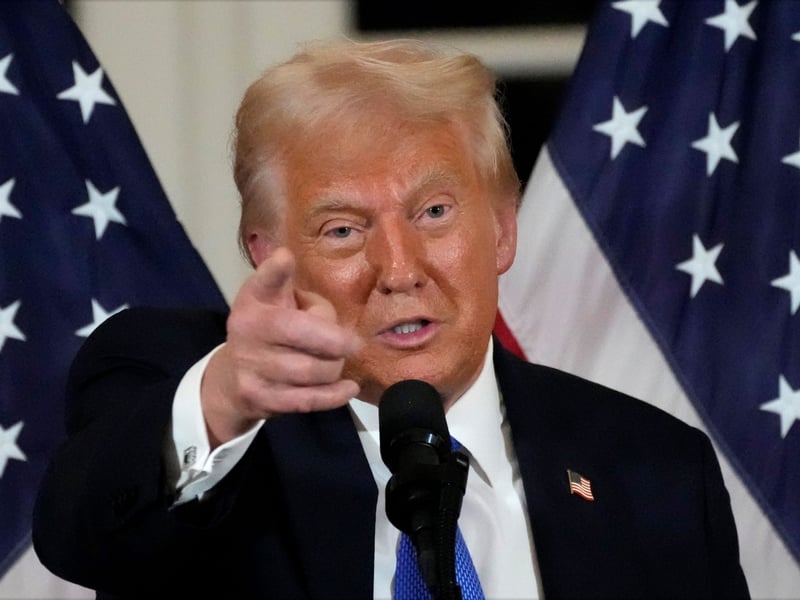
WASHINGTON (CN) — A D.C. Circuit panel ruled Friday that President Donald Trump had the authority to unilaterally remove independent officials atop two labor boards earlier this year, further chipping away at legal precedents that long prevented such terminations.
The three-judge panel ruled 2-1, finding that the National Labor Relations Board and the Merit Systems Protection Board were not protected by the landmark Supreme Court decision in *Humphrey’s Executor v. United States, *and thus leadership could be removed without cause.
“Congress may not restrict the President’s ability to remove principal officers who wield substantial executive power,” U.S. Circuit Judge Gregory Katsas wrote. “As explained below, the NLRB and MSPB wield substantial powers that are both executive in nature and different from the powers that *Humphrey’s Executor *deemed to be merely quasi-legislative or quasi-judicial.”
Trump terminated MSPB Chair Cathy Harris and NLRB member Gwynne Wilcox in the early days of his second administration via two-sentence emails that provided no justification for their removal.
A pair of federal judges deemed their terminations illegal, blasting Trump’s move as an overreach of his presidential authority to remove Democrat-appointed officials he viewed as opposing his agenda — both were appointed by former President Joe Biden, and Wilcox was the first Black woman to serve on the labor board.
Barack Obama-appointed U.S. District Judges Rudolph Contreras and Beryl Howell determined that the president could not terminate agency heads on a whim without just cause, which Congress specifically defined as inefficiency, neglect of duty or malfeasance in office under the Whistleblower Protection Act of 1989.
Katsas, joined by U.S. Circuit Judge Justin Walker in the decision, both Trump appointees, found that those removal protections did not apply to the NLRB and the MSPB because their exercise of significant executive power brought them under the Supreme Court’s 2020 decision in Seila Law v. Consumer Financial Protection Board.
There, the high court stripped removal protections for the CFPB’s director, finding that a president has the right to remove “lesser executive officers” at will and carving out exceptions for multimember expert panels and inferior officers with no executive authority.
Katsas explained that, since deciding *Humphrey’s Executor *in 1935, the high court has significantly narrowed the landmark holding, to the point it is “all but impossible to distinguish executive power from quasi-legislative or quasi-judicial power.”
On one hand, Katsas wrote, decades of Supreme Court rulings have determined that enforcement, rulemaking and administrative adjudication are all executive powers, to the point that the Federal Trade Commission — the relevant agency in *Humphrey’s Executor — *would be deemed as wielding executive powers if it were decided today.
On the other, the high court has made clear that “there are only three kinds of constitutional powers, and two of them are not delegable,” as only Congress itself may exercise legislative power, and only life-tenured judges may exercise judicial powers.
“So by process of elimination, if agencies may receive neither legislative nor judicial powers, what is left for them other than some portion of the executive power?” Katsas said.
U.S. Circuit Judge Florence Pan, a Biden appointee, was the lone dissenter and warned that her colleagues’ decision left independent agencies no longer insulated from politics, risked their independence and
“Today, my colleagues make us the first court to strike down the independence of a traditional multimember expert agencies: They hold that the for-cause removal protections that safeguard the political independence of the NLRB and the MSPB are unconstitutional,” Pan wrote.
“Under my colleagues’ reasoning, it appears that no independent agencies may lawfully exist in this country: Their determination that the MSPB cannot be independent — even though it is purely adjudicatory and does not touch upon core constitutional functions assigned to the president — suggests that no agencies can be independent,” Pan continued.
She warned that Friday’s decision effectively grants Trump dominion over 33 agencies, like the MSPB and NLRB, that had been previously independent.
“The government now urges an extreme view of Article 2’s vesting clause, torn from context: It attempts to reduce the actual art of governing to an uncompromising usurpation of power by the president, all in defiance of Congress’s authority and without regard for the public good,” Pan wrote. “My colleagues’ substantial acceptance of the government’s maximalist theory of executive power brings us closer to autocracy, harms our nation and violates the separation of powers.”
Katsas acknowledged his analysis leaves “very little remaining” of Humphrey’s Executor, suggesting it may just be limited to purely adjudicatory bodies like the War Claims Commission, or those with purely advisory functions like the United States Commission on Civil Rights.
Or, he opined, the Supreme Court may soon overrule the landmark decision outright in *Trump v. Slaughter, *which the high court will hear arguments for on Dec. 8.
 Follow @Ryan_Knappy
Subscribe to our free newsletters
Our weekly newsletter Closing Arguments offers the latest about ongoing trials, major litigation and rulings in courthouses around the U.S. and the world, while the monthly Under the Lights dishes the legal dirt from Hollywood, sports, Big Tech and the arts.