
 Search Articles


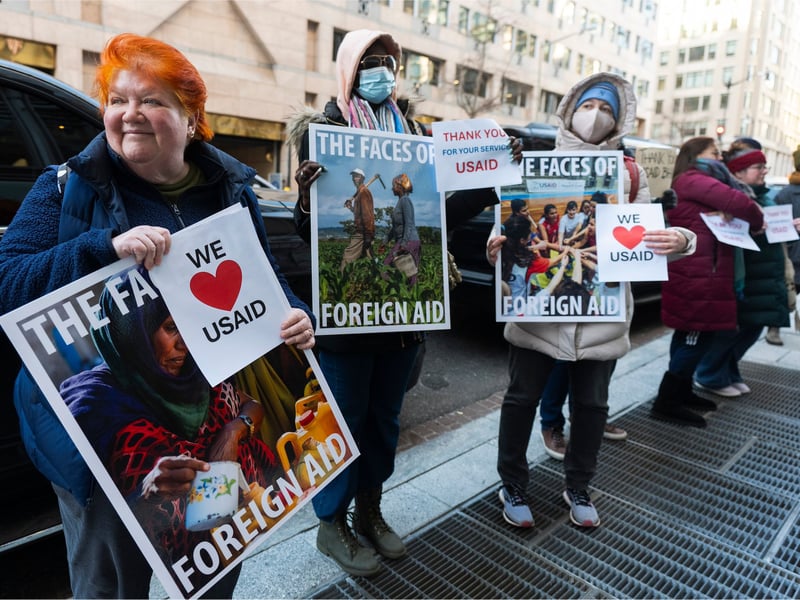
WASHINGTON (CN) — A D.C. Circuit panel expressed doubt Monday that the Trump administration had the authority to cancel billions in foreign aid assistance as part of its now-completed effort to shutter the U.S. Agency for International Development.
In the final oral argument session of the appellate court’s 2024 term, the three-judge panel grilled the Justice Department to determine whether funds allocated under Congress’ Consolidated Appropriations Act of 2024 were mandatory or discretionary.
Justice Department attorney Sean Janda argued that the executive branch has the authority to defer congressionally allocated funds under the Impoundment Control Act and is only required to send the legislative branch a “special message” to start a dialogue to rework distribution.
He added that U.S. District Judge Amir Ali’s emergency orders requiring the government to unfreeze billions of dollars owed to a coalition of nonprofit organizations had interrupted that dialogue. The Joe Biden appointee’s ruling should have been limited to requiring such a message, Janda said.
U.S. Circuit Judge Florence Pan, a Biden appointee, pressed Janda to explain how the court could accept that position given extensive public statements and court filings indicating the administration had no intention of ever spending the aid dollars.
She pointed to Elon Musk’s Feb. 2 post on X calling USAID a “criminal organization” and saying it was “time for it to die,” as well as President Donald Trump’s Feb. 7 Truth Social post explicitly calling for USAID’s closure.
“How can we credit what you’re saying when that’s a factual representation that the district court did not credit?” Pan asked. “When asked to identify anything in the record indicating any intention to spend the amount that’s been sidelined, defendants’ counsel stated he was not familiar with somewhere in the record that there is. It was uncontested that there was no intent to spend these funds, but on appeal you’re telling there is.”
Janda maintained that such statements only expressed a desire to save funds that had been allocated to USAID, which were “very different from a particularized determination that specific funds won’t be spent.”
Pan noted that the panel was bound by Ali’s finding that the government had no intent to spend, since the appeals court does not relitigate facts but rather considers the merits of the government’s legal arguments.
The DOJ argues the nonprofits’ claim that the funding freeze violated the separation of powers doctrine should be rejected as an effort to “constitutionalize” their argument.
The issue, Janda said, was a statutory one, and because the nonprofits had no role in enforcing the relevant statutes, specifically the Impoundment Control Act, their arguments should fail and Ali’s injunction should be vacated.
According to the nonprofits, represented by Daniel Jacobson of Jacobson Lawyers, the only statute that applies is Congress’ 2024 Appropriations Act, which makes clear that the vast majority of the $10 billion allocated to USAID was mandatory.
“These are mandatory because Congress did not use its discretionary language that its uses when it wants it to be discretionary,” Jacobson said. “Not a single [appropriation] says, ‘up to’ or ‘no more than.’”
U.S. Circuit Judge Gregory Katsas, a Trump appointee, asked Jacobson to explain the scope of the relief the nonprofits would receive if the panel were to affirm Ali’s order, noting that the groups had cited both active harm and future harms from the frozen grants.
Jacobson said the nonprofits relied almost exclusively on dollars appropriated by Congress, such as Democracy Forward — 98% of its revenue comes from USAID funding.
Ali’s underlying preliminary injunction, which enjoined the Trump administration from withholding any further funds under a Jan. 20 executive order, was a “universal” injunction that applied beyond the narrow case in question.
On June 27, the Supreme Court stripped federal judges of their ability to impose such nationwide relief, limiting parties to filing class actions or Administrative Procedure Claims to challenge executive actions.
Noting that major legal change, Jacobson requested the panel affirm Ali’s injunction only to the specific parties in the case and remand the case to allow other affected parties to join a potential class.
The Justice Department is likely to challenge any such ruling to the Supreme Court, having argued before Ali that the president’s foreign affairs powers grant him the authority to freeze the funds en masse.
The high court has already intervened in the case, rejecting the administration’s request to pause Ali’s orders to unfreeze approximately $2 billion in funds to the specific parties, in an apparent 5-4 ruling on the shadow docket.
U.S. Circuit Judge Karen Henderson, a George H.W. Bush appointee, rounded out the panel.
 Follow @Ryan_Knappy
Subscribe to our free newsletters
Our weekly newsletter Closing Arguments offers the latest about ongoing trials, major litigation and rulings in courthouses around the U.S. and the world, while the monthly Under the Lights dishes the legal dirt from Hollywood, sports, Big Tech and the arts.