
 Search Articles


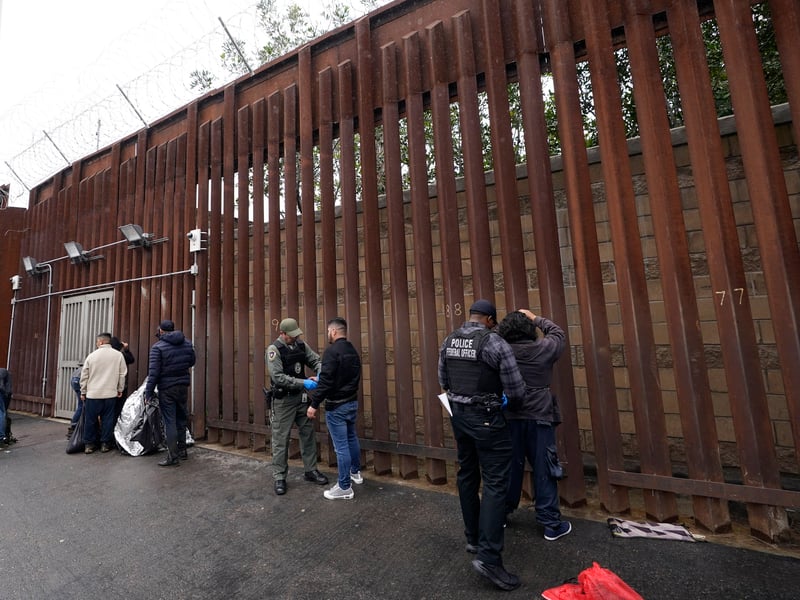
WASHINGTON (CN) — A D.C. Circuit panel on Tuesday appeared doubtful it could uphold a federal judge’s order blocking the Trump administration from expanding expedited removal procedures to immigrants who have been in the country under two years.
The three-judge panel heard arguments in a case initially brought in the U.S. District Court for the District of Columbia on Jan. 22, challenging the revival of a 2019 Department of Homeland Security policy that authorized the summary deportation of immigrants who cannot prove their extended residence.
Make the Road New York argued — as it had when it challenged the 2019 policy — that the rule was unconstitutional because immigrants who may be entitled to remain in the country, due to pending asylum claims or a withholding of removal order, may be swept up and wrongfully deported.
Justice Department attorney Drew Ensign argued that U.S. District Judge Jia Cobb’s Aug. 29 decision to stay implementation of the policy amounted to “universal relief” in violation of the Supreme Court’s decision in Trump v. CASAthis summer, which largely blocked federal judges from issuing sweeping injunctions.
“It has been well established that aliens who have not been lawfully admitted to the country are only entitled to whatever processes the political branches provide and cannot rely on the due process clause to impose additional procedural requirements,” Ensign said.
U.S. Circuit Judge Robert Wilkins, a Barack Obama appointee, was skeptical of Ensign’s view on due process, expressing doubt that migrants under the expedited removal policy were receiving sufficient notice and opportunity to adequately challenge their deportation.
Wilkins added that, under the Supreme Court’s 2001 decision in Zadvydas v. Davis, for immigrants who have entered the country, even if without the proper documentation, their legal status changes, and thus, they are entitled to due process.
U.S. Circuit Judge Neomi Rao — a Donald Trump appointee and the lone dissenter on a stay panel’s denial of the government’s request to freeze Cobb’s decision — asked Ensign whether immigrants have an interest in not being unlawfully removed.
She cited the Supreme Court’s shadow docket decisions in *A.A.R.P. v. Trump*and J.G.G. v. Trump to state that immigrants “don’t have a liberty interest to remain because they’re here unlawfully.”
Ensign responded that migrants would have some interest against unlawful removals but said that they are not entitled to any further procedures besides notice of expedited removal.
Wilkins appeared doubtful, noting that in either shadow docket decision, the Supreme Court still said the government had to provide notice with enough time for an individual to challenge their designation and removals.
U.S. Circuit Judge Justin Walker, a Trump appointee, followed up Wilkins’ line of questioning, noting that he agreed with Ensign that immigration officials likely did not have to inform an immigrant of all their affirmative defenses against a removal order.
“But I think it’s a little different to not even tell them they are being subjected to the expedited removal procedures,” Walker said. “It’s sort of like you don’t have a duty to tell a murder defendant that they have an affirmative defense if the killing was committed in self-defense, but you do have to tell them that they’re being charged with murder.”
“If they don’t even know they’re being charged with murder, how would they know to assert the affirmative defense that the killing was in self-defense?” Walker continued.
Ensign responded that migrants are given an opportunity to contact outside parties to obtain the relevant documents for their defense, before reiterating his position that the issue the court should address was Cobb’s “blanket, universal and maximalist relief.”
Ensign later clarified during rebuttal that migrants designated for expedited removal are provided a form titled “Notice and Order of Expedited Removal,” which includes the charges that an individual is asserted to be removable under.
American Civil Liberties Union attorney Anand Balakrishnan, representing the immigration rights group, argued that the speed of the process inherently removes any due process, as migrants are afforded a brief window to challenge their deportations.
He acknowledged the lack of evidence in the record describing specific instances of migrants being placed in expedited removal proceedings but explained that because the rights group sought relief under 8 U.S. Code Section 1252 (e)(2), which carries a 60-day deadline, theirs was a pre-enforcement challenge.
“In practice, we are going to have to rely, as we did in the record in the district court, on the past errors that have occurred over the past 20 years,” Balakrishnan said.
 Follow @Ryan_Knappy
Subscribe to our free newsletters
Our weekly newsletter Closing Arguments offers the latest about ongoing trials, major litigation and rulings in courthouses around the U.S. and the world, while the monthly Under the Lights dishes the legal dirt from Hollywood, sports, Big Tech and the arts.