
 Search Articles


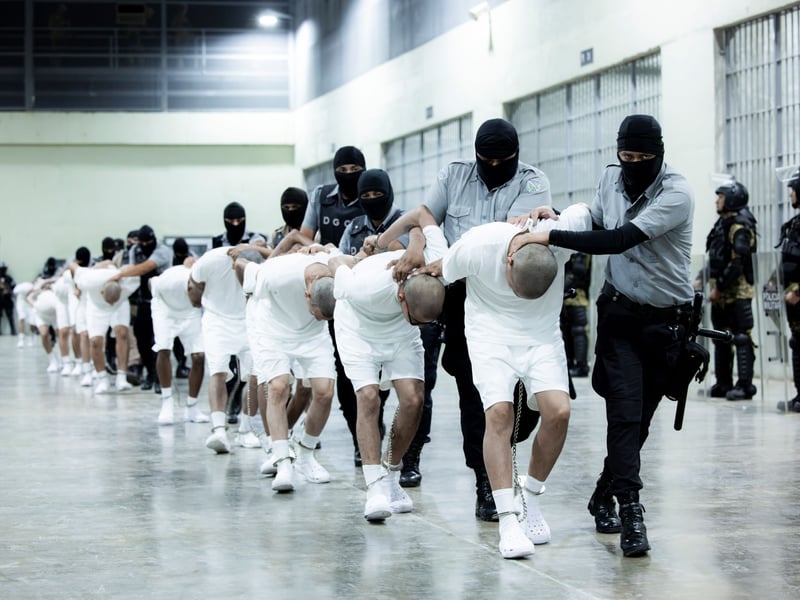
WASHINGTON (CN) — A D.C. Circuit panel on Tuesday froze Chief U.S. District Judge James Boasberg’s order instructing the Trump administration to facilitate habeas petitions for 238 Venezuelan migrants who were deported to an infamous mega-prison in El Salvador, pending further appellate proceedings.
The three-judge panel — U.S. Circuit judges Gregory Katsas, Neomi Rao and Justin Walker, each a Trump appointee — granted the Trump administration’s emergency request to stay Boasberg’s order.
In a filing, the Justice Department argued there was no way for the government to facilitate habeas petitions as it no longer had constructive custody over the migrants, whom the administration maintains are members of the Tren de Aragua gang.
“Even if the class members could file habeas (as the named petitioners have) there would be no jurisdiction,” the Justice Department said. “So the only way to facilitate the filing of meaningful petitions would be to force the executive to engage in diplomatic negotiations to regain custody over the petitioners.”
Last Wednesday, Boasberg granted the migrants’ motion for a preliminary injunction and to certify a class of migrants detained at the Terrorism Confinement Center in El Salvador — known as CECOT — but declined to certify a class of migrants currently in U.S. detention.
The Barack Obama appointee wrote in his 69-page opinion that his ruling does not address the validity of President Donald Trump’s invocation of the Alien Enemies Act of 1978, nor his declaration that the migrants were all members of the Tren de Aragua gang.
“But — and this is the critical point — there is simply no way to know for sure, as the CECOT plaintiffs never had any opportunity to challenge the government’s say-so,” Boasberg said. “Defendants instead sprinted way planeloads of people before any such challenge could be made. And now, significant evidence has come to light indicating that many of those currently entombed in CECOT have no connection to the gang and thus languish in a foreign prison on flimsy, even frivolous, accusations.”
The Justice Department argued that Boasberg’s order was speculating that there was a possibility for the government to regain custody over the migrants in the confinement center and suggested that any such remedy requiring that would violate the separation of powers.
Further, the stay was necessary to prevent irreparable injury to the administration, who would be “forced to commit to a course of foreign action within the week,” the Justice Department said.
Any harm to the plaintiffs held at the center is not traceable to the administration, and thus should not concern the appellate panel, they added.
“Even if this court’s order were not stayed, plaintiffs would experience no change in their station,” the Justice Department said.
Trump’s immigration policies have garnered considerable resistance in the courts — and in streets across the country — with several federal judges finding Trump’s invocation of the Alien Enemies Act of 1978 illegal and blocking any further deportations under it.
Just last Thursday, a coalition of immigrant rights groups and criminal defense lawyers sued the State Department over its agreement with El Salvador’s President Nayib Bukele to indefinitely hold migrants at the center. According to the suit, the U.S. is paying up to $20,000 per person — approximately $4.7 million for those deported thus far.
Tuesday’s order is the latest chapter in the long-running challenge, the first against Trump’s summary deportations under the Alien Enemies Act that have provided those accused of being gang members no opportunity to challenge such designations.
The case reached the D.C. Circuit in late March, where another three-judge panel upheld Boasberg’s initial order blocking further deportations under the Alien Enemies Act. The Supreme Court then reversed that ruling, after it found the migrants had to bring habeas petitions.
Walker also sat on that panel, but ruled in favor of lifting Boasberg’s order, as he thought the plaintiffs should have brought a habeas action in the Southern District of Texas, where the migrants were held.
There is a pending appeal of Boasberg’s finding of probable cause that the administration willfully ignored his court orders that the government return two removal flights that took off on March 15 during an emergency hearing, but a panel has yet to be assigned to it.
Boasberg had indicated that contempt proceedings may be warranted, but any such schedule is on hold pending the appeal.
Tuesday’s panel has yet to schedule oral arguments — as the Justice Department filed the appeal earlier on Tuesday — but they would have to take place by July 14 when the 2024 term ends.
 Follow @Ryan_Knappy
Subscribe to our free newsletters
Our weekly newsletter Closing Arguments offers the latest about ongoing trials, major litigation and rulings in courthouses around the U.S. and the world, while the monthly Under the Lights dishes the legal dirt from Hollywood, sports, Big Tech and the arts.