
 Search Articles


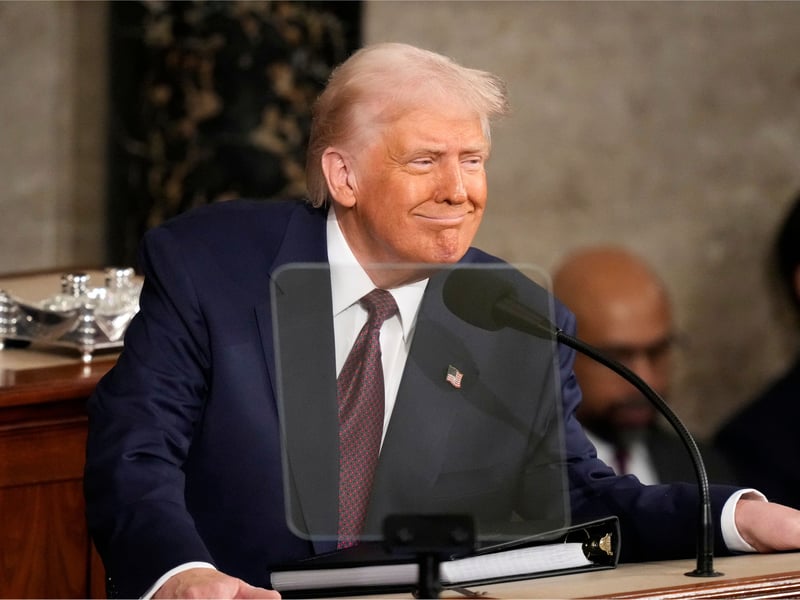
WASHINGTON (CN) — A D.C. Circuit panel on Friday opened the door for President Donald Trump to remove independent officials atop the National Labor Relations Board and the Merit Systems Protection Board.
The 2-1 decision stays a pair of federal judges’ decisions preventing Trump from removing MSPB Chair Cathy Harris and NLRB member Gwynne Wilcox after finding that the unjustified terminations likely violated the law.
As part of his effort to reshape the federal government, Trump has moved to remove an ever-increasing number of Congressionally approved appointees at independent agencies housed within the executive branch via one- or two-sentence emails.
U.S. Circuit Judge Patricia Millett, a Barack Obama appointee, dissented and said her colleagues’ decision conflicted with and effectively rewrote clear Supreme Court precedent in cases such as Humphrey’s Executor v. United States,Seila Law v. Consumer Financial Protection Bureau and Collins v. Yellen.
“The stay decision also marks the first time in history that a court of appeals, or the Supreme Court, has licensed the termination of members of multimember adjudicatory boards statutorily protected by the very type of removal restriction the Supreme Court has twice unanimously upheld,” Millett wrote.
The decision also strips both employee appeals boards of a quorum, effectively disabling the agencies “for as long as the president wants them out of commission,” Millett said, warning that hundreds of legal claims would remain unresolved.
“I cannot join a decision that uses a hurried and preliminary first-look ruling by this court to announce a revolution in the law that the Supreme Court has expressly avoided, and to trap in legal limbo millions of employees and employers who the law says must go to these boards for the resolution of their employment disputes,” Millett wrote.
U.S. Circuit judges Justin Walker, a Trump appointee, and Karen Henderson, a George H.W. Bush appointee, each wrote concurring opinions in support of granting the Justice Department’s stay motion.
Walker wrote that the government was likely to succeed in its argument that the two employee appeals boards wielded “substantial executive power” and thus the president should have complete removal authority over its members.
He found that the government, rather than Wilcox and Harris, was suffering irreparable harm each day Trump is “deprived of the ability to control the executive branch,” and that the public interest supported the stay.
“The people elected the president to enforce the nation’s laws, and a stay serves that purpose by allowing the people’s chosen officer to control the executive branch,” Walker wrote.
He said in his reading of the precedents in Seila Law and Collins, those two cases narrowed Humphrey’s Executor — during oral arguments on March 18 he described Humphrey’s as being within the trash compactor from Star Wars, with the other two cases the walls closing in on the case.
In the 2020 Seila Law , the high court found that removal protections for the Consumer Financial Protection Bureau’s director violated the separation of powers; a president has the right to remove “lesser executive officers” at will, carving out exceptions for multimember expert panels and inferior officers with no executive authority.
In the 2021 Collins, the justices further held that the Housing and Economic Recovery Act of 2008 wrongfully restricted the president’s authority to remove the Federal Housing Finance Agency director in violation of the separation of powers.
Walker took aim at U.S. District Judge Beryl Howell’s decision halting the termination of Wilcox, in which she described Trump’s insistence that he could fire anyone within the executive branch as a “power grab.”
“Even the most casual reader will have guessed by now that I agree with how Seila Law and Collins read Humphrey’s Executor, ” Walker wrote. “But even if I disagreed with them, this court would lack the authority to undo what they did. For a lower court like us, that would be a ‘power grab.’”
Henderson wrote in her concurrence that while she ultimately agrees that the boards have “substantial” executive power, she saw a few more holes in the government’s argument as to whether the boards possess executive power with a legislative form.
The decision sets up a further battle at the Supreme Court, where an increasing number of legal challenges against the Trump administration are reaching after decisions by the D.C. Circuit. The likely appeal gives the justices an opportunity to either overturn or strengthen Humphrey’s Executor.
 Follow @Ryan_Knappy
Subscribe to our free newsletters
Our weekly newsletter Closing Arguments offers the latest about ongoing trials, major litigation and rulings in courthouses around the U.S. and the world, while the monthly Under the Lights dishes the legal dirt from Hollywood, sports, Big Tech and the arts.