
 Search Articles


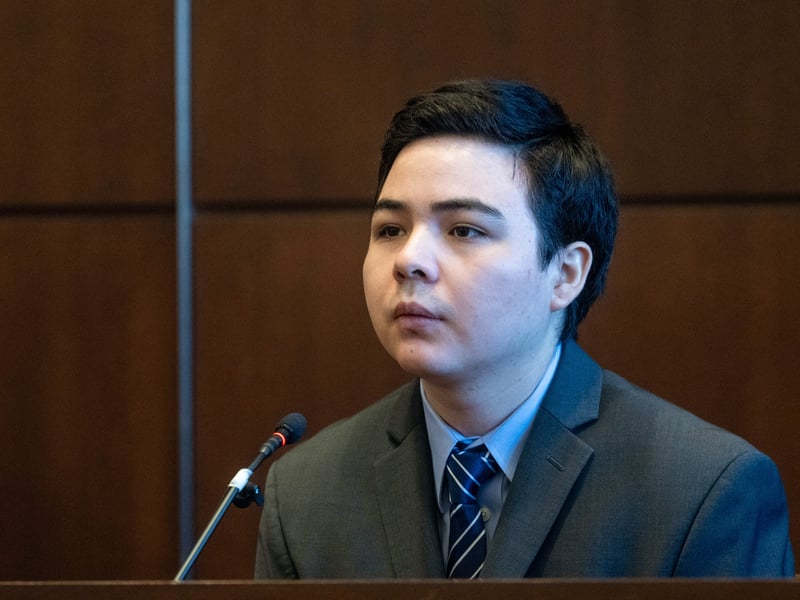
WOODLAND, Calif. (CN) — The shadow figure first came to Carlos Dominguez somewhere between waking and sleeping.
On trial for two fatal stabbings and the attempted murder of a third, the former University of California, Davis student told jurors Monday that symptoms of what he later realized was schizophrenia started in his freshman year.
Dominguez, 22, opted to take the witness stand in his own defense. Speaking in a quiet, steady tone, he told the jury he isn’t sure if he slept or woke when he saw the creature in a dorm room of the California college town.
“I’d seen a devil,” Dominguez said. “Like a shadow figure in the room. It was just like a dark, still figure with no features.”
Other sightings and symptoms followed, he said, culminating in two altercations at local parks with what Dominguez called “shadow-shapeshifters.” Those parks, Central and Sycamore, are where authorities found two fatal stabbing victims: David Henry Breaux, 50, and Karim Abou Najm, 20.
Dominguez said he saw another shadow figure beckoning toward him in a tent on a third occasion. Authorities say that’s where a homeless woman, who survived, was stabbed.
“It was pointing at me and with its other hand it was doing a laughing gesture,” Dominguez said of the figure at Sycamore Park. He added: “I remember getting up and lunging at him. I remember seeing a flashlight coming toward me. I thought it was the shadow-shapeshifters.”
The slayings happened in late April and early May 2023. Dominguez said his symptoms of mental illness began years before.
In one case, Dominguez suffered sleep paralysis. A shadow prevented him from moving as he lay on the bed. He told the jury tried to scream but couldn’t.
Not knowing about schizophrenia, Dominguez said his thoughts had started to race. He interpreted it as voices and once asked a friend if he, too, heard voices.
Others noticed a change in him as well, Dominguez recalled. He said his brother pointed out that, during one summer break, Dominguez kept staring into space.
“He said I was staring at the ceiling fan for a long time,” he added, noting later: “I didn’t really think about it.”
Jurors in the case have heard from witnesses for the government and Dominguez in a trial that began early last month. The prosecution called police officers and investigators who testified that Dominguez was found with a knife during his May 2023 arrest. DNA discovered on the knife later tied him to the stabbings.
Dominguez’s public defender, Dan Hutchinson, has argued his client suffered from schizophrenia at the time. Medical professionals testified that they believe Dominguez was schizophrenic when the stabbings occurred.
Now taking medication for his illness, Dominguez has pleaded not guilty, and not guilty by reason of insanity to the murders of Breaux and Najm. He’s also entered not guilty pleas to the stabbing of an unhoused woman, who survived the attack.
Under questioning by Hutchinson, Dominguez described his early childhood in his native country of El Salvador. He lived with his grandmother and didn’t have a close relationship with his parents. At one point, he testified, a maid employed by his grandmother had Dominguez lay on top of her while both were naked.
A doctor previously testified that early childhood trauma could have an effect on whether someone develops schizophrenia. That trauma could include his parents having human smugglers take a young Dominguez across borders and into the United States.
The trek across borders stopped when authorities intercepted Dominguez’s group. After a series of relocations, the then 6-year-old went to Oakland and reunited with his parents.
Dominguez testified he started school and learned English, becoming fluent. Over the years, he said became involved in sports and rose to football team captain in high school.
However, Dominguez said he grew concerned his senior year of high school when classmates began discussing college. A national of El Salvador, Dominguez said he initially was unsure he could attend college. Later, a counselor helped him through the application process. He decided to attend UC Davis under scholarship.
“That was something I tried to keep to myself,” Dominguez said of his immigration status. “I didn’t know how my friends would react to that.”
In a statement to Courthouse News, the federal Immigration and Customs Enforcement agency said Dominguez has a detainer on him. Detainers are requests from ICE to local authorities, asking for notification before a noncitizen is released from custody.
Dominguez and other students faced Covid-19-related restrictions their first year in college. Despite this, Dominguez said he developed friendships and began dating a woman.
But then, he said, whispers, paranoia and the shadow people began to appear. Dominguez said he heard his former friends, roommates and girlfriend testify about interactions they had with him, though he had no memory of many of them. He also had no recollection of applying to a fast food position, though he did have memories of being at the job.
He also said he kept seeing shadow people, including one time while riding a bicycle. In that example, his own shadow began to change.
“There was this other time I had horns,” Dominguez said of his shadow. “I reached to my face to see if they would go away, but they didn’t, at least on the shadow.”
Dominguez’s testimony is expected to continue Tuesday.
Subscribe to our free newsletters
Our weekly newsletter Closing Arguments offers the latest about ongoing trials, major litigation and rulings in courthouses around the U.S. and the world, while the monthly Under the Lights dishes the legal dirt from Hollywood, sports, Big Tech and the arts.