
 Search Articles


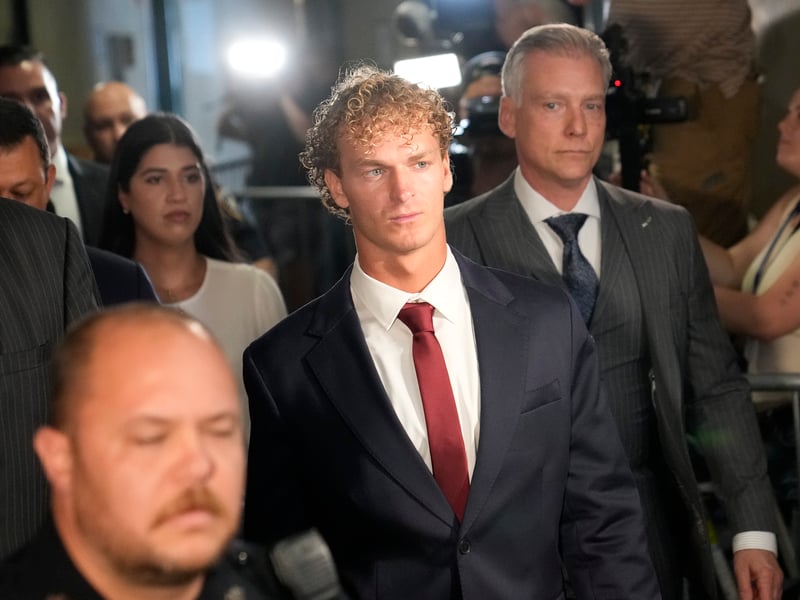
MANHATTAN (CN) — Daniel Penny went “way too far” when he choked homeless straphanger Jordan Neely to death on a New York City subway last year, Manhattan prosecutors argued Friday.
Penny’s hotly anticipated manslaughter trial kicked off Friday morning with opening arguments. Assistant District Attorney Dafna Yoran walked jurors through the chaotic scene that led Penny to approach Neely from behind and grab him with a fatal chokehold.
“We pass people like Jordan Neely every day in New York City,” Yoran told jurors during her roughly hour-long opening. “As New Yorkers, we train ourselves not to engage, not to make eye contact … But on May 1, 2023, Jordan Neely demanded to be seen.”
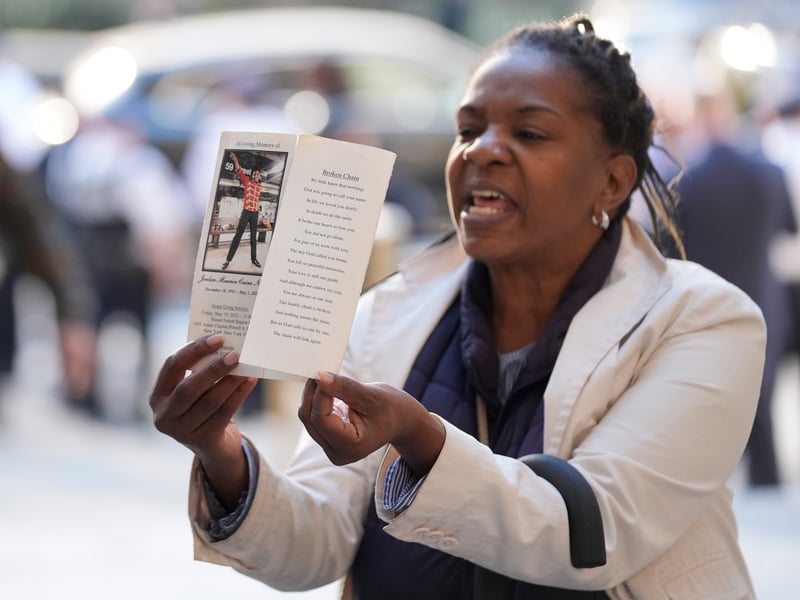
Protestors chanting Neely’s name could be heard from across the street as parties first filed into the courtroom. New York Supreme Court Justice Maxwell Wiley urged the jury to ignore anyone “expressing themselves” outside the courthouse when considering the evidence.
Neely, a 30-year-old Black man at the time of his death, was abusing drugs and experiencing homelessness around the time of the incident, Yoran said.
Penny, 26, is a white man and a U.S. Marine Corps veteran. He was returning from a college class in Brooklyn when he encountered Neely on the train last year.
Penny claims that Neely walked onto the subway car and violently threw his jacket on the ground before making explicit threats to kill other passengers — prompting him to step in and physically restrain Neely to protect other riders.
Yoran acknowledged that Neely was causing a frightening scene on the train that day and appeared “mentally ill." Still, she argued that Penny committed manslaughter by recklessly maintaining his chokehold for around six minutes, a duration Yoran described as far too long.
“He walked into a moderately crowded car on an F train and began screaming threats,” Yoran said of Neely. “He talked about being hungry. He talked about being thirsty. He also made threats about wanting to hurt people and wanting to go back to jail for life.”
“The defendant did not intend to kill,” Yoran continued. “But under the law, deadly physical force such as a chokehold is permitted only when it is absolutely necessary and only for as long as it is absolutely necessary. And here, the defendant went way too far.”
Pushing back, Penny’s attorney Thomas Kenniff argued Friday that it was ultimately first responders who failed Neely — not his client.
Kenniff called that fateful day on the subway just an “ordinary day” for Penny, who he said was jut an “ordinary college kid." But that changed when Penny encountered Neely, who Kenniff said entered the northbound F train with “unhinged rage.”
“As the subway doors begin to close, a seething, psychotic Jordan Neely storms on and announces his presence,” Kenniff said.
The defense attorney, who repeatedly referred to his client as “Danny,” cast Penny as a protector of women and children on the subway.
He claimed that Neely “set his sights on a bench of female passengers” during his supposed fit of rage, eventually uttering the words “I will kill” towards a mother who was “barricading her son behind a baby stroller.”
Kenniff insisted that Penny put Neely in the chokehold following that threat. He said Penny only held onto his neck to restrain him — not to cause him any harm.
Kenniff also scrutinized the police response time, which he claimed took “longer than anyone expected." He argued that forced Penny to continue restricting Neely as he waited for the cops to relieve him.
“He was desperately waiting for police to show up to help him the way he had helped other passengers on the train,” Kenniff said.
Kenniff pressed responding NYPD officers — the prosecution’s first witnesses on the stand Friday afternoon — on their administration of CPR to Neely. Bodycam footage played to the court showed officers performing chest compressions on Neely’s limp body, but not mouth-to-mouth resuscitation.
NYPD Sergeant Carl Johnson, one of the responding officers, said that it’s not standard police practice because of health concerns.
“I didn’t want my officers to put their lips on his mouth,” said NYPD Sergeant Carl Johnson, who said Neely looked “dirty” and that he didn’t want his officers to catch diseases like AIDS or Hepatitis.
Kenniff asked Johnson why his officers didn’t have rescue masks, a device designed to limit transmission of diseases during life-saving mouth-to-mouth procedures.
“I’ve never been issued a rescue mask,” Johnson said.
Penny craned his neck to see Johnson as he testified, periodically glancing over at the jury box.
The 12 Manhattanites who will decide Penny’s fate are a mix native and nonnative New Yorkers. Most of them ride the subway on a regular basis and have had their own relevant experiences on board.
During an arduous jury selection process that took nearly two weeks, a majority of the 12 jurors told the court they’d witnessed “outbursts” on city trains. Some said that they’ve felt personally threatened or harassed while riding, but none said they’d called the police over such incidents.
“I was going to work in the morning. I was on the train; it was moderately crowded,” one juror, an insurance lawyer living in Yorkville, said earlier this week. “A woman got on with this cart … and then she just rammed the cart into me, called me a name.”
Another juror, an Upper East Side retiree, said he was harassed by a man on the Q train “for no particular reason” about a year and a half ago.
Penny’s defense is likely to cater to those experiences. Kenniff stated during his opening Friday that Penny, on that cloudy spring day in 2023, did “what we would all want someone to do for us” in that situation.
“Stand up and protect thy neighbor,” Kenniff said dramatically. “That’s what Danny Penny did.”
Trial will resume Monday and is expected to last for six weeks. Penny faces charges of second-degree manslaughter and criminally negligent homicide.
 Follow @Uebey
 Follow @uebey.bsky.social
Subscribe to our free newsletters
Our weekly newsletter Closing Arguments offers the latest about ongoing trials, major litigation and rulings in courthouses around the U.S. and the world, while the monthly Under the Lights dishes the legal dirt from Hollywood, sports, Big Tech and the arts.