
 Search Articles


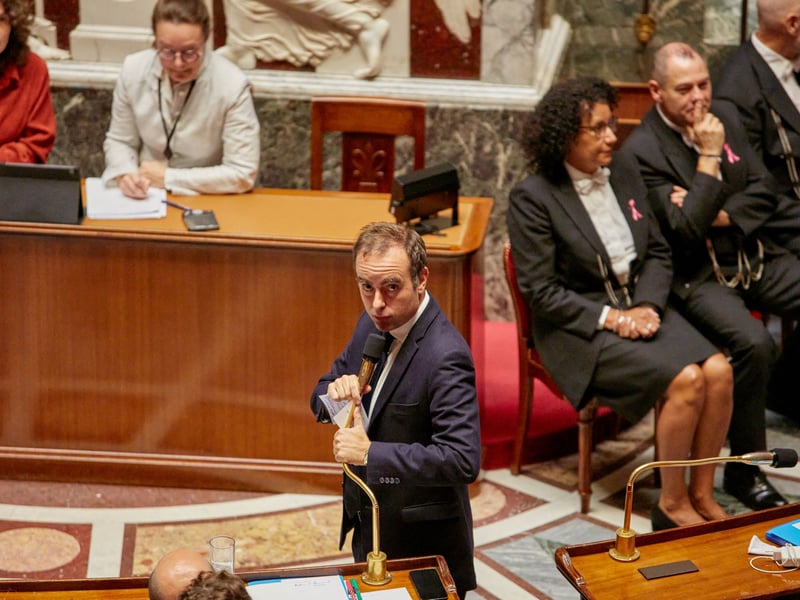
PARIS (CN) — In a high-stakes political test for French Prime Minister Sébastien Lecornu, lawmakers approved a Social Security financing bill Tuesday, marking a key step toward finalizing the 2026 budget before year’s end.
The budget has been a pain-point in France since June 2024, when President Emmanuel Macron called for snap legislative elections and abruptly dissolved the government. The move sent the country into a spiral of political chaos that has yet to end; Lecornu is the fourth prime minister since then.
Negotiations are crucial: France’s public deficit stood at almost $200 billion in 2024, accounting for over 5.8% of the country’s GDP and placing it well above the EU’s 3% deficit ratio.
But in a Parliament that is now divided into three roughly even blocs, agreeing how to tackle the budget and bring down the deficit has proven nearly impossible. The left, right and center groups have considerable weight to launch successful motions of censure, and appealing to enough lawmakers to pass legislation has proven a delicate balancing act.
“The problem with compromise is that it satisfies no one,” Pierre Allorant, historian and political scientist at the University of Orléans, said. “In the end, nobody feels fully represented in this budget.”
But passing this measure at all is a victory. In previous years, social security bills were largely pushed through without a vote using a controversial law. Lecornu vowed to avoid such a move, because it’s often criticized as undemocratic — and one that sunk some of his predecessors.
“What’s positive is that Parliament has regained some of its freedom, because for years, budgets — under [former Prime Minister] Elisabeth Borne’s government for example — were not being voted on,” said Allorant. “So members of Parliament couldn’t really express themselves. … This time, they have spoken a lot, and there were many compromises to try to get this budget passed.”
It wasn’t a landslide: 247 members of Parliament voted for the bill, known as the PLFSS, versus 234 against. Now, it will progress to the upper chamber, the Senate.
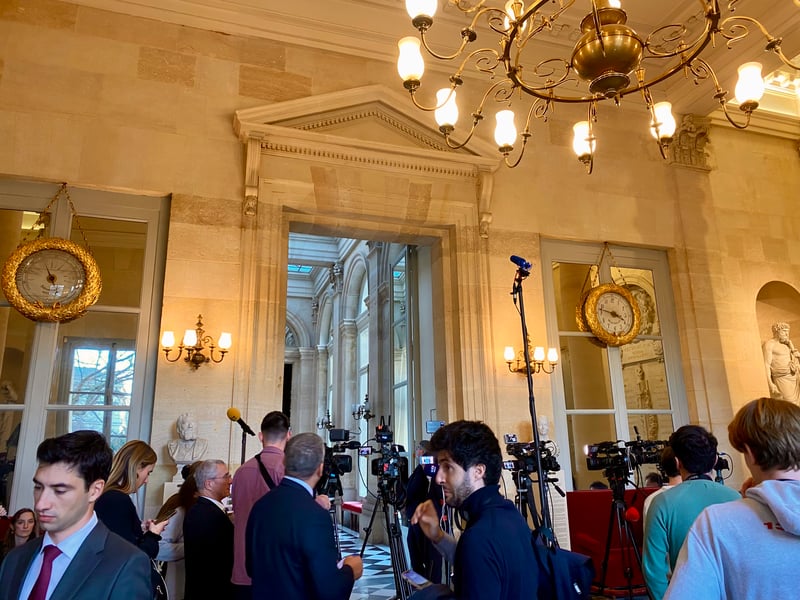
The news came at roughly 7:45 p.m. from the National Assembly in Paris, where journalists waited for hours under chandeliers and molded ceilings. Throughout the day, there were collective groans and whispers of boredom in the Buvette de Journalistes, the café inside Parliament where journalists can order snacks and drinks while watching debates play out on a flat-screen TV. When the news broke, one man working in the café cheered.
France’s social security deficit is expected to hit roughly $27 billion by the end of 2025, which is largely concentrated in the health and pension brackets; however, the bill includes a measure that would delay Macron’s controversial pension reforms, which raised the retirement age from 62 to 64 and sparked mass protests in 2023.
To balance this, the bill includes a lower increase in retirement pensions starting from 2027, and higher contributions from the health insurance providers that complement France’s general coverage. It would also freeze the baseline pension rate starting next year, and introduce a smaller growth rate for the years to come.
Minutes before the vote, the outcome was still impossible to predict.
“Every political group is proposing amendments, and the government is accepting them to attract support from as many members of Parliament as possible,” Ludovic Renard, a political scientist at Sciences Po Bordeaux, said. “But it’s complicated because you must avoid scaring away the groups whose support you’ve already secured by accepting amendments that would upset them so it’s very complex — there are a lot of negotiations.”
The left-wing Socialists threw their support behind Lecornu. For them, the suspension of pension reforms was non-negotiable.
“The prime minister made a commitment, and he proved reliable throughout the discussion,” Olivier Faure, the head of the Socialists, said on the French TV station BFM before the vote. “I hope that we, in turn, can be reliable and ensure that this budget is adopted.”
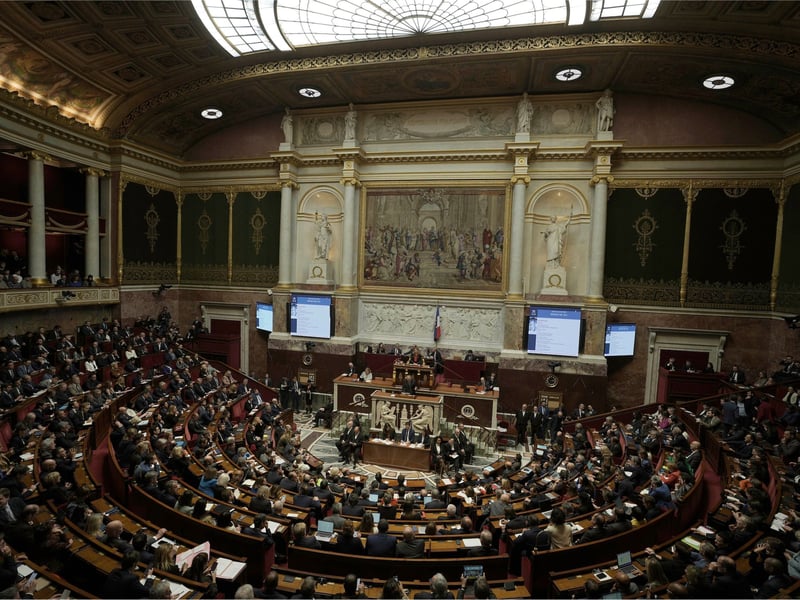
The outcome hinged on the support of the center and center-left; both extremes and the more moderate right were outspoken that they would not support the new draft.
“Of course we’re going to vote against this budget” Sébastien Chenu, vice-president of the extreme-right National Rally, said on the French radio channel Franceinfo Tuesday morning. “It’s a budget of convenience for the government, a budget of abdication for France.”
The extreme-left France Unbowed also voiced concerns. Manuel Bompard, a prominent but controversial party member, added that the Socialists changed their alliance by supporting the draft. This underscored how France’s left has significantly fractured since they campaigned as a coalition during the snap legislative elections.
“This is a very important moment for Sébastien Lecornu’s government, but also for a very divided opposition—especially the left-wing opposition,”Allorant explained.
But on the political side, the vote was a major test for Lecornu. Although he had maintained he wouldn’t resign if it didn’t pass, a loss would have been detrimental to his hopes of passing the general 2026 budget before the end of the year.
“So there would [have] likely been a special law to extend last year’s budget, so that the administration could keep functioning,” Allorant said. “A bit like avoiding a government shutdown in the United States, and to give Parliament more time to negotiate a budget.”
Experts were also weighing the possibility of a second government dissolution, which would lead to a new makeup of Parliament. Macron has avoided such a move, likely because recent polls have shown he would lose ground to the National Rally.
“The ultimate solution — which would only come in January — would be dissolution of the National Assembly to change its composition,” Renard said. “But nobody is talking about that right now because nobody wants it — it would destabilize France.”
Tuesday’s win means that the government can avoid starting from scratch — for now.
 Follow @lilyradz
Subscribe to our free newsletters
Our weekly newsletter Closing Arguments offers the latest about ongoing trials, major litigation and rulings in courthouses around the U.S. and the world, while the monthly Under the Lights dishes the legal dirt from Hollywood, sports, Big Tech and the arts.