
 Search Articles


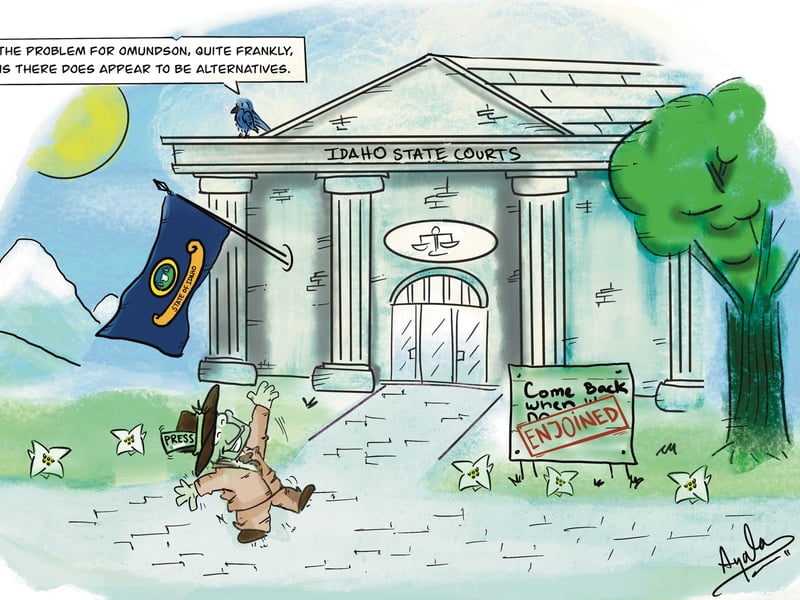
In the national war of litigation to hang on to the tradition of open courts, this news service won a key victory Monday in the Northwest where a federal judge handed down a broad ruling that enjoined Idaho’s top court official from withholding public documents.
Since her courts moved to electronic filing, the chief court administrator in Idaho, Sarah Omundson, has been withholding new court pleadings. She holds them back for a day or a few days and turns them into old news.
“The Court herby enters a declaratory judgment that Omundson’s policy is unconstitutional. She is preliminarily and permanently enjoined from continuing any process that denies CNS timely access to new non-confidential civil complaints,” wrote U.S. District Court Judge David Nye.
The Monday ruling ends a dry spell that has lasted for more than a year, since an injunction against the same policy was issued by a federal judge in Ohio. The Ohio ruling followed similar injunctions over the preceding decade against withholding policies in Vermont, Virginia, Illinois, New York, Texas and California.
That legal library of rulings stands in a national landscape where state court officials have abandoned a tradition of access to new pleadings as they come into court, a tradition that goes back beyond memory. They abandoned it in the switch to electronic records and have since used public funds and publicly paid lawyers to fight against the return of timely public access.
The tradition was simply and clearly summed up by Judge Bobby Shepherd speaking from the bench two years ago in the St. Louis-based 8th Circuit: “There was a time when — and some in this room may remember it — when you took a pleading to the courthouse and the clerk stamped it physically and it went into different bins and it was available immediately.”
Back in Idaho on Monday, Judge Nye wrote in a conversational and direct manner about the barricades regularly thrown up by state court officials trying to avoid giving access at the point where court pleadings cross the physical or virtual counter.
Their main defensive bulwark is privacy. But in Idaho, like almost all states, the duty to safeguard a person’s personal information rests with the lawyer filing the papers — not with administrator Omundson or any other government official.
“Even if a mistake is made and some personal information is included, it is not Omundson’s fault,” wrote Nye. “It is the filer’s duty to ensure protected information is redacted from publicly submitted documents.”
In the many standoffs over the same withholding policy, Courthouse News has also argued that whatever mistakes might be made by a filing lawyer, they can be fixed quickly. For example, this news service has occasionally made clerical mistakes in its federal court First Amendment papers, and a federal clerk has right away requested that they be corrected.
Nye made the same point.
“This is not to say the information cannot ever be corrected,” he wrote. “It can — just after it first becomes available to the public. While it may seem counterintuitive to correct something once it becomes publicly available, the Court sees this happen quite frequently in federal court. The entire process does not crumble because edits have to be made to documents — even documents that are publicly available.”
On the fundamental issue of what First Amendment test should be applied to the administrator’s withholding policy, Nye followed the straightforward test laid out by the Ninth Circuit which holds sway over a huge swath of Western states.
He said the first half of the test is whether the record has historically been open to press and public and whether the access plays a positive role in government. He concluded that the first part of the test is satisfied.
“After all, press coverage of judicial proceedings is a cornerstone of American democracy,” wrote the judge.
He then found that administrator Omundson has restricted that right of access, which moved the analysis on to the second part of the test set by the overarching U.S. Supreme Court precedent referred to as Press Enterprise II and the Ninth Circuit ruling referred to as Planet III : Is there a substantial probability that an overriding interest would be impaired by immediate access and are there are no reasonable alternatives.
“The problem for Omundson, quite frankly, is there does appear to be alternatives to the current system,” wrote Nye.
“And candidly, those alternatives seem reasonable,” he continued. “Other states use alternative methods with good success. Most federal courts, including Idaho, have alternative systems and they use those with success as well.”
Courthouse News is represented in the Idaho case by Rachel Matteo-Boehm, Jon Fetterly and Katherine Keating in the San Francisco office of Bryan Cave Leighton & Paisner, and by Amber Dina with Givens Pursley in Boise. The administrator is represented by Keely Duke and Molly Mitchell with the Duke Evett firm in Boise.
“Today’s ruling affirms a central principle at the heart of this case and other similar cases brought by Courthouse News — administrative processing of new complaints does not need to interfere with press and public access to those complaints,” Fetterly said in an email. “The district court thoroughly considered the reasons Omundson offered for why access to new complaints should be restricted until after clerk processing, and rejected them. The ruling is a victory for the First Amendment right of access.”
Beyond the Idaho ruling, the national field of conflict has been locked into the equivalent of hand-to-had legal combat for more than a year. So Judge Nye’s injunction falls into ongoing First Amendment battles in the Second and Fourth Circuits and trial court mano-a-manos currently engaged in federal courts in Texas, Minnesota, North Carolina, Washington, D.C., Pennsylvania and Cincinnati, Ohio.
[/et_pb_text][/et_pb_column] [/et_pb_row] [/et_pb_section]Subscribe to our free newsletters
Our weekly newsletter Closing Arguments offers the latest about ongoing trials, major litigation and rulings in courthouses around the U.S. and the world, while the monthly Under the Lights dishes the legal dirt from Hollywood, sports, Big Tech and the arts.