
 Search Articles


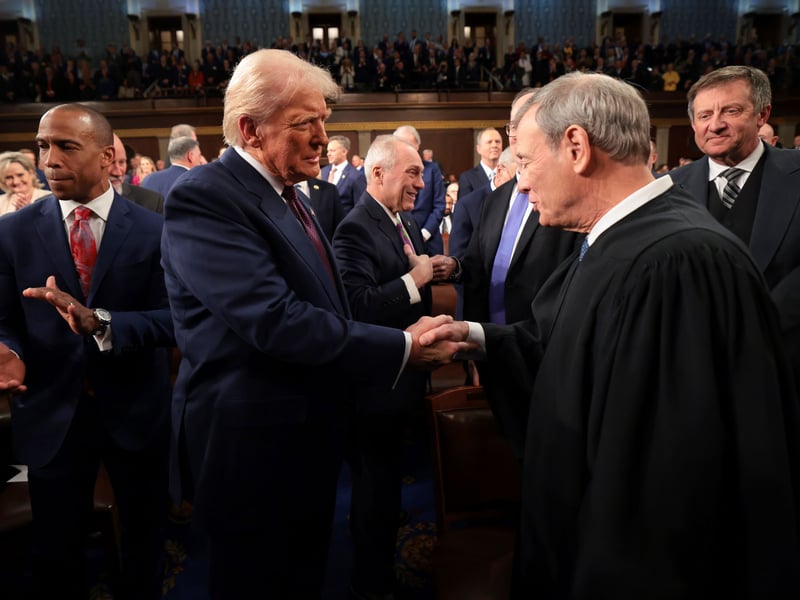
WASHINGTON (CN) — Nearly one year ago, Chief Justice John Roberts clapped back at the Supreme Court’s critics for tainting the judiciary’s independence and threatening the rule of law. But court watchers say Roberts and his colleagues then spent the next 12 months embracing upheaval in the democratic system at the behest of one individual.
For the Supreme Court, 2025 was a whirlwind of high-stakes, fast-paced and contentious rulings that served as the lynchpin to President Donald Trump’s second term agenda. Allying with the White House staved off a brewing constitutional crisis, but experts claim the White House’s wins laid bare the error in Roberts’ critique.
“Roberts and his brethren seem to be the largest threat to undermining the courts, more so than anybody on the outside could do,” Devon Ombres, senior director of courts and legal policy at the Center for American Progress, said.
After a push for ethics reform at the Supreme Court fizzled out last summer, Roberts responded in December 2024 by lambasting public officials for suggesting political bias in adverse rulings, stating that such attacks undermined judicial independence. But not even a month into the transfer of power, Vice President JD Vance sparked concerns that the White House might defy court orders: “Judges aren’t allowed to control the executive’s legitimate power,” he wrote on X.
U.S. District Judge James Boasberg — the Barack Obama-appointed chief judge of the federal district court in Washington — took the brunt of conservative outrage to unfavorable court rulings after stymieing the administration’s removal of Venezuelan migrants under the 1798 Alien Enemy Act.
In March, Trump called Boasberg crooked and a “radical left lunatic of a judge,” pressing for his impeachment in a Truth Social post. U.S. Representative Darrell Issa, chair of the House Judiciary Committee’s subpanel on federal courts, joined in on X. “The Resistance now wears robes,” he wrote.
The incident led to a rare rebuke from Roberts, who released a statement censuring impeachment calls after disagreements with court rulings. But the chief justice’s defense was tempered by the high court’s deference to Trump despite widespread opposition in the lower court.
“I think what everybody took that for at the outset was a historical understanding of, the wheels of justice will turn, we will get to it,” Ombres said of Roberts’ rebuke. “But I think what Roberts was actually inferring, and as it turned out, [he meant] go through the appeals process and we’re going to end up being on your side, so you don’t have to attack the lower court judges.”
According to tabulations by Courthouse News, the Supreme Court has sided with Trump on nearly two dozen emergency applications less than a year into his second term, giving the White House a win rate of over 80%.
Those wins included gutting federal agencies, slashing grant funding, ignoring deportation hurdles, topplingindependent regulatory boards, revoking parole status for over half a million migrants, concealing records about controversial cost-cutting operations, booting transgender service members from the military, resuming sweeping immigration raids and more.
Elora Mukherjee, a professor at Columbia Law School, said the high court has effectively been a rubber stamp for most of Trump’s policies, especially on immigration.
“The court has shown time and again a willingness to let the worst abuses of the executive branch go unchecked,” Mukherjee said. “The current court is not a meaningful check on executive branch abuses, and the constitutional structure of checks and balances is in jeopardy."
Roberts claimed that the judiciary was ill-suited to combat criticism from politicians and legal commentators because judges typically only speak through their decisions. But court watchers and lower court judges alike were left empty-handed in 2025.
“That idea that judges are only supposed to speak to their rulings is a little bit more frustrating in a situation where the court is not speaking nearly as much as we would like them to,” said Daniel Epps, a law professor at Washington University in St. Louis.
In the shadows
The high court’s use of the shadow docket has been a persistent source of censure for legal experts, but lower court judges joined the chorus over the last year. As the justices overruled their decisions on the emergency docket with little to no explanation, federal judges made the rare move to publicly share their discontent.
A dozen federal judges told NBC News that the Supreme Court, and in particular Roberts, weren’t doing enough to defend the integrity of their work. Boasberg was just one high-profile example of the threats faced by federal judges ruling against Trump. Chief U.S. District Judge John McConnell, another Obama appointee, said he received over 400 threatening voicemails and six credible death threats after temporarily pausing the administration’s attempt to freeze federal grants.
The federal judiciary’s policymaking body urged Congress to allocate additional funding for security to meet rising threats against judges and courthouses in April. And lawmakers renewed calls to shield the personal information of judges to curb doxxing. House Democrats even sent a letter to Roberts requesting details on what appropriators needed to do to protect judges and courts from escalating threats.
When reviewing emergency applications, legal experts said that the Supreme Court is only supposed to intervene in cases where the lower courts clearly erred. However, in a number of cases, court watchers said the justices disregarded extensive fact finding, undermining the work of lower court judges.
“The lower courts can be disempowered in some ways,” Adam Winkler, a law professor at UCLA, said. “If this court feels that the lower courts are acting inappropriately or perhaps ruling rashly or doing something silly like following existing precedents — that’s not necessarily acceptable behavior in the Supreme Court’s view.”
Winkler said his tongue-in-cheek comment reflected what some people had come to believe about the justices’ rulings.
“There has been the sense that the court rebukes lower courts for following the law rather than predicting what the Supreme Court’s going to do,” Winkler said. “And what the Supreme Court’s going to do is much more in line with the Trump administration than what some of the lower courts are willing to do.”
Thomas Berry, director of the Cato Institute’s Robert A. Levy Center for Constitutional Studies and editor-in-chief of the Cato Supreme Court Review, said Trump’s flood of litigation provided a stress test for the emergency docket, forcing the justices to weigh in on many high-profile cases in quick succession. There are valid criticisms of the high court’s emergency docket decisions, Berry said, but he didn’t see the justices’ reversals of lower court rulings as a long-term problem.
“My own view is the emergency docket, it’s never going to be satisfying either way no matter what they do because they have so little time to decide it and because they’re not supposed to be reaching the merits,” Berry said.
Once the cases come back to the court on the merits, Berry said, the justices can give lower court judges the full guidance they’re looking for.
‘Roberts court revolution’
Legal experts said the high court’s deference to Trump follows a shift of jurisprudence by the conservative supermajority, favoring a broad interpretation of the executive’s authority.
“I think a lot of that comes down to, for Roberts and the conservative justices, principled adherence to the unitary executive theory,” Ombres said.
Trump filed a number of emergency appeals concerning the firing of independent regulatory board members, who have been protected from political interference for nearly a century. Court watchers said that the Roberts court’s push to overturn precedent protecting board members was set long before 2025.
The high court’s conservative tilt persisted in cases without Trump as a litigant, such as allowing Tennessee to ban certain health care for transgender minors, giving Maryland parents an opt-out of LGBTQ+ story time, boosting a straight woman’s reverse discrimination claim and greenlighting a reckoning on California’s electric vehicle mandate.
“We continue what I think of as the Roberts court revolution that is sort of as broad and as far reaching as the Warren court revolution back in the 1950s and 60s,” Winkler said. “The court continues to rewrite major areas of law… [and] operate on the shadow docket and decide many cases without full briefing and oral argument, often writing opinions that are far reaching but don’t necessarily have the same kind of well reasoned opinions behind them.”
There were notable exceptions to the Supreme Court’s deference to Trump, however. David Cole, a law professor at Georgetown University, said that the court put a stop to one of the administration’s most aggressive and blatantly illegal actions, invoking the Alien Enemies Act. The justices also ruled that Trump had to return a wrongfully deported Maryland father and temporarily prevented him from removing a member of the Federal Reserve board.
Cole and other legal experts said the high court could be teeing up more losses for the administration as cases undergo merits review — versus preliminary review on the emergency docket.
“When we get to the end of this term, it may look like a very different court than it looks when you focus only on the emergency measures that the court has granted thus far,” Cole said.
The constitutional crisis that some court watchers warned of — where the White House outright defies a court order — never materialized this year. Legal experts said the high court’s acquiescence to Trump negated the need for any outright defiance of court orders.
But court watchers pointed out questionable actions that teetered on the line toward defiance, like sending the California and Texas National Guard to Oregon after a judge prevented the deployment of the state’s guard in Portland.
Question of enforcement
The high court’s review of Trump’s tariffs, limits on birthright citizenship and terminating a member of the Federal Reserve board could reignite concerns over a constitutional crisis, legal experts said.
“The court’s power is really just dependent on people willingly following its decisions,” Epps said. “The court has no power to enforce its decisions, and so long as political actors are willing to comply the court is powerful. But if the president starts saying, ‘[the court said] we have to give citizenship to the children of illegal immigrants, I just disagree with that and we’re not going to do it,’ that’s when the real conflict happens.”
The Supreme Court’s review of a TikTok ban garnered controversy early in 2025, but the Trump administration’s disregard on its enforcement got far less attention despite larger conversations about the White House ignoring court rulings.
Berry said the situation presented a dilemma for many who disliked the controversial law. On one hand, he said it was concerning that the administration ignored the law, which was passed by Congress, signed by President Joe Biden and upheld by the high court. On the other hand, Berry disagreed with the government’s encroachment on free speech.
“If you’re someone like me who thinks the law is unconstitutional … nonetheless, you also think it’s important for the executive branch to faithfully execute the laws, even if it disagrees with those laws,” Berry said.
Berry said that the administration’s silence on enforcement was concerning. He said that the White House would have had more leeway if it had said it was declining to enforce the law because Trump thought it conflicted with his independent duty to uphold the Constitution.
“I think there’s a strong argument that he was violating his constitutional duty, that he take care that the laws be faithfully executed,” Berry said. “And it is surprising that there was not as much concern. Unfortunately, there’s not much judicial recourse when the president chooses not to enforce a law. It’s easy enough to challenge an exercise of enforcement, but it’s very difficult to challenge nonenforcement, even if the law requires the president to enforce it.”
 Follow @KelseyReichmann
 Follow @kelseyreichmann.bsky.social
Subscribe to our free newsletters
Our weekly newsletter Closing Arguments offers the latest about ongoing trials, major litigation and rulings in courthouses around the U.S. and the world, while the monthly Under the Lights dishes the legal dirt from Hollywood, sports, Big Tech and the arts.