Search Articles


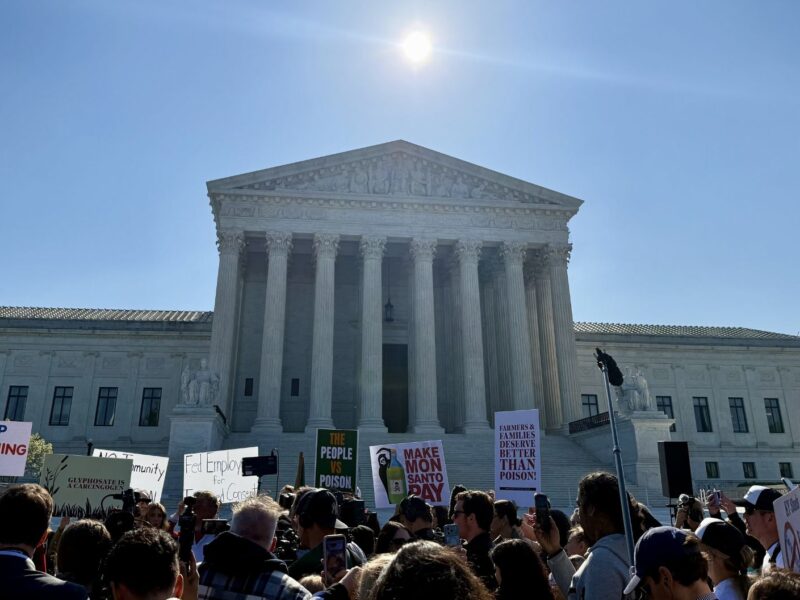
WASHINGTON (CN) — The Supreme Court overturned a $1.25 million verdict on Thursday against Monsanto, the maker of Roundup weedkiller, ruling that a cancer patient’s personal injury lawsuit was barred by federal law.
In a 7-2 decision, the high court determined the Federal Insecticide, Fungicide and Rodenticide Act preempted petitioner John Durnell’s Missouri state-law claim that the chemical company should have included a cancer warning on the weedkiller’s label.
Under the federal statute, also known as FIFRA, the EPA must approve such warning labels first, and because the agency has repeatedly approved the label without a warning and has repeatedly concluded the glyphosate-based product is not likely to cause cancer.
Justice Brett Kavanaugh wrote the majority’s opinion and said Durnell’s claims would have required Monsanto to use a label “in addition to or different from” the label required by the EPA, and thus was preempted by the federal law’s requirement that a product’s labels are uniform nationwide.
“Durnell’s state-law failure-to-warn claim would require a cancer warning on Roundup’s label — a requirement ‘in addition to’ and ‘different from’ the label required by EPA under FIFRA,” the Donald Trump appointee wrote. “FIFRA therefore expressly preempts Durnell’s claim.”
FIFRA sets rules for selling pesticides. Manufacturers submit safety data and proposed labeling to the EPA, which checks that the pesticide doesn’t create an unreasonable risk of adverse effects on human health.
The EPA administrator also reviews product labels for compliance with FIFRA. Misbranding, such as not containing a warning or caution statement necessary to protect health and the environment, is strictly prohibited. This process repeats every 15 years to consider any labeling changes.
Since 1974, the EPA has repeatedly concluded that glyphosate doesn’t warrant a cancer warning. But a Missouri jury held otherwise, finding Monsanto liable for not warning Durnell of Roundup’s risks.
Durnell was diagnosed with an aggressive form of non-Hodgkin lymphoma in 2018, at which point he’d been using Roundup for over two decades. In 2019, he filed a failure-to-warn claim against Monsanto in Missouri, and a jury awarded him $1.25 million in damages.
Monsanto asked the Supreme Court to review Durnell’s case, arguing his claims were barred by FIFRA. Because the statute prohibits manufacturers from making label changes without approval, Monsanto claims the EPA’s pesticide-specific labeling determinations are a mandate that manufacturers must adhere to under federal law.
During oral arguments in April, the Trump administration said states couldn’t require different warning labels, but they could take other actions, like banning the products altogether. In February, President Donald Trump issued an executive order invoking the Defense Production Act to protect the manufacturing of glyphosate-based herbicides.
The EPA faces an October deadline to reexamine glyphosate’s safety. Monsanto says it has no reason to believe the agency will diverge from its consistent findings that glyphosate can be used safely and does not warrant a cancer warning.
Late last year, a landmark study touting Roundup’s safety was retracted by the scientific journal that published it a quarter century ago. The journal said concerns were raised about the validity of its findings after potential conflicts of interest among its authors and misrepresentation of their contributions came to light, thanks to lawsuits against Monsanto.
Monsanto said glyphosate has been extensively studied over the last five decades and thousands of studies have validated its safety. The company said it had no involvement in the vast majority of those published studies.
In February, Monsanto proposed a nationwide class settlement to resolve current and future Roundup claims for non-Hodgkin lymphoma injuries. The company agreed to make annual payments for 21 years totaling up to $7.25 billion.
Monsanto said the proposed class combined with Durnell’s case before the Supreme Court “are independently necessary and mutually reinforcing steps in the company’s multipronged strategy designed to significantly contain the Roundup litigation.”
A favorable ruling from the justices would only apply to those who claim exposure to Roundup after Feb. 12, those who opted out of the settlement and certain limited exceptions.
Christopher Seeger, of firm Seeger Weiss and the proposed class counsel in the settlement with Monsanto, decried the high court’s decision in an emailed statement on Thursday.
“This Supreme Court ruling wrongly slams the courthouse door on Americans sickened by pesticides, and underscores why we negotiated a $7.25 billion settlement that guarantees compensation to Roundup victims regardless of today’s decision,” Seeger said. “We urge those opposing this agreement, including the attorney who unsuccessfully argued Durnell, to drop their opposition so that tens of thousands of cancer victims no longer have to wait for justice after a decade of delay.”
 Follow @KelseyReichmann
 Follow @kelseyreichmann.bsky.social
Subscribe to our free newsletters
Our weekly newsletter Closing Arguments offers the latest about ongoing trials, major litigation and rulings in courthouses around the U.S. and the world, while the monthly Under the Lights dishes the legal dirt from Hollywood, sports, Big Tech and the arts.