
 Search Articles


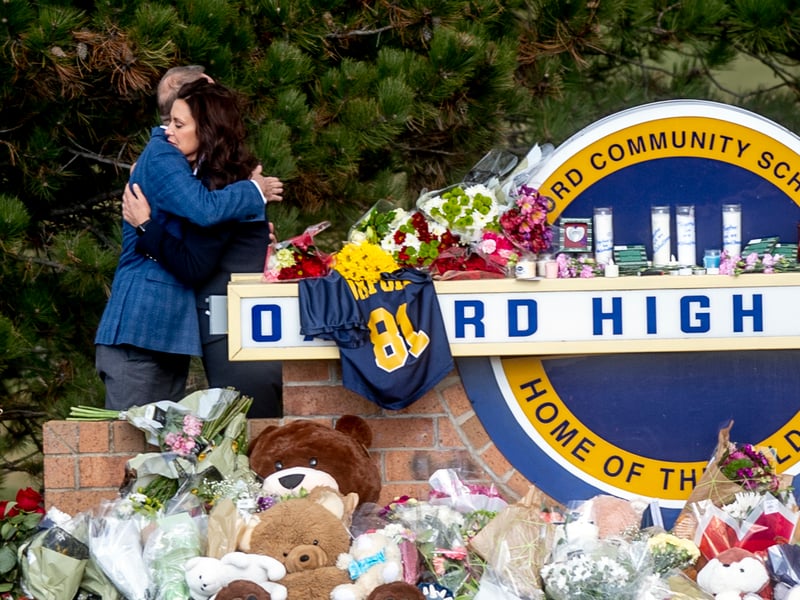
CINCINNATI (CN) — The victims of the 2021 Oxford High School shooting and their families cannot use a “state-created danger” theory of liability to recover damages in federal court, several school employees told an appeals panel Wednesday.
Counselor Shawn Hopkins — who met with shooter Ethan Crumbley on the morning he shot and killed four students and injured seven others — and dean of students Nick Ejak urged the Sixth Circuit to overturn a federal judge’s decision to deny their request for qualified immunity.
A pair of lawsuits, each of which seeks $100 million in damages for substantive due process violations, was filed in the aftermath of the deadliest school shooting in Michigan history, with victims claiming administrators should have known Crumbley was likely to act.
The victims said a meeting on the day of the shooting, during which Hopkins told Crumbley and his parents he would contact child services if they refused to get their son counseling, spurred Crumbley to immediate and fatal action.
Attorney Ken Chapie of Giarmarco, Mullins, and Harton PC in Troy, Michigan argued Wednesday on behalf of Hopkins and Ejak and emphasized Crumbley had planned the shooting over eight months.
U.S. Circuit Judge Raymond Kethledge, a George W. Bush appointee, pointed out Crumbley’s planning did not necessarily absolve his clients of liability.
“This isn’t a binary question about whether there was a preexisting risk,” Kethledge said. “If they greatly increase the risk, there is the potential for liability.”
“The risk is the same after the affirmative action,” Chapie responded. “The shooter told his friend the plan for the shooting, he begged his parents for a gun. This is just private actor violence, this is not state action.”
U.S. Circuit Judge Joan Larsen, a Donald Trump appointee, asked the attorney whether his clients inferred a risk of homicide when they met with Crumbley on the morning of the shooting.
“They inferred a risk of suicide,” she said. “If they inferred homicide, wouldn’t that shock the conscience?”
Kethledge joined in Larsen’s question and asked specifically why a drawing of blood and bullets couldn’t prove an inference of homicidal intent.
“The drawing doesn’t state that he is actually going to commit a mass murder,” Chapie said.
Attorney Kevin Carlson of Pitt, McGehee, Palmer, Bonanni, and Rivers PC in Royal Oak, Michigan argued on behalf of the victims and their families.
He drew attention to the fact Hopkins and Ejak have admitted they did not believe Crumbley when he told them he was not a threat to himself or others in the meeting that preceded the shooting.
“The officials had subjective knowledge and full appreciation of the dangers posed by the student on the day of the shooting,” Carlson told the panel.
“A substantive due process claim is not something grounded by traditional tort principles,” Kethledge reminded the attorney. “It’s a much, much higher standard.”
“When they approach this student, he has literally pleaded for help and the only reasonable inference is a child in severe distress,” the attorney said.
Kethledge remained skeptical.
“Conscience-shocking applies only to the most egregious official actions. Can we infer bad faith on the officials’ part?” he asked.
“I don’t know if we can infer bad faith, but they knew there was a high degree of risk of suicide,” Carlson said.
“It’s not just negligence,” Kethledge responded. “It has to be conscious callousness. How, really, can we infer from the complaint that they don’t care? That is pretty tough to infer.”
The families’ attorney admitted the difficulty, but emphasized no discovery has been conducted in the case, which he argued is distinguishable from others of its kind because of Crumbley’s pleas for help.
In their brief to the appeals court, Hopkins and Ejak emphasize how long the shooter had planned the attack and focus on the fact there is no evidence either man “knew he had a gun or planned to shoot his classmates.”
“The Sixth Circuit has repeatedly found that where the risk of the type of harm that ultimately occurs existed before the state actor intervened then there is no state created danger,” the school officials say. “There is no dispute that, had teachers and counselors simply ignored Ethan’s behavior, there would be no liability whatsoever. However, because they tried to help a student — and in a manner wholly reasonable — they now face liability.”
The families dispute the officials’ version of events in their brief and call the shooting “preventable,” while also pointing out both Hopkins and Ejak “admitted to law enforcement they knew that Ethan was homicidal when they met with him hours before the shooting.”
“They knew his behavior indicated acute psychiatric distress, that he had access to guns, that he drew images of gun violence on his schoolwork with the words, ‘blood everywhere,’ and literally pleaded, in writing, ’the thoughts won’t stop. Help me,’” the families said.
Crumbley, 15 at the time of the Nov. 30, 2021 shooting, was sentenced to life in prison in December 2023 after he pleaded guilty to 24 charges, including the first terrorism charges brought against a U.S. school shooting suspect.
His parents, Jennifer and James Crumbley, were each convicted of manslaughter in separate trials for their refusal to address their son’s mental health issues and providing him easy access to the gun he used in the shooting.
U.S. Circuit Judge Andre Mathis, a Joe Biden appointee, rounded out the panel, which did not set a timetable for its decision.
 Follow @kkoeninger44
Subscribe to our free newsletters
Our weekly newsletter Closing Arguments offers the latest about ongoing trials, major litigation and rulings in courthouses around the U.S. and the world, while the monthly Under the Lights dishes the legal dirt from Hollywood, sports, Big Tech and the arts.