
 Search Articles


LANDERS, Calif. (CN) — One night in 1953, a strange man awoke George Van Tassel from his home in the Mojave Desert.
It was 2 a.m. The man, Solgonda, was a visitor from the planet Venus.
Although Van Tassel had nothing on but his underwear, Solgonda nonetheless invited him aboard his glittering spacecraft.
The experience naturally left a lasting impact on Van Tassel, a former Lockheed test flight inspector.
In newsletters to his fellow believers, Van Tassel explained how Solgonda had given him information about a technology that could rejuvenate the human body.
Later that year, Van Tassel began work constructing it.
His otherworldly instructions forbade any metal. Instead, he only used wood and glue.
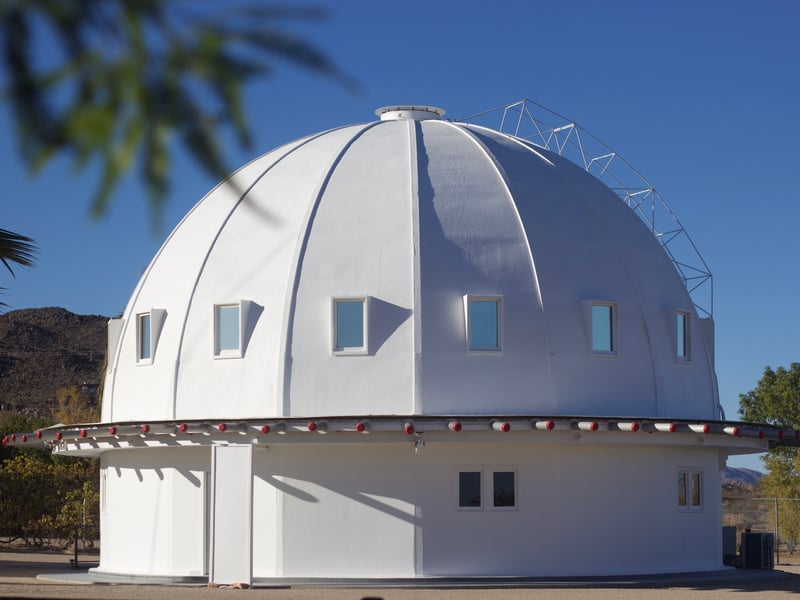
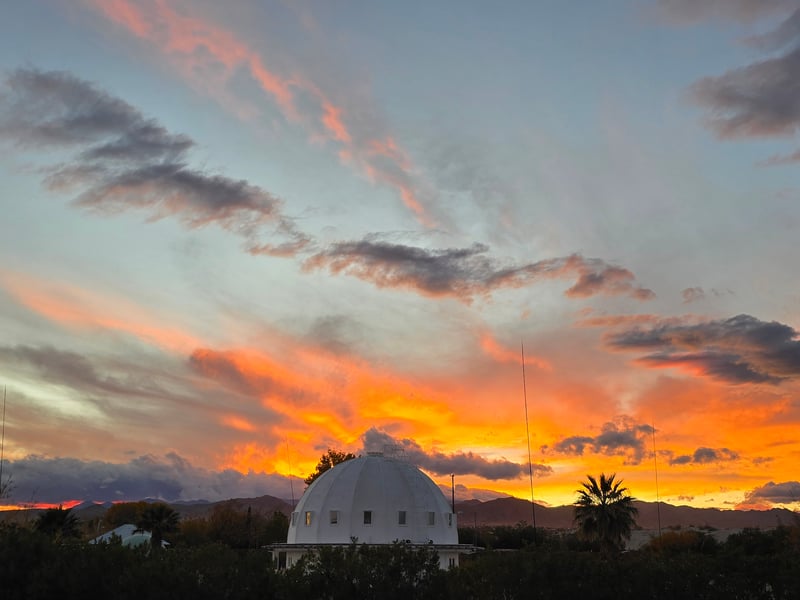
The result: the Integratron, a 38-foot-high, 55-foot-wide dome outside of Joshua Tree National Park in Southern California.
Whatever one makes of Van Tassel’s galactic tales, this striking white dome has earned a listing on the U.S. National Register of Historic Places.
Advertised as a “fusion of art, science and magic,” it’s become a tourist destination for the curious, the skeptical and the true believers.
Now under new management, the Integratron these days is mostly known as a retreat for sound bath meditation.**** Van Tassel’s parabolic design is said to be acoustically perfect, with sounds evenly balanced throughout the room.
In Van Tassel’s time, the Integratron was ostensibly a research laboratory for an organization he called the College of Universal Wisdom. He imagined it as part of a larger campus dedicated to UFO research and metaphysics.
After he died in 1978, the property bounced between various owners, including his widow. In 2000, sisters Joanne, Nancy and Patty Karl bought it for sound bath therapy.
Although sound baths are more grounded in science from Earth, the Karl sisters nonetheless lean into Integratron’s unique history, with Van Tassel and his beliefs featuring prominently on an official website. The sisters continue to operate the landmark today.
Visiting for a sound bath on a recent afternoon was a diverse crowd. There were crystal-collecting yogis, as well as curious retirees vacationing at nearby Joshua Tree National Park.
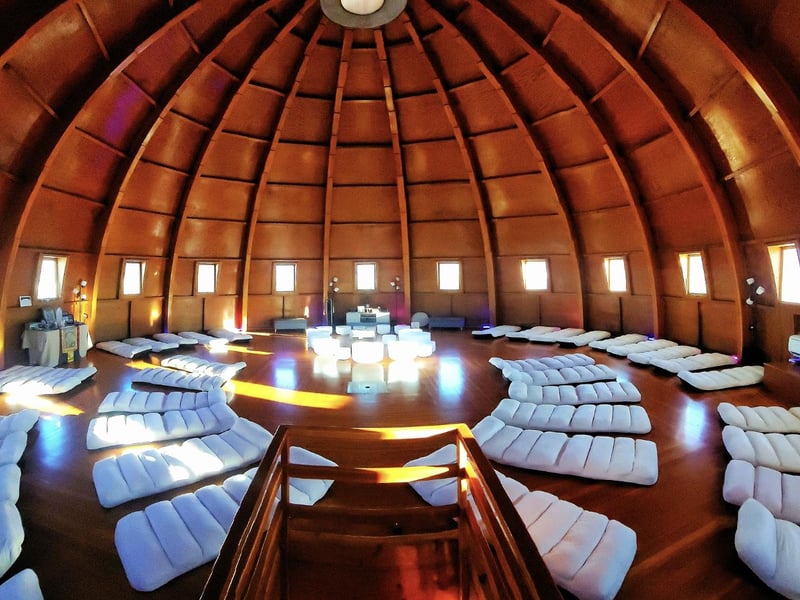
When it was time, the Integratron’s stewards ushered their guests into a rustic first-floor room inside the large domed building. The exposed Douglas fir walls and faint faint scent of palo santo are a marked contrast to its bright, futuristic exterior. After some instructions, the group ascended a steep staircase to the second floor where the baths take place.
There are some rules at the Integratron. No shoes, no talking and absolutely no snoring. Phones must be not only silent but powered off completely.
That’s in large part because of the building’s unique acoustics, which allow a whisper on one side of the building to be easily heard on the other.
“There are no secrets in the Integratron,” sound therapist Kristine Atkinson told the group as they settled onto their mats.
Sitting near the front of the room, Atkinson surrounded herself with 22 white crystalline singing bowls ranging in size from mixing bowl to garden planter.
Singing bowls like these are said to calm the mind and are often used in meditation practices. Although they can veer into alternative wellness and are not the panacea that some proponents claim, a growingbody of evidence suggests that auditory meditation does have real benefits, including improved mood, sleep and pain management.
“It’s like nutrition for your nervous system,” Atkinson told the group. “No two bowls are the same, so it is a process. You have to develop an ear for the space.”
In the dead center of the Integratron, right under its vertex, is a small patch known as the “magic square.”
Because of the acoustic effect of the building’s dome, sound waves effectively gather here, becoming louder for listeners in the center as sounds echo off the curved walls. Atkinson invited each guest to stand in the magic square and say something they were grateful for.
Atkinson gently rubbed the edge of the bowls with wooden dowels, creating a low humming sound.
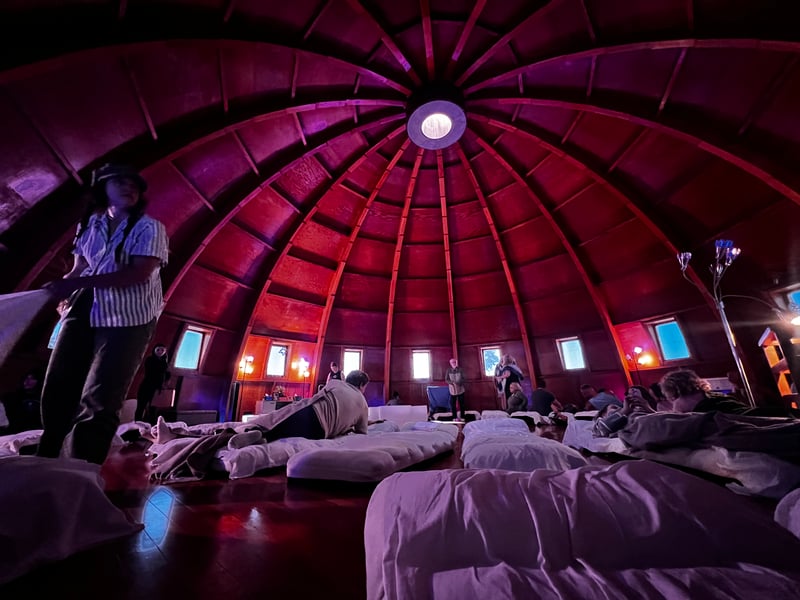
Some guests covered themselves with small blankets and put sleeping masks over their eyes. Atkinson instructed the group to take a few deep breaths.
For around 45 minutes, she ran her dowel along her various singing bowls, creating different pitches. They got louder, their ringing tones vibrating and bouncing off the circular frame of the Integratron.
Sometimes the bowls were quiet. At other times the warbling sound was loud and guttural, as though the Venusians were back and hovering their spacecraft just outside of the building.
A couple of snores broke the silence but were quickly hushed. Then the sound bath was over.
In a brief interview afterwards, Atkinson explained how the bowls are arranged according to the seven chakras in the human body — starting with a C note corresponding to the root chakra at the bottom of the spine and working down to a B note for the crown chakra at the top of the head.
One visitor — Irina Contreras, a Los Angeles resident on a trip to Joshua Tree — explained how images came to her as the singing bowls increased in pitch and volume.
“I cycled through all these thoughts. I kept on seeing stone,” Contreras explained. There were more images carved in the stone, “and then I saw someone’s face, and then I got a little freaked out.”
“I think that different spaces have more dimensionality than we’re able to put language to,” Contreras added. “We’re very stuck in this kind of 2D, 3D world.”
Also visiting from Los Angeles, Phoebe Darling said she’d participated in sound baths before, but none as immersive as this.
As the bowls began to sing, Darling said she could feel physical sensations inside of her.
“The first one, it felt like a little bit of pain,” she said. “I wasn’t expecting the physical reactions.”
For Darling, the unique setting of the Integratron is a big part of the draw.
“It’s the merger of my favorite things,” she said: “aliens and spirituality and hippie stuff.”
Atkinson, Nancy Karl’s daughter, has been working with singing bowls for 10 years. Trained by her mother and aunt Joanne, she says it took her about a year to learn the technique.
Although the Karl sisters didn’t take ownership of the Integratron until 2000, their roots at this place stretch back further. According to Atkinson, her mother and aunt had left corporate jobs to lead wilderness meditation retreats when, in 1986, a friend suggested they check out this unique landmark.
The Karls have turned the Integratron into more of a UFO-themed meditation retreat while paying tribute to its original DNA. In a statement, they said they have “deep respect for Van Tassel’s gift to humanity and his commitment to frequency, vibration and human potential.”
Asked whether they’d had their own UFO experiences like Van Tassel did, Atkinson was circumspect.
“Let’s just say we’ve had experiences that expanded our understanding of what’s possible,” she wrote in an email.
Van Tassel left his job at Lockheed in 1947, when he was 37 years old. With his wife and children, he moved to the Mojave Desert to run an airport and cafe.
1947 was the same year a mysterious craft crashed near Roswell, New Mexico, igniting America’s fascination with UFOs. Van Tassel certainly had an interest in otherworldly topics. Around that time, he started holding weekly meditation meetings under Giant Rock, a free-standing boulder in the region that was once a meeting point for Indigenous people. He even lived beneath it for a period.
In 1952, the year before he said he met Solgonda, Van Tassel said he was telepathically contacted by another Venusian, Lutbunn, who was interested in his group’s activities.
According to Van Tassel’s newsletter, these benevolent, egalitarian beings resided in highly developed technological societies on the moon, Mars, Venus and even farther-flung planets.
Like Van Tassel, they were critical of the materialistic and aggressive behavior of humans on Earth. Though he described himself a Christian, Van Tassel did not like what he called “Churchianity.” In his newsletters, he wrote that human civilization was going down a dark path.
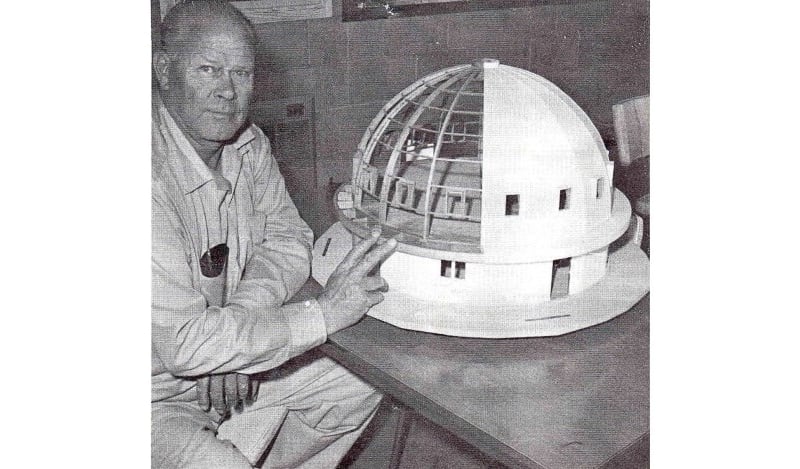
Unsurprisingly for the Cold War era, the United States government took an interest in this unusual man who was operating an air strip and lecturing about secret technologies. Was he a communist?
The FBI investigated, then seemed to lose interest. In a now disclosed file, agents cast him as simply a “dirty and unkempt” restaurant and airport owner.
“He has been described as eccentric and [an] apparent mental case,” they concluded.
Nonetheless, Van Tassel was among a small but growing group of people in the United States who believed in the existence of intelligent life in space. His meditation gatherings eventually evolved into an annual convention for the UFO-curious.
Van Tassel himself is harder to pin down. He was an artist, scientist, and philosopher who thought as much about society as technology. More curious than culty, the beings he wrote about have nonetheless been described as angelic. Atkinson sums up his thinking with a favorite quote by him: “Science and religion are two sides of the same wall.”
It’s not exactly clear how the Integratron was supposed to work. According to the Integratron’s official website, Van Tassel “claimed that the structure is based on the design of Moses’ Tabernacle, the writings of Nikola Tesla and telepathic directions from extraterrestrials.”
Copies of Van Tassel’s newsletter, “Proceedings of the College of Universal Wisdom,” are available online for anyone hoping to decipher the Venusian technology.
According to documents from the U.S. National Register of Historic Places, the “primary function” was “as a negative ion-producing cell regenerator.”
The Integratron’s stewards aren’t quite sure what that means, either. Ostensibly, the dome’s upper level can collect and store energy, which is then directed downward to the first floor for visitors to receive. Van Tassel believed the building would be critical for other breakthroughs too, including time travel and the anti-gravity fields needed to run flying saucers.
In a sense, Van Tassel’s Integratron is an incomplete project. And yet with this unusual and beautiful structure, he created something genuinely special, a monument to possibility and wonder in an uncertain universe.
Today, people of all ages, backgrounds and interests visit this strange building in the desert. Thousands are drawn in each year. According to Atkinson, the building has become a destination for meditators, audio professionals, scientists, Tibetan monks, artists and veterans with PTSD, among many others. And thus there is the Integratron as it stands today: part laboratory, part temple and part unanswered question.
Subscribe to our free newsletters
Our weekly newsletter Closing Arguments offers the latest about ongoing trials, major litigation and rulings in courthouses around the U.S. and the world, while the monthly Under the Lights dishes the legal dirt from Hollywood, sports, Big Tech and the arts.