
 Search Articles


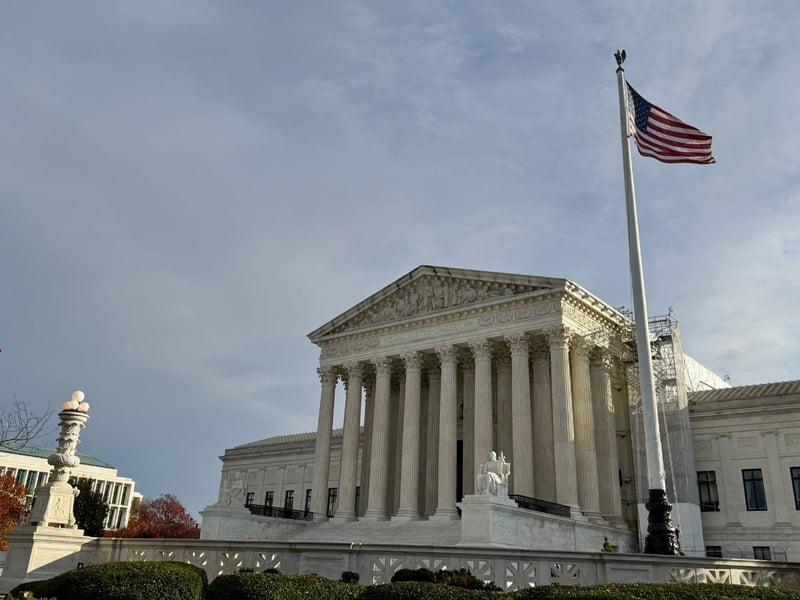
WASHINGTON (CN) — Tens of thousands of current and former Cornell University employees prevailed**** at the Supreme Court on Thursday, winning**** support to challenge the school’s management of billions of retirement plan assets.
The high court unanimously ruled in favor of the employees’ more straightforward pleading standard for Employee Retirement Income Security Act claims.
“The Court today holds that plaintiffs seeking to state a [Employee Retirement Income Security Act] claim must plausibly allege that a plan fiduciary engaged in a transaction proscribed therein, no more, no less,” Justice Sonia Sotomayor, a Barack Obama appointee, wrote for the court.
A class of 30,000 Cornell employees claim their retirement service providers unlawfully participated in the recordkeeping and administration of their plans. According to the employees, Teachers Insurance and Annuity Association of America-College Retirement Equities Fund and Fidelity paid substantially more than the “reasonable” recordkeeping fee and didn’t seek bids from other providers.
Under the Employee Retirement Income Security Act, fiduciaries must act solely in the interest of the beneficiaries. Cornell employees said the university violated its duties of loyalty and prudence by allowing its plan servicers to charge beneficiaries excessive fees.
The Supreme Court took up the case to decide the pleading standard for prohibited transaction claims under the Employee Retirement Income Security Act.
The employees said they only needed to prove that the university was responsible for the unlawful transactions. Cornell University, in contrast, would need to prove that the retirement plans contained exemptions allowing TIAA and Fidelity to participate in recordkeeping and administration duties.
One provision of the Employee Retirement Income Security Act — §1001 — prohibits plan fiduciaries from entering into certain transactions with parties in interest. There are some exemptions to that rule in a separate section of the statute — §1108(b)(2)(A) — including contracting or making reasonable arrangements with a party of interest for office space or services necessary to operate the plans.
The justices were asked if Cornell employees had to show that the exemptions in §1108(b)(2)(A) don’t apply to the contested transaction.
“The Court holds that §1108 sets out affirmative defenses, so it is defendant fiduciaries who bear the burden of pleading and proving that a §1108 exemption applies to an otherwise prohibited transaction under §1106,” Sotomayor wrote.
Education groups warned that the case could have broad implications for faculty and staff at colleges across the country. The American Council on Education and 13 other associations said that a more relaxed pleading standard would make it harder to administer plans, diverting resources from academic and research missions.
The university claimed that the relaxed pleading standard would lead to an avalanche of meritless litigation. Sotomayor acknowledged that Cornell had serious concerns, but the statutory text and structure of the law clearly demand a less stringent standard.
Sotomayor noted that there are other avenues to fight off frivolous suits.
“To the extent future plaintiffs do bring barebones §1106(a)(1)(C) suits, district courts can use existing tools at their disposal to screen out meritless claims before discovery,” Sotomayor wrote.
Justice Samuel Alito, a George W. Bush appointee, agreed with the majority but wrote a separate concurrence to highlight the untoward practical results of the justices’ ruling. Joined by Justice Clarence Thomas, a George H.W. Bush appointee, and Justice Brett Kavanaugh, a Trump appointee, Alito said that universities typically hire outside firms to manage retirement plans, expanding the parties of interest in the plan. This connection makes the firms’ services to the plan unlawful unless one of the statute’s exemptions applies.
“The upshot is that all that a plaintiff must do in order to file a complaint that will get by a motion to dismiss under Federal Rule of Civil Procedure 12(b)(6) is to allege that the administrator did something that, as a practical matter, it is bound to do,” Alito wrote.
As applied to the current case, Cornell set up a plan to allow employees to invest in the Teachers Insurance and Annuity Association of America-College Retirement Equities Fund and Fidelity funds. The firms provided the recordkeeping services for their own funds as they customarily do.
“There is nothing nefarious about any of that,” Alito wrote. “Yet under our decision that is all that a plaintiff must plead to survive a motion to dismiss. And, in modern civil litigation, getting by a motion to dismiss is often the whole ball game because of the cost of discovery.”
Alito pushed district courts to prevent this windfall for plaintiffs and their attorneys by asking for additional briefing on any exemptions.
“Whether these measures will be used in a way that adequately addresses the problem that results from our current pleading rules remains to be seen,” Alito wrote.
 Follow @KelseyReichmann
 Follow @kelseyreichmann.bsky.social
Subscribe to our free newsletters
Our weekly newsletter Closing Arguments offers the latest about ongoing trials, major litigation and rulings in courthouses around the U.S. and the world, while the monthly Under the Lights dishes the legal dirt from Hollywood, sports, Big Tech and the arts.