Search Articles


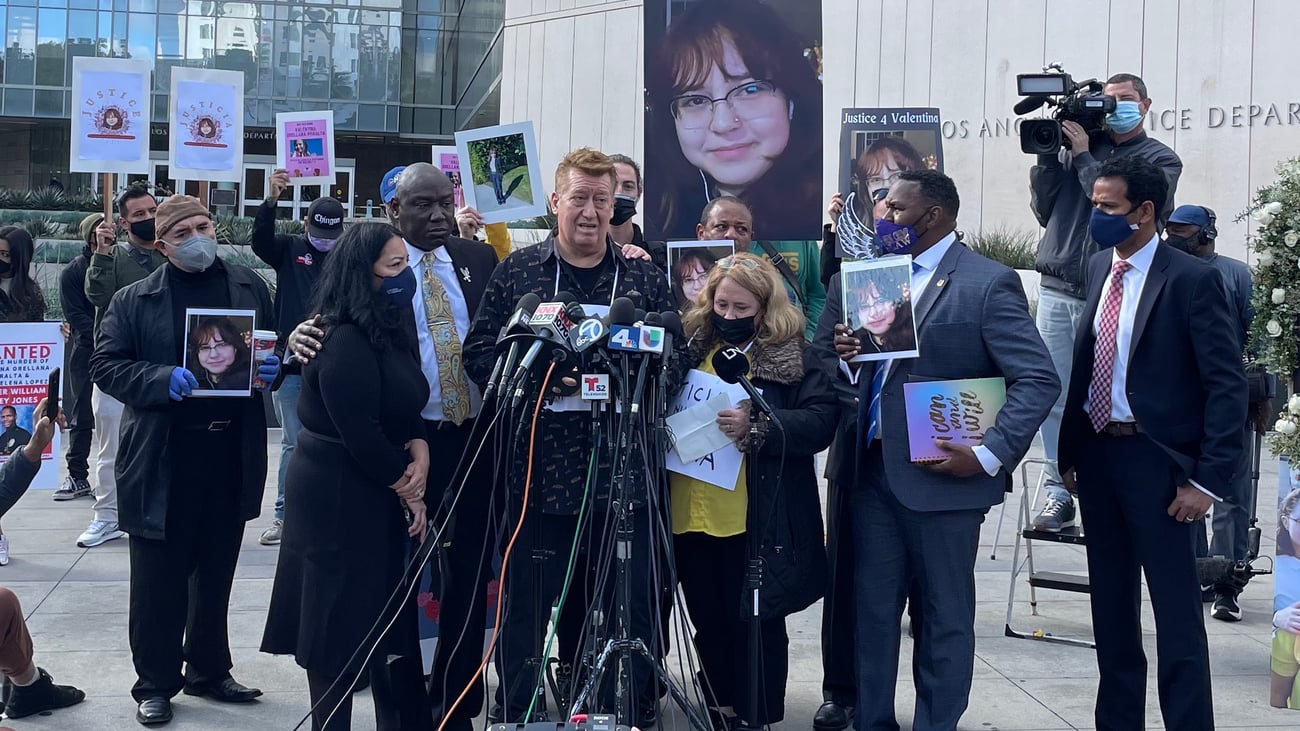
LOS ANGELES (CN) — On the witness stand Thursday, a Los Angeles Police Department officer denied that his colleague acted rashly and independently when he accidentally shot a teenage girl while responding to a call in 2021.
14-year-old Valentina Peralta and her mother were hiding in the dressing room of a Burlington Coat Factory, in North Hollywood, when an apparently mentally disturbed man began threatening customers with a large bike lock, beating at least one in the face.
Six police officers stormed the department store. Officer William Jones fired three shots from his department-issued AR-15. One of the bullets hit the suspect in the back, killing him. Another ricocheted off the ground and hurtled through the thin fitting room wall, striking Peralta and killing her.
In the girl’s parent’s civil jury trial accusing the city of LA of negligence, LAPD Officer Michael Mazur, the most senior police officer at the scene, resisted the depiction that Jones acted on his own, outside of Mazur’s orders that the officer with the less-than-lethal gun take down the suspect.
“It’s a little bit more complicated. I’m trying to prep the team. If we can, that would be optimal,” Mazur said on the stand.
The Peralta family argues Jones acted rashly, rushing into the scene with his assault rifle and pushing to the front of his fellow officers’ tight formation and quickly squeezing off three shots in less than a second at the suspect, without pausing to see what he was holding.
Mazur took responsibility for arranging the police formation. He told one officer to carry a shotgun, and to take “point,” at the head of the formation, he testified. He also said he told another to carry a “tube,” or a weapon capable of shooting less-than-lethal rounds, like bean bags, and to take the first shot at the suspect. He said that he and other officers would handcuff the suspect, once he was incapacitated.
Mazur can be heard, on body camera footage played over and over again during the trial, telling Jones to “strap that,” referring to Jones’ rifle.
That order has been the subject of much debate. The plaintiffs have suggested that Mazur wanted Jones to put the assault rifle away, as the weapon was too powerful to be used indoors without endangering bystanders. But Jones has testified that Mazur simply wanted him to put the strap around his neck, so as to be ready to put the AR-15 down after the suspect was disarmed.
At any rate, Jones did put the strap around his weapon, but also pushed his way to the front of the formation, effectively taking over the “point” position. Mazur can be heard repeatedly telling Jones to “slow down,” screaming those words at him in the seconds leading up to the fatal shooting. After the shots, Mazur can be heard saying, in a resigned voice, “Alright. Shots fired.”
Mazur tried to emphasize that the situation was fast-moving and dynamic. His placement of different LAPD officers in the formation applied only to the “initial phase.” Once they saw a woman lying in the aisle of the store, her face covered in blood, a new phase had begun, he said. Although Mazur had initially told investigators that Jones had ignored his orders to slow down, he testified that, in retrospect, Jones had in fact slowed down.
When asked by plaintiff attorney Nick Rowley how long he had spent preparing for his testimony, Mazur replied, “Six weeks over the course of three to four years,” with much of that time coming recently.
“We were assigned the last couple weeks,” he said.
The LAPD officer was actually retired, as of a few years ago. But, he testified, he was hired back by the department in January, and assigned to work at the police academy.
“For purposes of this case?” Rowley asked.
“No sir,” Mazur replied.
In what may prove to be a key moment in the trial, Superior Court Judge Frank Tavelman did not allow a section of body camera footage to be shown the jury. In that footage, only seconds after shooting, Mazur can be heard saying, “That was fucked up … we tried to slow it down.”
“I don’t find the subsequent debriefing is relevant,” Tavelman told the attorneys, outside the presence of the jury and witness, adding that Mazur’s statement would function as an expert opinion, which he was not certified for.
Later, during cross examination by the deputy city attorney, Mazur became unexpectedly overcome with emotion, choking up on the stand.
“When you don’t do anything, you don’t go in, people can get hurt,” Mazur testified, fighting back the tears. Referring to his orders that he gave his fellow officers, he said, “They’re listening to me … They’re trusting me to make the right decisions.”
Mazur will retake the stand on Tuesday. Jones is also expected to retake the stand next week.
This is only the first phase of the trial, in which a jury will decide if the city is liable. If they do, there will be a second trial to determine damages to the Peralta family. Peralta’s parents are not likely to testify in the first phase, but will take the stand in the damages phase, if there is one.
 Follow @hillelaron
Subscribe to our free newsletters
Our weekly newsletter Closing Arguments offers the latest about ongoing trials, major litigation and rulings in courthouses around the U.S. and the world, while the monthly Under the Lights dishes the legal dirt from Hollywood, sports, Big Tech and the arts.