
 Search Articles


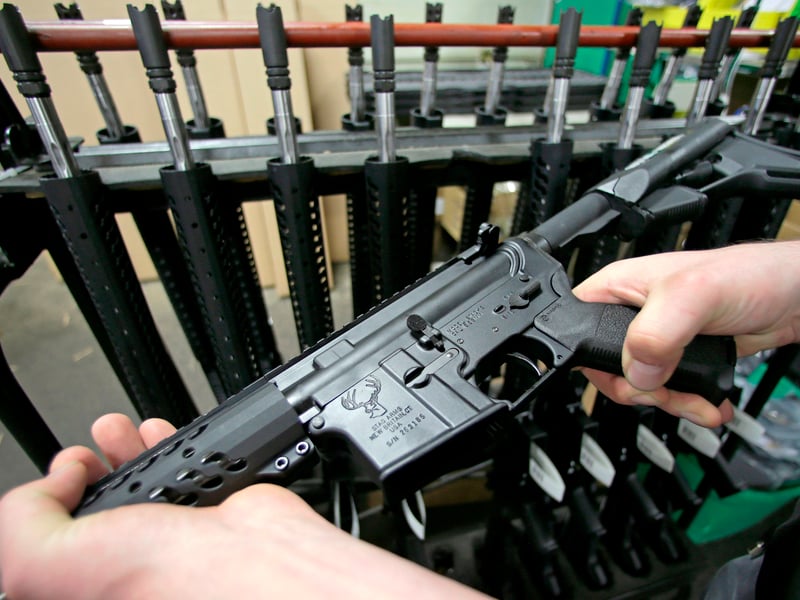
CHICAGO (CN) — The Seventh Circuit heard oral arguments Tuesday in a case challenging Cook County, Illinois’ decades-old assault weapon ban.
The plaintiffs in the case — several Cook County residents and two gun rights advocacy groups — claim the ban infringes on the Second Amendment by criminalizing the ownership of assault rifles that are commonly owned and traded across the country. In their appellate brief, they said U.S. Supreme Court precedent establishes that only “dangerous and unusual weapons” do not enjoy Second Amendment protection.
“The Second Amendment protects the right to own common semi-automatic rifles like the AR-15, whether under this court’s Bevis test or under the Supreme Court’s “dangerous and unusual” test,” the plaintiffs’ attorney Peter Patterson argued Tuesday, also referencing the Seventh Circuit’s decision to leave Illinois’ statewide assault weapon ban in place last year.
Cook County, which includes Chicago and its surrounding suburbs, has had some form of assault weapon ban in place since 1993. The relevant laws were strengthened in 2006 and again in 2013 when they were rechristened as the “Blair Holt Assault Weapons Ban” in honor of a 16-year-old high school student killed in a 2007 shooting.
The current ban, with some exceptions, outlaws the ownership and trade of a wide range of guns deemed assault weapons. The county also outlaws a number of firearm accessories, and those who violate the ban can face up to $15,000 in fines and six months in prison.
The Cook County residents and gun rights groups who oppose the ban filed suit challenging it in August 2021. But the 2022 Independence Day mass shooting in the Chicago suburb of Highland Park, which suspected gunman Robert Crimo III carried out using legally purchased assault rifles, threw the case into chaos.
Public outrage over the deadly shooting resulted in the January 2023 passage of the Protect Illinois Communities Act, effectively a statewide version of the Cook County ban. The plaintiffs’ suit against the county’s ban then became entangled with separate legal challenges against the state’s. Those cases resulted in split rulings from different Illinois federal courts last year; a Joe Biden-appointed judge in Chicago supported the state ban in April 2023 while a Donald Trump-appointed judge in East St. Louis enjoined it three days later. The Supreme Court, meanwhile, declined to take up the issue.
The Seventh Circuit consolidated the suits against the statewide assault weapon ban as Bevis v. City of Naperville . Though the three-judge panel considering the consolidated case was divided, the majority ultimately ruled last November that the statewide assault weapon ban could remain in place.
U.S. District Judge Rebecca Pallmeyer, a Bill Clinton appointee and another Chicago-based federal judge, took the appellate court’s cue and ruled in favor of Cook County in this case last March.
Like the appellate court looking at the statewide ban, Pallmeyer found there was little appreciable difference between assault rifles available for civilian purchase and weapons reserved for military use. While military weapons like the M16 are capable of firing fully automatic, and models available to civilians like the AR-15 typically fire semiautomatic, both the Seventh Circuit and Pallmeyer decided this distinction wasn’t relevant to the weapons’ essential functionality — especially because, with certain modifications, civilian assault weapons can fire fully automatic as well.
“If the M16 can effectively’ shoot at 150–200 rounds a minute and the AR-15 can, premodification, shoot at 45–65 rounds a minute, then the AR-15 can shoot about 33% as many rounds in a minute as the M16 does,” Pallmeyer wrote in March. “There is no indication in Bevis that this percentage difference in minute-to-minute firing capacity would render AR-15s different enough from M16s to render them subject to Second Amendment protection.”
Patterson challenged that conclusion before another three-judge Seventh Circuit panel Tuesday.
“Under Bevis , the key question is whether semiautomatic rifles are predominantly useful for military purposes. And the answer is no. Indeed no known military in the world uses a semiautomatic-only rifle for its standard service rifle,” Patterson argued.
This point was disputed by U.S. Circuit Judge Diane Sykes, a George W. Bush appointee. She commented that the plaintiffs hadn’t produced anything to “undercut” the Bevis panel’s decision.
Patterson disagreed, claiming his team had shown there were military-only applications for full-auto rifles like laying “suppressive fire” on an enemy. But U.S. Circuit Judge Amy St. Eve, a Donald Trump appointee, countered that the court was only just now seeing much of the plaintiffs’ new material, and that some of it — like retail and consumer surveys confirming the AR-15’s popularity among U.S. civilian gun owners — was legally shaky.
Assistant state’s attorney Jessica Scheller emphasized this same point when she argued on behalf of the county; she accused Patterson of choosing “not to participate in discovery.”
Wile Sykes sympathized with Scheller’s criticism of her opponent, U.S. Circuit Judge Michael Brennan, another Trump appointee, pressed Scheller on what Bevis meant for Second Amendment cases moving forward.
Brennan sat on the Bevis panel and issued a dissent to its majority ruling; on Tuesday he wondered if Bevis requires plaintiffs to prove a weapon enjoys Second Amendment protections, while excusing the government from having to justify weapon regulations.
“Isn’t the burden then on the plaintiff to show that an arm falls within the Second Amendment? I’m worried is that the Bevis rule has effectively shifted that historical burden,” he said.
Scheller disputed that characterization.
“The Bevis rule says that arms within the text of the Second Amendment are presumptively constitutional unless the government refutes that with history and tradition supporting regulation,” Scheller argued. “And in the Bevis case, the government did bring forth history and tradition of regulation.”
A key point in the state government’s arguments to the Seventh Circuit last year was how restrictions on machine guns, like the Thompson submachine gun famously associated with Prohibition-Era organized crime, have been in place since the 1930s.
Sykes, St. Eve and Brennan took the attorneys’ arguments under advisement but did not say when they would issue a ruling.
Tuesday’s arguments came just four days after U.S. District Judge McGlynn permanently blocked enforcement of the statewide assault weapon ban. McGlynn is the same Trump-appointed, East St. Louis judge who attempted to block the statewide assault weapon ban in April 2023 before the Seventh Circuit overturned that ruling.
 Follow @djbyrnes1
Subscribe to our free newsletters
Our weekly newsletter Closing Arguments offers the latest about ongoing trials, major litigation and rulings in courthouses around the U.S. and the world, while the monthly Under the Lights dishes the legal dirt from Hollywood, sports, Big Tech and the arts.