
 Search Articles


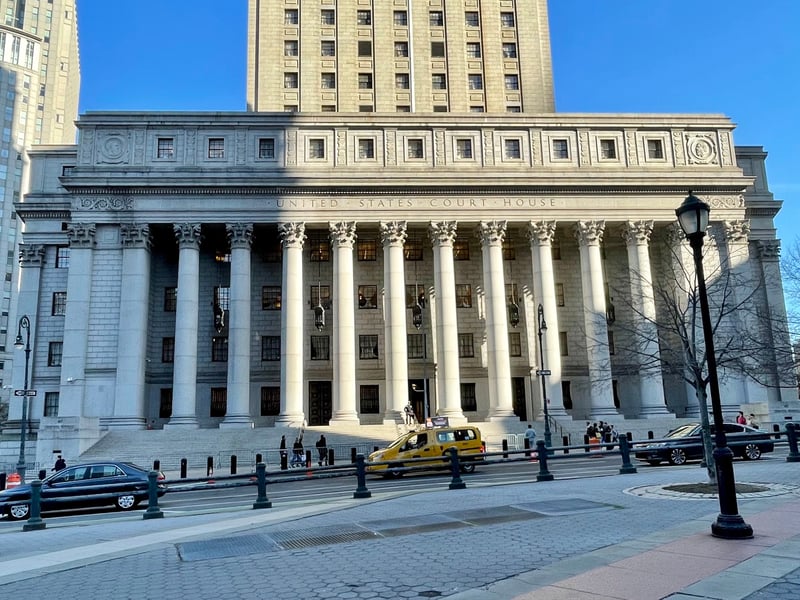
MANHATTAN (CN) — A convicted al-Qaida operative asked a Second Circuit panel on Monday to give him a redo on his resentencing for a foiled 2009 plot to bomb a busy shopping mall in Manchester, England.
Abid Naseer, a Pakistani national who lived in Brooklyn, was arrested in the United Kingdom just days before the attack was set to take place. Six years later, Naseer was found guilty for providing support to al-Qaida in his role plotting the three-pronged scheme, which in addition to the Manchester shopping mall included targeting the New York City subway and a newspaper office in Copenhagen, Denmark.
U.S. District Judge Raymond Dearie, a Ronald Reagan appointee in the Eastern District of New York, sentenced Naseer to 40 years in prison for his charge of using a destructive device in connection with a crime of violence, plus two 15-year sentences for convictions on providing material support to a foreign terrorist organization, to run concurrently.
But in 2022, Dearie vacated the destructive device charge on the back of new Supreme Court precedent, which raised the bar for what is considered a “crime of violence.” Axing the 40-year sentence, the judge resentenced Naseer and elected to have the two 15-year sentences run consecutively instead.
That was wrong, Naseer’s attorney told the Second Circuit on Monday; Naseer was entitled to a de novo resentencing instead of being resentenced via written order.
“I believe that had Mr. Naseer been given the opportunity that he deserved … that Judge Dearie may very well have decided to give him a different sentence,” Randa Maher of the New York-based Maher & Pittell told the panel.
But the trio of judges wasn’t quick to assume that Dearie would have rethought his decision. U.S. Circuit Judge Denny Chin, a Barack Obama appointee, told Maher that prior case law gives district judges “a fair amount of latitude” in imposing sentences that they find appropriate.
“Didn’t he make it clear that he thought 40 years was appropriate?” Chin asked. “The only reason he ran the sentences concurrently the first time around was because it didn’t matter to getting the 40-year sentence. So this time, to achieve what he thought was an appropriate sentence, he made the two remaining counts consecutive.”
Maher countered that it was still an abuse of discretion from the judge to skirt a de novo resentencing and merely issue the change on paper.
It was an argument that garnered some sympathy from U.S. Circuit Judge Sarah Merriam. The Joe Biden appointee pressed Assistant U.S. Attorney Nicholas Moscow, who argued to keep the sentencing in place, when Moscow suggested that the two 15-year sentences were an “afterthought” from the judge in comparison to the now-vacated 40-year sentence.
“Isn’t that, if anything, a reason for de novo resentencing?” Merriam asked. “If everyone was so focused on that [vacated] count, isn’t that a good reason to say … let’s look at those free standing and independently and really talk about what the right sentence is?”
Moscow shot back that Dearie’s focus was on Naseer’s conduct as a whole — not just the vacated count.
“Clearly, Judge Dearie’s focus was and has been on the total term of imprisonment,” Moscow said.
The three-judge panel didn’t immediately rule on Monday. Joining Chin and Merriam was U.S. Circuit Judge Michael Park, a Donald Trump appointee.
Naseer’s theatric two-week Brooklyn trial in 2015 made headlines when a batch of MI5 officers testified in wigs and makeup to mask their identities. Adding to the spectacle, a then-28-year-old Naseer, who was described in reports as being well spoken and charismatic, represented himself throughout the proceedings and prepped for court in his jail cell.
 Follow @Uebey
 Follow @uebey.bsky.social
Subscribe to our free newsletters
Our weekly newsletter Closing Arguments offers the latest about ongoing trials, major litigation and rulings in courthouses around the U.S. and the world, while the monthly Under the Lights dishes the legal dirt from Hollywood, sports, Big Tech and the arts.