
 Search Articles


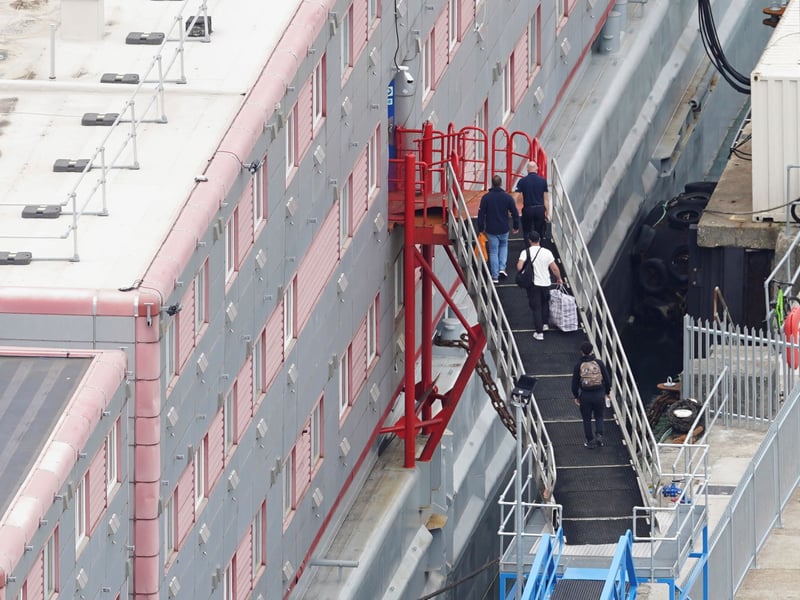
(CN) — An accommodation barge being used to house asylum-seekers in Britain opened its doors today, amid controversy over the move.
There have been numerous delays over the past few months in relocating asylum-seekers to the Bibby Stockholm, currently moored on the south coast of England in Portland, in part due to considerable political, legal and public opposition.
However, on Monday the first 50 people were moved onto the boat, signaling the beginning of the vessel’s operations. Government ministers have said that moving people applying for asylum will reduce pressure on the local communities where they are currently housed, as well as reducing the burden on public finances.
But the government is on the defensive over the plan after a number of safety concerns were raised over living conditions on board. Questions over whether the boat is prepared in the event of a fire have forced the government to deny that the ship is a “deathtrap."
Warnings from the Fire Brigades Union that the ship is overcrowded and lacks sufficient fire exits have strengthened those concerns. In a public statement, the union said the government had “scrapped vital fire safety measures for asylum-seeker accommodation” that would ordinarily be in place for rental housing and intended to place “more than 500 people onto an off-shore barge designed to hold around 200.”
“As firefighters, we are driven by the need to prevent loss of life and protect public safety. Everyone has the right to live in safe and decent housing, no matter where they are from,” the statement continued, adding that the current arrangement “puts the safety of firefighters at risk.”
A separate and much-publicized report from the nongovernmental organization One Life to Live said that the barge could become a “floating Grenfell,” in reference to a 2017 apartment building inferno in which 72 people died. Investigations from the U.K.’s health and safety executive have caused some of the delays to the relocation of asylum-seekers.
In addition to safety concerns, human rights organizations have voiced their opposition to moving asylum-seekers on to what has been described as a “quasi-prison ship.” Campaigners point out that many of the intended occupants have already experienced traumatic journeys at sea to enter the U.K. and complain about restricting their movements.
“Amongst our clients are people who are disabled, who have survived torture and modern slavery and who have had traumatic experiences at sea,” said Steve Smith of the charity Care4Calais, describing asylum-seekers’ housing on the Bibby Stockholm as “inhumane.”
An open letter from the refugee council struck a similar tone.
“Those who will be contained on the barge are not criminals; they are seeking protection in the UK," the letter’s authors wrote. “The barge is not officially to be used as a prison or detention vessel, yet people will be held in detention-like conditions with severe restrictions on freedom of movement.”
Amnesty International has described the ship as “reminiscent of the prison hulks from the Victorian era.”
The government insists that those who are relocated to the vessel are “non-detained,” and that occupants can arrange bus journeys to other destinations. However, Portland is a remote location on an island connected to the mainland by a small strip of shingle. As a result, most services, such as healthcare and catering, will be provided on board.
In the U.K., 51,000 people are currently being housed in hotels while their asylum applications are processed. The government hopes that the Bibby Stockholm model will reduce the costs of providing asylum-seekers with shelter.
The barge also fits into a wider electoral strategy for the Conservative government, which has heavily shifted its focus towards refugee policy since losing its reputationfor economic competence in September 2022. Then-Prime Minister Liz Truss resigned after her failed attempts to revamp the financial system. Asylum and migration is seen as traditionally more fertile electoral ground for the party.
Prime Minister Rishi Sunak has made “stopping the boats” one of his five key pledges to the electorate, on which he wants to be judged going into the next general election. The “boats” refer to small vessels — usually inflatable dinghies — in which those seeking asylum have been entering the U.K. in increasingly large numbers.
The phrase “stop the boats” is not a new one — it was a key pledge of the former Australian Prime Minister Tony Abbot, and it helped secure him election victory in 2013. Abbot was advised by political strategist Lynton Crosby, who has frequently worked at a high level within the U.K.’s Conservative Party.
It has now become a core plank of the party’s electoral strategy. Other British government schemes — such as the high-profile plan to relocate refugees to Rwanda — are similarly aimed at discouraging asylum-seekers to open applications in the U.K. In addition, there has been a raft of hardline legislation passed in recent years aimed at restricting the entry of refugees into the country.
Much of the government’s “stop the boats” agenda has been derailed by intense opposition and legal obstacles. The latest piece of legislation put forward by the Home Office, the U.K. interior ministry, is the Illegal Migration Act 2023. It experienced considerable parliamentary and international opposition in the House of Lords before passing into law last month.
The act prevents anyone who has entered the country illegally from claiming asylum and allows them to be detained. There remain significant obstacles to its implementation, including the lack of detention capacity required to take such an approach.
The plan to “offshore” refugees to Rwanda has also suffered significant setbacks in the courts. The scheme as its stands was found to be unlawful by the Court of Appeal in June, a decision the government has decided to appeal to the Supreme Court. That case is expected to be heard later this year.
The government hopes that the arrival of asylum-seekers at the new barge will signal that at least some progress is happening on its stated aim of “stopping the boats." But if they intend for the scheme to be a blueprint for the future, there will likely be more hurdles ahead.
On Monday came the news that Glasgow City Council has rejected a government request to install a new refugee-housing barge on the River Clyde in the Scottish city. It is the latest in a long line of local authorities to deny permission for such an operation and indicates the scale of the logistical challenge that sustained opposition to the government’s approach is creating.
Subscribe to our free newsletters
Our weekly newsletter Closing Arguments offers the latest about ongoing trials, major litigation and rulings in courthouses around the U.S. and the world, while the monthly Under the Lights dishes the legal dirt from Hollywood, sports, Big Tech and the arts.