
 Search Articles


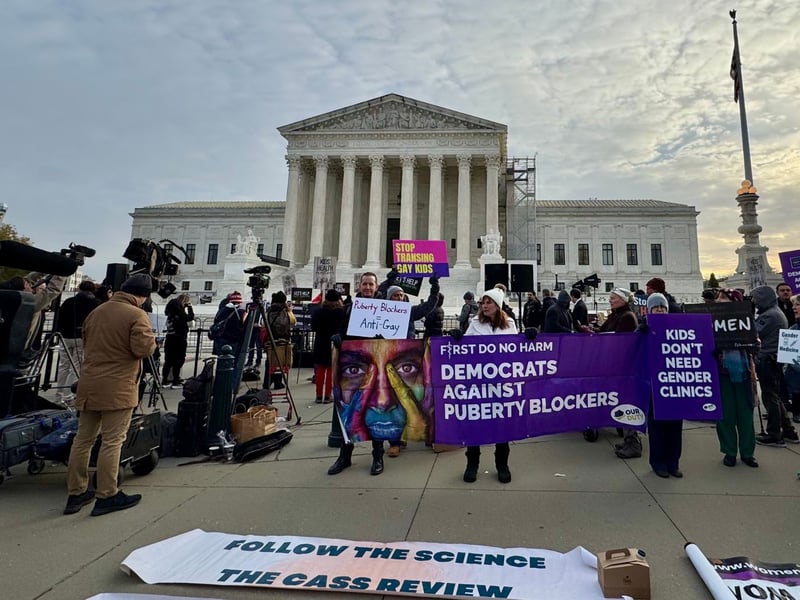
WASHINGTON (CN) — The Supreme Court seemed likely Wednesday to uphold Tennessee’s ban on gender-affirming care for transgender teens.
Throughout the two-and-a-half-hour session, the court’s conservative justices pushed back against the teens’ declarations on the necessity and efficacy of gender-affirming care. Those concerns, combined with hesitancy to become the national decision-maker on transgender rights, suggested that the high court would be more comfortable leaving the issue up to the states.
“Of course, we are not the best situated to address issues like that … and if that’s true, doesn’t that make a stronger case for us to leave those determinations to the legislative bodies rather than try to determine them for ourselves?” Chief Justice John Roberts, a George W. Bush appointee, asked.
The conservative justices were troubled by evolving medical standards across the globe. Justice Samuel Alito, a George W. Bush appointee, noted health authorities in the United Kingdom and Sweden say that the risks and dangers of transition care for minors outweighed the benefits, citing the Independent Review of Gender Identity Services for Children and Young People, commonly known as the Cass Review.
“I don’t regard the Cass Review as the Bible or as something that’s true in every respect, but … it says: ‘There is no evidence that gender-affirmative treatments reduce suicide,’” Alito said.
Alito criticized the Biden administration for relegating the report to a footnote and seemed shocked when the government refused to retract statements about the safety of transition care.
Major American medical associations say that gender-affirming care is evidence-based and medically necessary for children suffering from gender dysphoria, though the Biden administration acknowledged medical uncertainty about transition care for minors.
While the government said it wasn’t the court’s role to entirely second-guess Tennessee’s legislature, U.S. Solicitor General Elizabeth Prelogar said the judiciary had a responsibility to scrutinize state laws for constitutional violations.
“I think it would be a pretty remarkable thing for the court to say that just because we’re in the space of medical regulation, you are not going to apply the traditional standards that ordinarily are applied when there’s a sex classification,” Prelogar said.
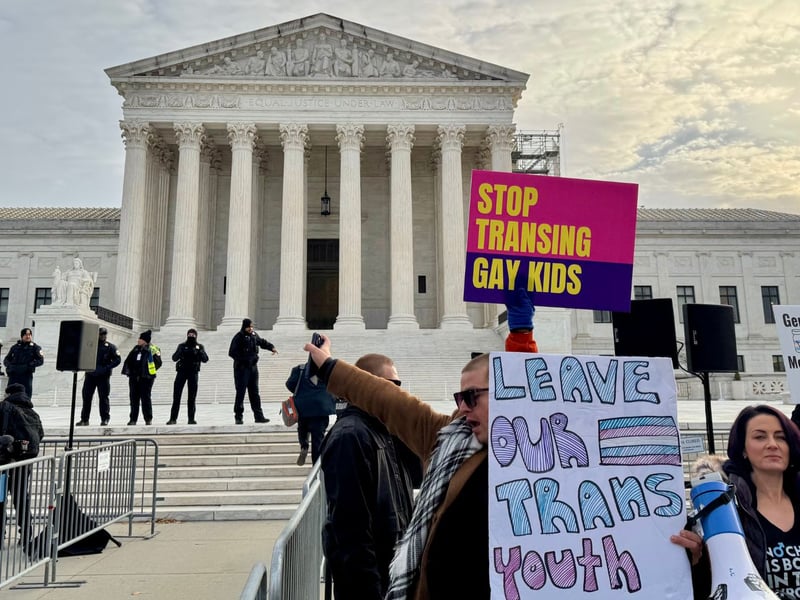
Tennessee’s legislature adopted Senate Bill 1 in 2023, prohibiting health care providers from prescribing, administering or dispensing any puberty blocker or hormone aimed at helping a minor identify with a gender that is inconsistent with the minor’s sex.
Three transgender minors, their families and a Memphis-based doctor claim that the ban is unconstitutional. The Biden administration intervened in their suit, viewing the case as a matter of public importance.
The Sixth Circuit reversed a lower court’s finding that Tennessee’s law was unconstitutional after applying a rational basis review, prompting the Biden administration to say a higher level of scrutiny was necessary.
Transgender teens currently face a checkerboard of rights across the over two dozen states that have passed bans on gender-affirming care.
“If the Constitution doesn’t take sides, if there are strong forceful scientific policy arguments on both sides in a situation like this, why isn’t it best to leave it to the democratic process?” Justice Brett Kavanaugh, a Donald Trump appointee, asked.
Justice Sonia Sotomayor, a Barack Obama appointee, said legislatures have historically discriminated against minority groups.
“When you’re 1% of the population or less, it’s very hard to see how the democratic process is going to protect you,” Sotomayor said. “Blacks were a much larger part of the population, and it didn’t protect them. It didn’t protect women for whole centuries.”
Chase Strangio, an attorney with the ACLU representing the three transgender teens, said that transgender people currently face a challenging political arena.
“There is a significant challenge for transgender people to protect themselves in the political process where you do have laws excluding transgender people from places where they need to go in all aspects of life, and there is a difficulty in that type of majoritarian protection,” Strangio, the first openly transgender attorney to argue before the Supreme Court, said.
Justice Ketanji Brown Jackson, a Joe Biden appointee, said she was concerned that the court was reverting to arguments from the 50s and 60s to create racial classifications.
“I’m worried that we’re undermining the foundations of some of our bedrock equal protection cases,” Jackson said.
Tennessee argued states have traditionally regulated medical care and framed its ban as treatment-based, not sex-based.
“We’ve had multiple instances in somewhat recent history where we have stuff like lobotomy, eugenics, that had widespread acceptance among the medical community, and the state had to intervene as a regulator to protect the children,” Matthew Rice, Tennessee’s solicitor general, said.
The Biden administration said Tennessee’s arguments would allow the state to extend its ban to transgender adults.
“It’s important to recognize that my friend’s arguments would equally apply to a nationwide ban if this were enacted by Congress,” Prelogar said.
Jackson became visibly frustrated with Tennessee’s refusal to acknowledge the sex-based nature of the law. Justice Elena Kagan, a Barack Obama appointee, accused Tennessee of dodging the sex-based classification. She said the law’s classification was based on the state’s view that there’s something fundamentally wrong or bad about youth trying to transition.
“What’s really going on here is discrimination against and disregard for young people who are trans,” Kagan said.
Kavanaugh, however, suggested that the law prohibits all boys and all girls from transitioning using certain medical treatments.
Tobias Barrington Wolff, a professor at the University of Pennsylvania Carey Law School, said in an interview some of the justices indicated an interest in remand on this issue.
“If the court recognized it as a sex classification, then the court’s precedent is clear that heightened scrutiny is needed,” Wolff said.
Remanding the case would force the Sixth Circuit to do a more thorough review of Tennessee’s law. Wolff suggested that the court might prefer for the lower courts to create a record before potentially reviewing the issue again.
 Follow @KelseyReichmann
 Follow @kelseyreichmann.bsky.social
Subscribe to our free newsletters
Our weekly newsletter Closing Arguments offers the latest about ongoing trials, major litigation and rulings in courthouses around the U.S. and the world, while the monthly Under the Lights dishes the legal dirt from Hollywood, sports, Big Tech and the arts.