
 Search Articles


WASHINGTON (CN) — House Republicans on Wednesday remained skeptical that the federal government should authorize even more funding to help the state of Maryland rebuild the Francis Scott Key Bridge.
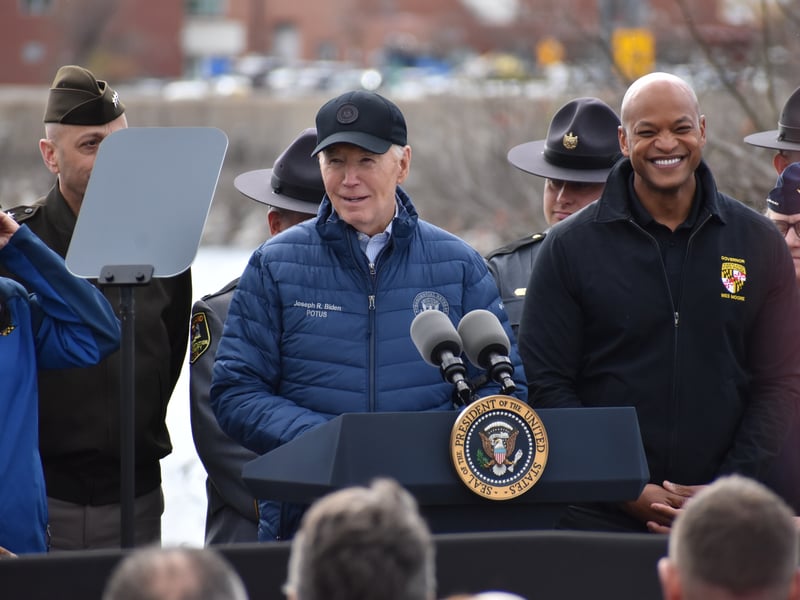
President Joe Biden has pledged that Washington will foot the bill for replacing the bridge, which partially collapsed in the early hours of March 26 after it was struck by the Dali, a Singapore-flagged container ship departing the Port of Baltimore. Six people, mainly members of a construction crew, died in the collapse.
In the days following the Key Bridge’s destruction, the White House authorized roughly $60 million in so-called “quick release” aid for the Maryland Department of Transportation, designed as a down payment on repair costs, which have since been estimated at as much as $1.9 billion.
Biden asked Congress in April to authorize a 100% federal cost-sharing scheme for rebuilding the bridge. Under current law, the government would only cover expenses for replacing the Key Bridge if repair crews start work within 270 days, or roughly six months. After that, the rate shifts to around 90%, leaving the government of Maryland responsible for remaining costs.
But lawmakers, particularly Republicans, have been reticent to back any effort to fully fund a bridge replacement using government money — arguing, among other things, that it would be an unnecessary burden on taxpayers.
Speaking at a House Transportation and Infrastructure Committee hearing Wednesday morning, Missouri Representative Sam Graves suggested there was little urgency in Congress to authorize a 100% cost-sharing plan.
“While the president’s request has been received and is under consideration, Congress has roughly six months to act,” said the Republican lawmaker, who chairs the panel.
Graves pointed out that the cost estimate for replacing the Key Bridge was still in flux, and that Congress needs a firm number before it moves forward.
The government must also use existing cash and other funding avenues before lawmakers should consider greenlighting additional aid, he added. Maryland is slated to receive a roughly $350 million insurance payout for the bridge collapse and is also seeking liability payments from the company that owned the Dali.
Other committee Republicans agreed.
Pennsylvania Representative Scott Perry worried that the government footing the bill for the Key Bridge would set a precedent that taxpayers are responsible for future federal responses to infrastructure disasters. He pointed out that the bridge was not a part of the federal interstate highway system, but rather a section of Maryland’s state highway network that charged tolls.
The lawmaker needled Shailen Bhatt, administrator at the Transportation Department’s Federal Highway Administration, on that concern.
“I’m wondering if you think it’s fair that the American taxpayer should not only pay to reconstruct the bridge but then pay tolls after which to use the infrastructure they paid for with their taxes?” Perry asked Bhatt, one of the witnesses invited to testify Wednesday.
Bhatt pointed out that the Key Bridge has since been reclassified as part of the interstate system, meaning that tolls collected once the span reopens can only be used for purposes laid out under federal law, such as maintenance.
“The American taxpayer will be benefitting from those tolls,” Bhatt told lawmakers.
Perry, though, wasn’t convinced. “You’re asking taxpayers across the country to pay for [the bridge]. If you’re from Washington state, you’re likely never going to travel across that bridge, but you’re sure going to pay for it.”
The Pennsylvania Republican suggested that the government should implement a plan to recuperate the costs of repairs by using bridge tolls to reimburse the Transportation Department’s emergency fund, which he argued would stand to benefit the entire country and not just the state of Maryland.
Louisiana Representative Garrett Graves said he fully supported upfront federal funding to rebuild the Key Bridge. However, he called the circumstances surrounding the planned rebuild a “major anomaly,” pointing to the issue of toll collection on the bridge, as well as the fact that the collapse was caused by an outside party rather than a natural disaster.
Republicans have for months pumped the brakes on full federal funding for a Key Bridge rebuild. Following the White House’s April request to Congress, the conservative House Freedom Caucus came out against any legislation that would allocate additional federal funds to the project without first exhausting other options.
The voting bloc argued that the feds should first seek maximum liability from the Dali’s owners and that the Port of Baltimore should dip into existing federal funds before new cash is authorized.
If Congress must move ahead with an additional aid package, the Freedom Caucus contended that it should be fully offset by government revenue and that repair efforts be allowed to ignore environmental regulations to prevent what they see as unnecessary cost overruns.
Virginia Representative Bob Good, chair of the Freedom Caucus, said at the time that any federal involvement in the Key Bridge’s reconstruction “should make the project faster and cheaper while not borrowing any more money to pay for it.”
Other congressional Republicans, such as Pennsylvania Representative Dan Meuser, have rejected outright the possibility that the government would foot the bill for replacing the Key Bridge.
Despite that, Maryland’s congressional delegation introduced a bill in April that would ensure full federal funding for the project.
Meanwhile, efforts to remove the Key Bridge’s tangled wreckage from Maryland’s Patapsco River and extricate the Dali container ship continue apace. Demolition crews earlier this week used explosives to free the vessel from the span’s superstructure.
U.S. Coast Guard Vice Admiral Peter Gautier told lawmakers Wednesday that 6,000 tons of steel and concrete have been removed from the river so far and that maritime access to the Port of Baltimore has been reopened. The Dali, he added, could be fully removed from the bridge’s wreck as early as next week.
 Follow @BenjaminSWeiss
Subscribe to our free newsletters
Our weekly newsletter Closing Arguments offers the latest about ongoing trials, major litigation and rulings in courthouses around the U.S. and the world, while the monthly Under the Lights dishes the legal dirt from Hollywood, sports, Big Tech and the arts.