
 Search Articles


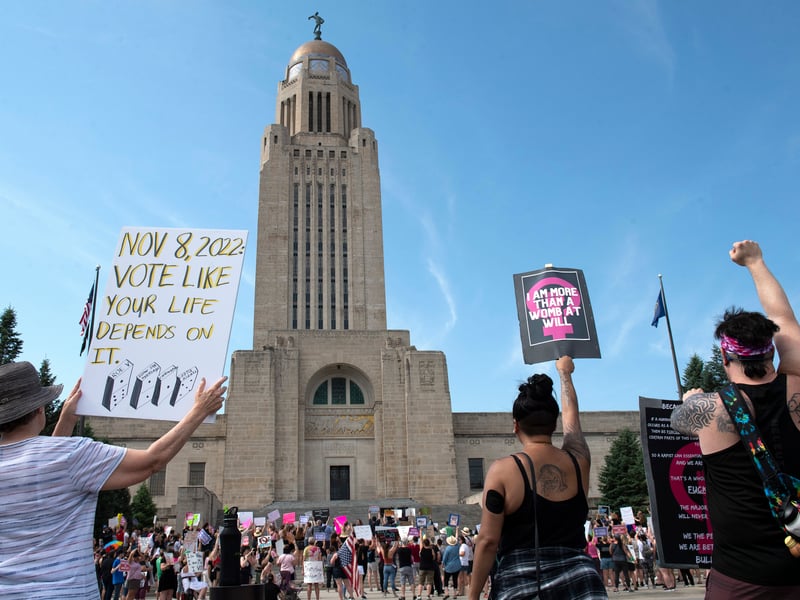
(CN) — With just a week left until the Nebraska secretary of state must finalize the ballot for the upcoming election, three interlocking cases challenging competing ballot measures to either grant a constitutional right to abortion or ban abortions and grant fetuses rights in the state are still in the hands of the Nebraska Supreme Court.
Brenna Grasz, an attorney for Catherine Brooks, a neonatologist challenging the ballot measure, said at oral arguments Monday that the language used in the Protect Our Rights initiative — a ballot measure asking Nebraskans to establish a constitutional right to abortion up until fetal viability — “goes beyond merely personal rights of a woman.”
The ballot’s reportedly confusing language includes “all persons, mothers, fathers, parents, personal rights and third-party rights,” she added, which amounts to a violation of the single-subject rule in the state’s constitution that requires ballot initiatives only deal with one subject at a time.
Matthew Heffron, an attorney for Carolyn LaGreca, who’s also suing to stop the Protect Our Rights initiative, said the ballot measure throws together ideas that are popular with voters, like allowing abortions early in a pregnancy, with ones that aren’t, like allowing abortions later in a pregnancy.
Each initiative should be separated into bills that people should be able to vote on or, they should go to the state legislature where they can be given more time for debate, in public, he argued.
The ballot measure, Heffron suggested, could also allow non-physicians permission to perform abortions.
“Healthcare practitioners, is that an expansion of the current law? Are we talking about masseuses and athletic trainers, are we talking about physicians? Who does that include?” asked Justice Jeffrey J. Funke.
Paul Rodney, an attorney for the sponsors of the Protect the Right to Abortion initiative, said it’s an expansion of rights only for healthcare practitioners who have expertise and skill and can operate as appropriate care providers.
Funke then asked if that included dentists and midwives, including certified and “lay” midwives.
“I think that is another future refraction that this court might have to grapple with,” Rodney said. “We don’t think a dentist under current professional ethics and professional obligations would seek to become the treating physician for a pregnant patient and a pregnancy.”
Rodney also countered that the ballot initiative does have a single specific subject, which is to limit government interference with abortion.
That’s why the secretary of state approved the initiative for the ballot, “and that’s why this court should affirm that decision and let the voters decide,” he added.
The lawsuits brought to stop the measure from going to voters were brought because they have objections to possible repercussions of the initiative, not concern on whether it lines up with the state’s single-subject rule, Rodney said, arguing that the plaintiffs should instead be communicating those objections during the upcoming election, not in court.
The ballot also still leaves room for the state to regulate abortions, it just allows people to have access to an abortion without the government interfering, similar to the law of the land before Roe v. Wade was overruled in 2022.
The third case heard on Monday asks the court to either keep both the abortion rights ballot initiative and an opposing one that would restrict abortion rights on the ballot and let voters decide, or remove them both by applying a more rigid interpretation of the single-subject rule to both.
“However, if the court were to apply a more tightly focused, stricter approach to the single-subject test, we think that the restrictions amendment would clearly fail that test far before the rights amendment would," said David Gacioch, the attorney representing 29 physicians in the case.
The restrictive ballot measure, the Protect Women and Children initiative, would create a constitutional amendment that bans abortions after the first trimester of pregnancy if passed.
The use of the phrase “unborn children,” in the Protect Women and Children initiative opens up a “pandora’s box of potential impacts,” Gacioch said, since the concept of anointing personhood before birth isn’t in the state constitution.
When asked by Chief Justice Michael G. Heavican if the initiative specifically gives rights to fetuses, James Campbell, an attorney for the Protect Women and Children, which intervened in the case, said yes, but only the right to be protected from an abortion during the second and third trimester of a pregnancy.
The primary purpose of the Protect Women and Children ballot initiative is to protect “unborn children” after the first trimester and the secondary purpose is to protect women, Campbell said.
“Unborn children get rights, and finish the sentence. Do women get rights under your proposal?” Justice Lindsey Miller-Lerman asked.
“Our proposal is that the other purpose is to protect women, and we do believe this protects women,” Campbell said.
“I don’t think that is quite corresponding to what I’m trying to tease out here,” Miller-Lerman said. “Does this proposal protect pregnant women?”
“This proposal creates limitations on the protection for unborn children to address situations where tragedies befall pregnant women, so yes, in the context of medical emergencies, sexual assault and incest there is a limitation imposed on the right created for unborn children,” Campbell said.
He added that since the physicians already agreed that the initiative meets constitutional requirements, there’s no controversy. Instead, Campbell said, they should have intervened in the other case, since this case seems entirely contingent on that one.
“You can’t come to court and concede that what the respondent did was legally correct and then claim that there’s a ripe case or controversy,” Campbell said.
Subscribe to our free newsletters
Our weekly newsletter Closing Arguments offers the latest about ongoing trials, major litigation and rulings in courthouses around the U.S. and the world, while the monthly Under the Lights dishes the legal dirt from Hollywood, sports, Big Tech and the arts.