
 Search Articles


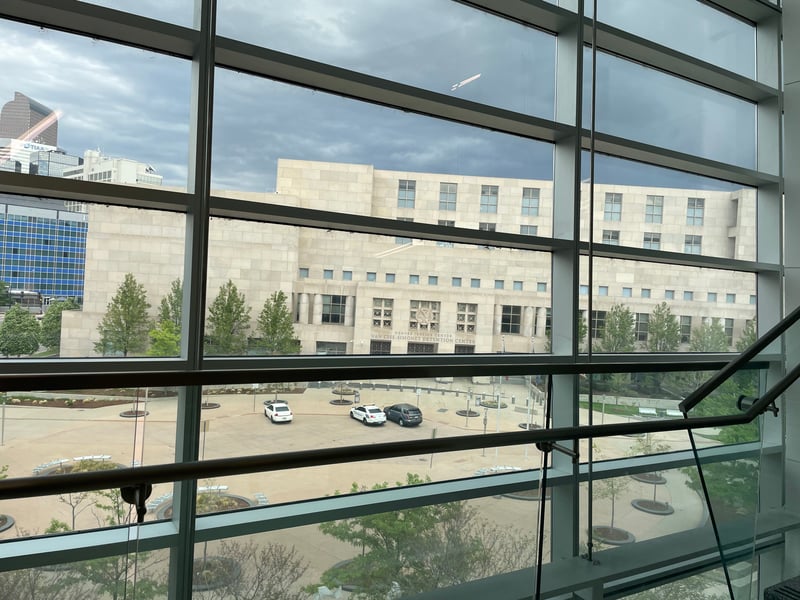
DENVER (CN) — A public defender’s former colleague testified Wednesday before a Denver judge that she thought he dropped cases in hopes of initiating litigation to challenge a law he didn’t like.
“He indicated to me he planned to do it and would do it,” recalled Megan O’Brien, supervising deputy public defender who worked with Travis Weiner in Greeley, Colorado.
As a public defender, Weiner found himself juggling a triple-digit caseload in 2024. The magnitude of the caseload, he feared, could force him to violate professional standards and offer subpar representations. Worse, he thought the entire office faced the same risk. When he reported his concerns to his supervisors, Weiner said he was told dropping cases wasn’t an option.
Eventually, Weiner withdrew from three cases, prompting the head of the office to discipline and then fire him. Claiming violations of the State Employee Protection Act and his free speech rights, Wiener sued in November 2024.
O’Brien said she saw Weiner as a competent attorney who often jumped in to help his colleagues. While she often fielded calls from clients who struggled to get in touch with their attorney, O’Brien said she rarely heard complaints from Weiner’s clients and that he seemed to carry the caseload well.
Among friendly chats and conversations about streamlining the workload, O’Brien said Weiner regularly criticized their workload and discussed dropping cases — a practice banned by both office policy and state law.
“In the back of my mind, I was hoping the plan would peter out,” O’Brien testified on the third and final day of a hearing on the state’s motion to dismiss Weiner’s lawsuit.
Weiner’s attorney, David Lane, characterized his colleagues’ offers to reassign his cases to reduce his workload as akin to rearranging the deck chairs on the Titanic.
After comparing his workload to a 2023 RAND report on the issue, Weiner calculated he was pulling nearly triple the number of cases experts found an attorney could competently carry. To properly represent his clients, he’d need to work 12-hour days 365 days each year.
Referring to the report, legal ethicist and attorney Gerald Pratt called Weiner’s workload “impossible” and opined that he was ethically obligated to act.
“In Mr. Weiner’s situation, he has an obligation to provide effective assistance of counsel to his client,” Pratt said. “If he is not able to do that, it is ethically imperative for him to bring it to the court.”
Chief Deputy Public Defender Lucienne Ohanian pushed back on the RAND report, stating there was no number of cases she thought was inherently too much work without looking at other factors like case type and client.
State law actually bars public defenders from withdrawing from cases simply due to having an excessive workload. And Ohanian defended the prohibition as providing leverage for funding.
“This statute has turned out to be a significant tool in our budget advocacy because part of our narrative has been ‘listen, the general assembly has set this expectation, and if this expectation is going to exist, you have to ensure we are funded in a way to comply with it,’” Ohanian said.
Ohanian worried Weiner’s move to drop clients would leave them without representation and give the entire public defense system a bad name.
“He was communicating with clients that he couldn’t do the thing he needed them to do; his conduct threatened to make our clients think they couldn’t trust the public defenders’ office,” Ohanian said.
Representing the office of the Colorado State Public Defender, state attorneys Juliane DeMarco and Lauren Davison argued Weiner was fired for disobeying his supervisor’s order not to withdraw representation, not for whistleblowing on a workload crisis. Throughout the hearing, the state worked to frame the case as being about Weiner’s individual case management rather than a systemic deluge.
Second Judicial District Judge Sarah Wallace will schedule closing arguments on the matter next week. She did not indicate when or how she will decide the case.
 Follow @bright_lamp
Subscribe to our free newsletters
Our weekly newsletter Closing Arguments offers the latest about ongoing trials, major litigation and rulings in courthouses around the U.S. and the world, while the monthly Under the Lights dishes the legal dirt from Hollywood, sports, Big Tech and the arts.