
 Search Articles


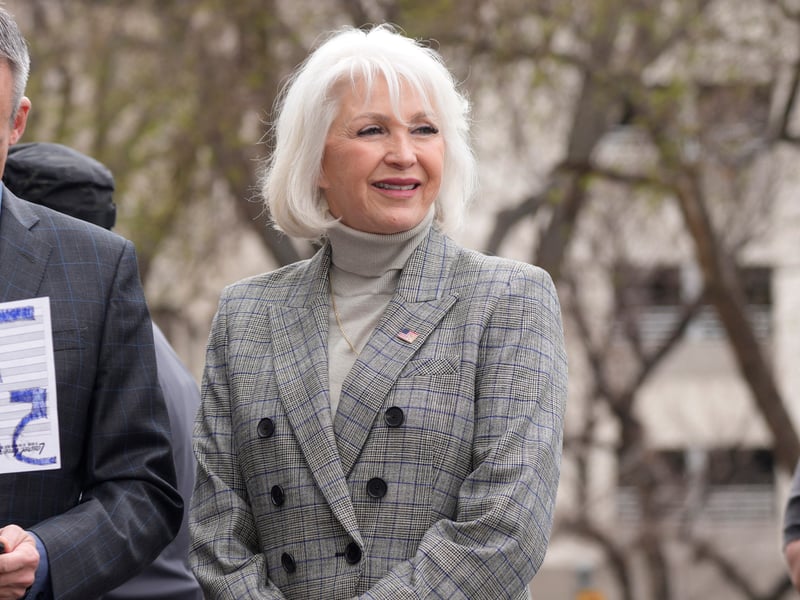
DENVER (CN) — The Colorado Court of Appeals on Thursday vacated a contempt citation against former Mesa County Clerk and Recorder Tina Peters, after finding insufficient evidence to support the claim that she violated a court prohibition on recording in the courtroom in 2022.
“Peters is correct that the contempt judgment lacks several required findings, without which it cannot stand,” wrote Court of Appeals Judge Stephanie Dunn in a 9-page opinion.
Prosecutors said that in May 2021, Peters instructed her deputy clerk Belinda Knisley to turn off security cameras and then arranged for an associate to observe and photograph the voting machine trusted build, an update process conducted in person since the machines can’t connect to the internet.
Peters then reportedly sent data and passwords to a Florida-based company for analysis and allowed them to be posted on the social media site Telegram by Ron Watkins, a key player in the QAnon conspiracy movement.
On Feb. 7, 2022, before the district attorney’s office filed charges against Peters, she attended a court hearing in support of Knisley. During the hearing, the district attorney’s staff told 21st Judicial District Judge Matthew Barrett they saw Peters recording the proceeding on an iPad. At the time, prosecutors claimed, Barrett had issued a decorum order prohibiting recording and relayed the information by posting a sign on the courtroom door.
The next day, law enforcement seized the device from Peters. On Feb. 24, 2022, the district attorney’s office filed to cite Peters for contempt. Following Barret’s recusal, Fifth Judicial District Chief Judge Paul Dunkelman presided over Peter’s 2023 contempt trial and ultimately ordered her to pay a $1,500 fine.
Peters appealed the contempt conviction, arguing the DA’s office failed to meet its burden of proof by not presenting the court order, or the door sign, announcing the prohibition on recording.
Four factors are required to support punitive contempt sanctions under Colorado law: an order must exist, which the defendant must be aware of, be capable of following, and then intentionally disobey.
The Court of Appeals agreed with Peters, finding the lower court failed to establish that an order prohibiting recording in the court existed at all, much less that Peters purposefully violated it.
“It’s unknown what the sign said or whether it was a court order,” Dunn wrote. “Thus, the record is devoid of any evidence about the existence, scope, or content of the court order that Peters allegedly violated.”
Court of Appeals Judge Christina Gomez and Senior Judge Daniel Taubman concurred. All three members of the appellate panel were appointed by Democratic governors: Gomez by Jared Polis, Dunn by John Hickenlooper and Taubman by Bill Ritter.
In an email, 21st Judicial District Attorney Dan Rubinstein said he disagreed with the opinion, but didn’t see a benefit in appealing.
“I believe they failed to understand the trial judge’s ruling. The trial court found, beyond a reasonable doubt, that Ms. Peters was in contempt for lying to Judge Barrett,” Rubinstein wrote. “The appellate court incorrectly confused that with a finding of contempt for recording proceedings in violation of the order prohibiting the recording.”
Peters’ attorney, John Case, did not immediately respond to an inquiry for comment, and represents her on appeal of the nine-year prison sentence Barret imposed after a jury found her guilty of four felonies and three misdemeanors related to leaking voting machine data following the 2021 Grand Junction municipal election.
 Follow @bright_lamp
Subscribe to our free newsletters
Our weekly newsletter Closing Arguments offers the latest about ongoing trials, major litigation and rulings in courthouses around the U.S. and the world, while the monthly Under the Lights dishes the legal dirt from Hollywood, sports, Big Tech and the arts.