
 Search Articles


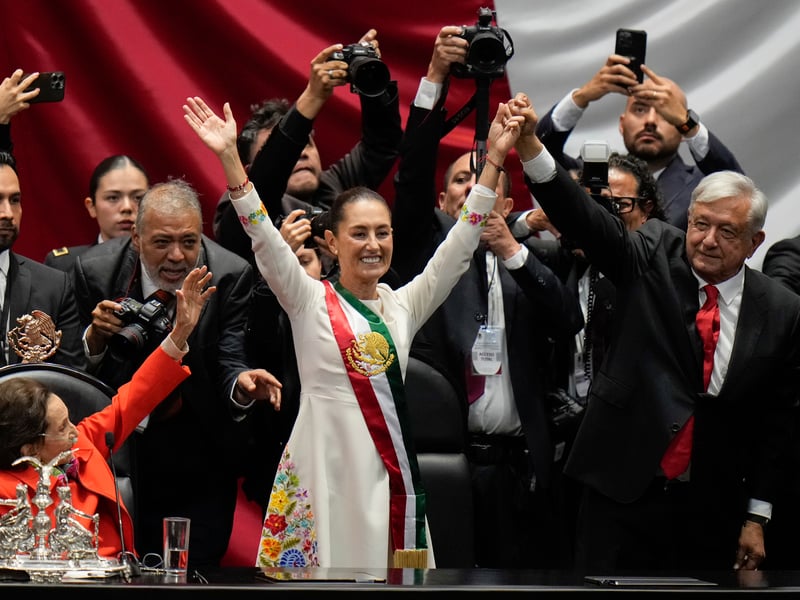
MEXICO CITY (CN) — Mexico’s first female president Claudia Sheinbaum was sworn in Tuesday at the Congress of the Union in Mexico City amid applauding shouts of “presidenta.” The former Mexico City mayor and climate scientist took office after she won a landslide election, and her Morena party secured a super-majority in Congress in June.
After welcoming presidents and other politicians who joined the ceremony from abroad, Sheinbaum praised former President Andrés Manuel López Obrador as one of the greatest social justice fighters in the history of modern Mexico.
Sheinbaum then remarked on the historic day.
“On June 2, 2024, the people of Mexico said it is time for transformation — and one by women,” Sheinbaum said in her first message to the country Tuesday. “After 200 years of the republic, for the first time, we women come to lead the destinies of our beautiful nation. And I say ‘we arrived’ because I do not arrive alone; we all arrived.”
Sheinbaum inherits significant hurdles from her predecessor. How she will govern an indebted oil-producing nation amid a surge of violence in the northern part of the country and manage two controversial constitutional reforms passed in the final month of López Obrador’s presidency remains to be seen.
The first, a judicial reform ushered in by the Morena party, will see all of Mexico’s judges elected by popular vote. Critics say the reform could limit the judicial branch’s independence, lead to pandering to politicians and organized crime, potentially affecting international investment.
Sheinbaum defended the reform in her speech.
“The popular vote of judges and magistrates means more independence and autonomy for the judicial power,” she said. She also assured investors that their investments were safe in Mexico.
“Sheinbaum will need to figure out the allocation of these resources. How are the elections going to be run? She needs to be careful of who is going to be elected but she needs to be impartial in the process,” said Terry Cárdenas Banda, a law professor at Technical and Higher Education Center in Mexicali, during a phone interview Monday. “Sheinbaum’s mandate is to maintain independence in the three powers [of government].”
Though Cárdenas Banda doesn’t support the reform, she doesn’t see that it will cause major issues in the short term concerning investment and is optimistic about Mexico’s labor pool when it comes to nearshoring.
“We have many systems to protect investors, we have treaties to protect investors and that’s not going to decrease because of the judicial reform,” Cárdenas Banda said.
The second reform, passed Sept. 25, puts Mexico’s National Guard under military command, giving more power to the military to perform everyday security tasks.
“With the continuous militarization of public security, we will see constant and very serious human rights violations like forced disappearances, and other abuses of force by the military,” said Jacques Coste, a historian and columnist for Expansión Politica, during a phone interview Monday.
Coste believes López Obrador has ushered in a dangerous shift in Mexican politics, one that will become stronger under Sheinbaum, who he says will continue López Obrador’s rhetoric that glorifies the military.
“When Andrés Manuel López Obrador became president, analysts and intellectuals on the left seemed to think that since Mexico has a left-wing president for the first time in a long time they should avoid criticizing him, so as not to [give more help] to the right,” he said. “A lot of left-leaning groups who were demonstrating against militarization before are actually celebrating the militarization of the National Guard now.”
Coste says he is worried about the rise of “military–entrepreneur elite.”
“If the military is acting as ordinary security for government tasks then we should treat it as such, like another public institution and then we need to scrutinize the army as we do the rest of our public institutions,” Coste said.
In perhaps one of the largest departures from her predecessor, Sheinbaum is expected to boost renewable energies and energy efficiency through the construction of photovoltaic, wind, hydraulic, geothermal and green hydrogen plants, and by promoting solar panels and solar heaters on roofs of homes and commercial areas.
“It is in the interest of all of us to promote energy efficiency in the state’s public energy companies for current and future generations,” Sheinbaum said.
Sheinbaum was responsible for updating electric bus infrastructure during her mayoral term in Mexico City, and for installing one of the world’s largest urban solar plants on top of the city’s massive food warehouse and market, something she has a desire to continue, specifically in the north and southeast of the country where solar energy can be harnessed most effectively.
“I am a mother, grandmother, scientist and woman of faith. And as of today, by the will of the people of Mexico, the constitutional president of the United Mexican States,” Sheinbaum said to conclude her speech.
Sheinbaum later gave her first public speech as president on Tuesday to thousands of energetic supporters who filled Mexico City’s Zócalo, or public square, and much of downtown. In her speech, she outlined every one of her 100 steps toward the fourth transformation.
The fourth transformation was López Obrador’s presidential promise to transform the country after the first three transformations in Mexico’s modern history: the Mexican War of Independence, the Reform War and the Mexican Revolution. Sheinbaum has vowed to continue this fourth transformation as president.
“My hope is that she continues the fourth transformation that is continuing to change the power structure from every angle. For this, we are here to support her, because we believe she will continue the fourth transformation started by Obrador,” said Sheinbaum supporter Martha Adriana Ramiréz Barrientes in the Zócalo.
“I am 90 years old, it is God’s miracle that that this transformation is happening while I am still here. I listened to the President’s speech [this morning]. Everything she said is purely for building our country. There is nothing that worries me. It’s been 90 years until I can finally enjoy this moment. Imagine, 90 years waiting for this moment. This for me is wonderful,” said Jesús Cecilio Rivera Vega in the Zócalo.
Subscribe to our free newsletters
Our weekly newsletter Closing Arguments offers the latest about ongoing trials, major litigation and rulings in courthouses around the U.S. and the world, while the monthly Under the Lights dishes the legal dirt from Hollywood, sports, Big Tech and the arts.