
 Search Articles


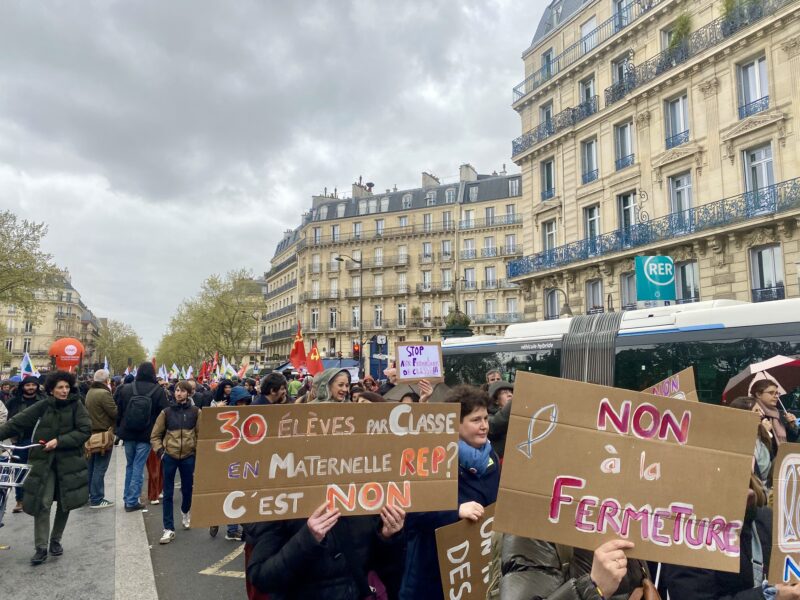
PARIS (CN) — Thousands of teachers marched Tuesday afternoon against the backdrop of Paris’ Jardin du Luxembourg, wielding picket signs and shouting chants denouncing precarious working conditions.
In typical French protest fashion, the mood was jovial; Queen’s “We Will Rock You” echoed throughout the streets, and small groups smiled while chatting amongst themselves. But the underlying motives were serious — teachers painted a picture of degrading working conditions, unmanageable class sizes and a system making their jobs harder. They said it’s also impacting the lives of young students.
“I’m here because the national education system has no more money, and it’s the basis of society,” Garcia del Rio, a geography teacher, explained during the march. “They’re not giving any more money and classes are getting bigger — those who are very scholarly can get through, but not the others.”
French Prime Minister Sébastien Lecornu successfully passed a 2026 budget — a mission that took down his two predecessors — after months of negotiations. The nation is struggling with burgeoning debt, which stood at $4 trillion, according to the national statistics bureau in December 2025 — or 117.4% of GDP. Part of the plan includes cutting 4,018 teaching positions throughout the school year, most of which will impact the public sector.
Lecornu framed the narrative as something positive, without addressing the loss of jobs.
“In the national education system, 2,000 additional positions will be created, particularly to accommodate children with disabilities,” Lecornu said in a speech in January.
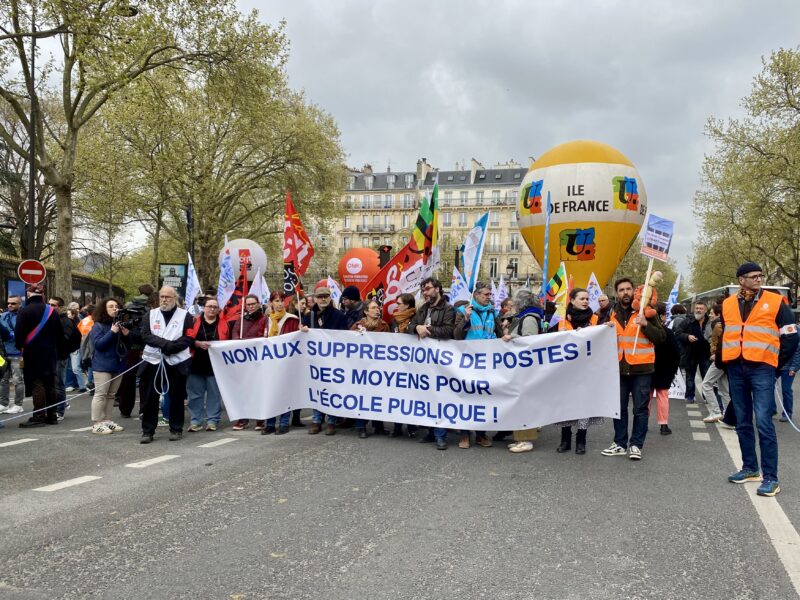
On Tuesday, some of France’s biggest unions — the FSU, Unsa, CFDT, CGT and SUD — organized a national strike amid a general week of action to denounce the new measures. The Ministry of Education and the unions disagree on the turnout; the ministry estimated roughly 10% of teachers were striking, while the unions estimated the number was closer to 25%.
Jérôme, a primary school teacher and member of the CFDT union who asked to go by his first name, attended the protest in Paris. In his view, the job cuts will force class sizes to expand in a landscape is already stretched thin. According to a report published by the French Ministry of Education’s DEPP in 2022, the average class size for junior high students was 26. The EU average was under 21.
“They’re running out of money and they need to make savings, they need to find money,” Jérôme said. “And we think there are other ways to find money, so we’re fighting against this point of view.”
Jérôme has 25 students in his class size. He said this already poses particular problems for students with disabilities and those struggling in class; when the group is too big, the teacher has to cut straight to the point, and some children can be left on the sidelines as a result.
“We want the government to listen to us,” he said. “We still live in a democracy and we can say when we don’t agree with our government, so we take that opportunity.”
Del Rio expressed similar concerns.
“In a class of 30 students, I can’t really help a student who’s struggling,” he said.

In some teachers’ experiences, the effects of overcrowding are already manifesting. Séverine Gaultier, who teaches disabled students in the Parisian suburb of Montreuil, said she’s already noticed a decline in students’ ability to read in recent years.
“The big story is that kids aren’t succeeding with reading anymore,” she said. “Then the difficulties accumulate.”
Gaultier added that from a services standpoint, working-class neighborhoods don’t benefit from the same facilities as more affluent areas. Some neighborhoods don’t have nurses at the high schools, for example.
Del Rio emphasized the same worries. He said over the eight years he has been teaching, he’s watched building infrastructure progressively fall apart — something he doesn’t think would happen in the city center.
“More and more I’ve seen buildings with leaks, electrical problems, heating problems … It’s very cold in the winter and very hot in the summer,” he said.
He compared those conditions with a prestigious urban high school.
“It’s mostly working-class neighborhood schools. … At Henri IV in Paris, you can rest assured that there will be air conditioning when it’s too hot,” he said.
Last summer, his school had to temporarily close during a heat wave. In terms of teachers, Del Rio described a landscape where jobs seemed secure in recent years; that is no longer the case.
“More and more we see that everyone has to fight to keep their jobs,” he said. “When I started it wasn’t a question.”
Corine Sagnier, a teacher who has lived in Paris since the 1980s, also sees a concerning social divide.
“It’s a big sociological difference, the money given to kids in public schools versus private schools,” she said. “This is all catastrophic … The budget law will give even less financing to public schools, and will shut them down.”
 Follow @lilyradz
Subscribe to our free newsletters
Our weekly newsletter Closing Arguments offers the latest about ongoing trials, major litigation and rulings in courthouses around the U.S. and the world, while the monthly Under the Lights dishes the legal dirt from Hollywood, sports, Big Tech and the arts.

