
 Search Articles


CHICAGO (CN) — A group of Illinois immigration detainees and local activists filed a class action against federal immigration authorities on Thursday over what they describe as deplorable conditions at the Broadview immigration processing facility.
The group wrote in its 76-page complaint that the Broadview processing facility, located just around 10 miles from downtown Chicago, quickly became a “black box” where federal immigration authorities disappeared people from U.S. justice and immigration systems since the start of “Operation Midway Blitz.” The group of detainees and activists is represented by the MacArthur Justice Center, the ACLU of Illinois and the Chicago office of Eimer Stahl.
Federal immigration authorities historically used the Broadview facility as a processing center where detainees were held for a few hours before they were transferred to a larger detention facility. But since the start of the Trump administration’s crackdown on immigration enforcement, people have been held at the Broadview facility for days on end, without any way of contacting their families or their attorneys.
“Defendants’ officers have a policy and practice of threatening and coercing detainees to sign forms consenting to their being sent out of the country without appearing before an immigration judge and otherwise waiving their legal rights,” plaintiffs wrote in the class action. “The objective of this policy and practice is to expel as many detainees out of the country as quickly as possible.”
Detainees also say officers at the Broadview facility falsely translated a departure form designed to trick detainees into self-deportation. Beyond the due process violations, they claim they were forced into overcrowded cells with people packed together like sardines, without sufficient food, water and privacy. The detainees added that the lights are on all night and they are provided with no sleeping mats, blankets or pillows, which makes sleep deprivation almost certain.
“The physical conditions are filthy, with poor sanitation, clogged toilets and blood, human fluids and insects in the sinks and the floor,” the complaint states. “Due to the overcrowding, unhygienic conditions, lack of medical care and deprivation of adequate food, the facility is a breeding ground for illness to spread.”
One of the more disturbing accusations is that officers failed to provide medical care or clean up after one detainee vomited and another defecated in his pants. Detainees described the processing facility as putrid and filthy, in part because they are routinely denied showers, basic hygiene items and menstrual products.
“This lawsuit is necessary because the Trump administration has attempted to evade accountability for turning the processing center at Broadview into a de facto detention center,” Kevin Fee, legal director of the ACLU of Illinois, said in a news release. “DHS personnel have denied access to counsel, legislators, and journalists so that the harsh and deteriorating conditions at the facility can be shielded from public view. These conditions are unconstitutional and threaten to coerce people into sacrificing their rights without the benefit of legal advice and a full airing of their legal defenses.”
Members of Congress tried to visit the Broadview facility in June, and then again when the immigration crackdown began, but they were repeatedly denied access. Faith leaders and members of the clergy who historically provided pastoral care to Broadview detainees were also prohibited from entering the facility. Even detainees’ family members have been denied entry to the facility.
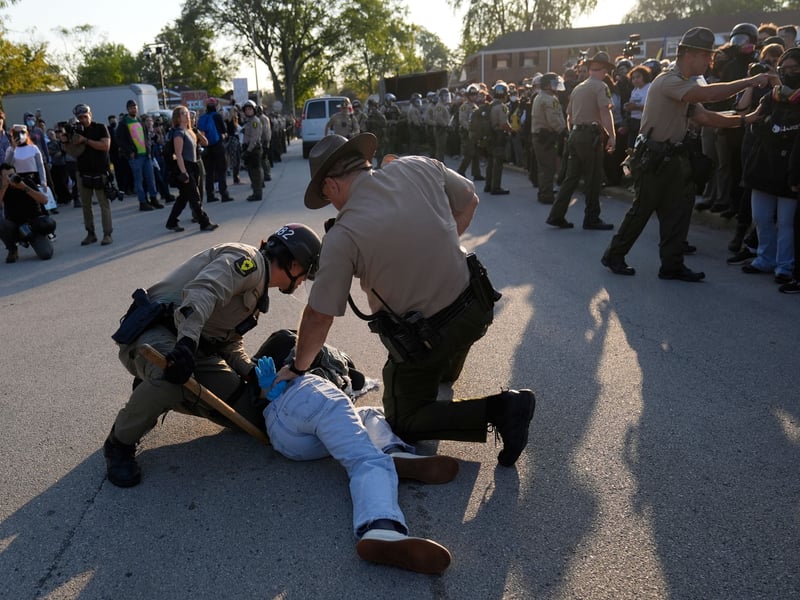
The Broadview immigration processing facility has been a powder keg since protesters started appearing outside the center when the enforcement operation began in September. Faith leaders and activists gathered outside of the facility to peacefully protest and were met with brute force by federal law enforcement officials.
“They have launched tear gas and pepper spray on protesters, lawyers, religious leaders, elected officials and journalists, shot pepper balls and rubber bullets into the crowd, pointed rifles at unarmed individuals, including legal observers and attorneys, and thrown individuals on the asphalt,” the group wrote in the complaint.
As a result of the force exhibited by federal law enforcement at the Broadview facility, U.S. District Judge Sara Ellis issued a temporary restraining order on Oct. 9 barring officers from using tear gas or other nonlethal munitions against peaceful protesters, clergy members or journalists.
Ellis soon had to call federal immigration authorities — including Border Patrol Commander Gregory Bovino — before her after a series of violations of her order, which included tear gassing a residential neighborhood just moments before a children’s costume parade was set to pass through.
She went over the stipulations of her order with Bovino to ensure he and his agents understood when use of force was appropriate. She also required Bovino to appear before her everyday at 5:45 p.m. to give daily reports of his enforcement activities, which the Seventh Circuit stayed.
 Follow @RosenCaitlyn
Subscribe to our free newsletters
Our weekly newsletter Closing Arguments offers the latest about ongoing trials, major litigation and rulings in courthouses around the U.S. and the world, while the monthly Under the Lights dishes the legal dirt from Hollywood, sports, Big Tech and the arts.