
 Search Articles


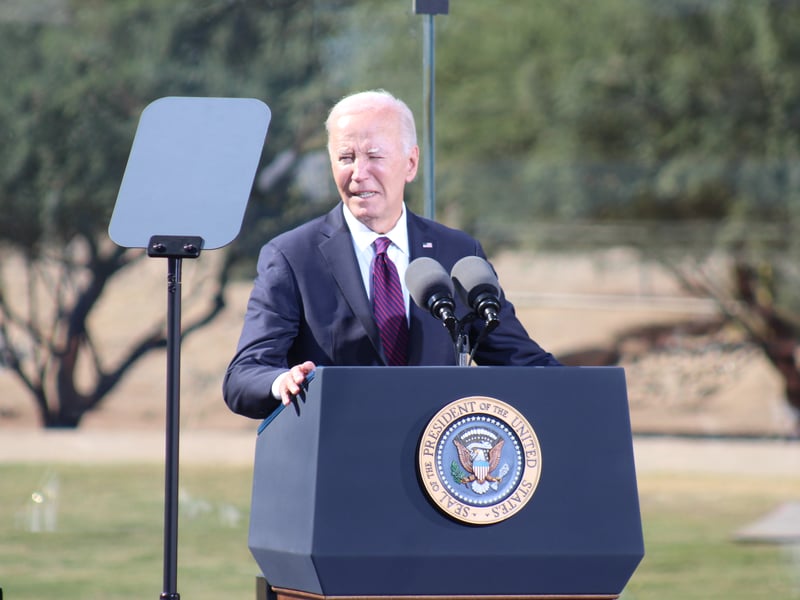
PHOENIX (CN) — President Joe Biden’s $15 minimum wage for government contractors violates federal law, a Ninth Circuit panel declared Tuesday, creating a rift between the court and another in the federal appeals circuit that approved the mandate six months ago.
Nearly two years after an Arizona trial judge dismissed a challenge from five states to Biden’s 2021 executive order, the appellate panel reversed course, finding that Executive Order 14026, which established a $15 minimum wage for all government-contracted work, more than doubling the federal minimum for roughly one-fifth of America’s workforce, exceeds the power granted to Biden under the Federal Property and Administrative Services Act of 1949.
The 61-page opinion written by Donald Trump-appointed U.S. Circuit Judge Ryan D. Nelson and joined by fellow Trump appointee U.S. Circuit Judge Danielle Forrest runs contrary to the 10th Circuit’s opinion on the same issue: In April, a three-judge panel in Colorado found that the mandate falls within guidelines set by the 1949 act, otherwise known as the Procurement Act.
Given the circuit split, it’s unclear how the Arizona case will now progress, but the U.S. Supreme Court may have to settle the dispute.
The act in question gives the president power to streamline federal procurement of work contracts to increase efficiency and coordination across government agencies. It permits the president to “prescribe policies and directives that the president considers necessary to carry out.”
But the president must establish legislative authority to carry out those actions, which attorneys general for Arizona, Idaho, Indiana, Nebraska and South Carolina said Biden didn’t do.
“True, the president may enjoy a modest valence of necessary and proper powers surrounding those powers enumerated in the statute. But before he can wield this necessary and proper power, he must show that it derives from an enumerated power,” Nelson wrote.
“In short, it does not give the president unrestrained authority to issue any procurement policy that he desires,” he continued. The president can only use it to issue a policy that carries out an operative provision of the FPASA.”
Minimum wage bump challenged
Biden issued the executive order after his proposal to increase the federal minimum wage to $15 in a Covid-19 relief package was rejected by a 42-58 vote in the U.S. Senate. The Department of Labor supported Biden by issuing a final rule implementing the mandate.
The states’ February 2022 challenge followed, accusing Biden and the Department of Labor of violating both the Procurement and Administrative Procedures Acts.
The Ninth Circuit panel agreed with the states, finding that the Procurement Act doesn’t authorize wage mandates, comparing it to specific federal statutes establishing prevailing wages for certain contractors.
“This is exactly the kind of statutory language we look for to determine whether Congress authorized such a policy. And this is the kind of language that does not exist in the FPASA,” Nelson wrote.
The panel also found that the Department of Labor violated the Administrative Procedures Act by failing to consider alternatives to implementing the wage mandate.
“DOL admits that it did not consider modifying the amount of the minimum wage rate, changing the effective date for the wage rate, or phasing in the wage rate over a number of years despite receiving comments with these suggestions,” Nelson wrote.
Dissenting from the majority, U.S. Circuit Judge Gabriel Sanchez, a Joe Biden appointee, said the Labor Department considering any other rule would run in direct violation of Biden’s order.
Sanchez said Biden’s order is within the scope of the Procurement Act because the law gives the president authority to direct agencies to make specific decisions regarding details of federal contracts. The dissenting judge framed the order differently than his Republican-appointed counterparts, explaining the order as one that directs federal agencies to enter contracts only with companies that agree to pay their employees at least $15 per hour.
Biden’s mandate applied to recreation companies with U.S. Forest Service special-use permits, sparking a lawsuit from river rafting groups in Arkansas and Colorado in December 2021. A trial judge denied their motion for summary judgment, and a 10th Circuit panel affirmed the decision, reasoning that higher wages promote economic efficiency by boosting worker productivity, health and morale.
Donald Trump-appointed U.S. Circuit Judge Allison Eid penned a 19-page dissent warning that the Procurement Act appears unconstitutional, likely running afoul of the nondelegation doctrine.
Arizona’s Democratic Attorney General Kris Mayes didn’t join in the appeal alongside the four other states — she took over in 2022 for Republican Mark Brnovich who originally joined the suit — and declined to comment on Tuesday’s opinion.
Neither the Department of Justice nor the Department of Labor has replied to requests for comment.
 Follow @JournalistJoeAZ
Subscribe to our free newsletters
Our weekly newsletter Closing Arguments offers the latest about ongoing trials, major litigation and rulings in courthouses around the U.S. and the world, while the monthly Under the Lights dishes the legal dirt from Hollywood, sports, Big Tech and the arts.