
 Search Articles


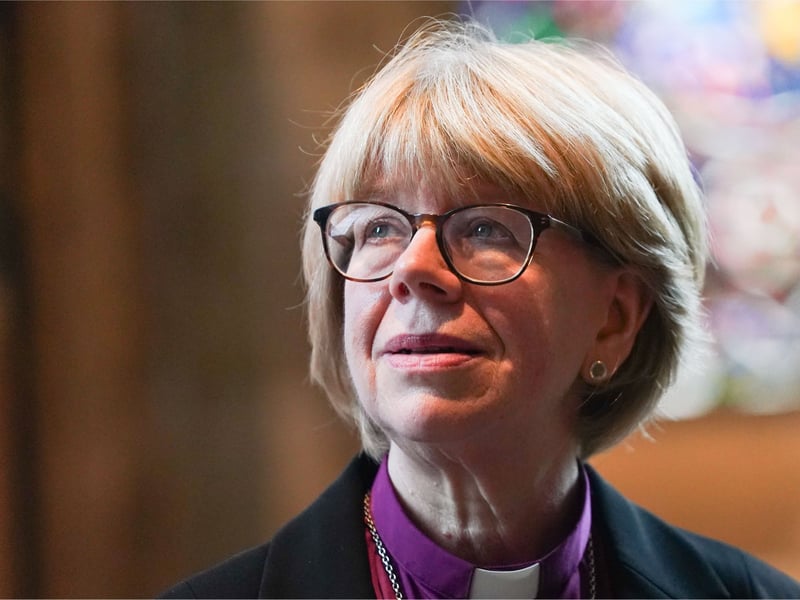
MANCHESTER, England (CN) — When Bishop Sarah Mullally stood before the altar of Canterbury Cathedral earlier this month, she acknowledged the weight of history as she broke the stained-glass ceiling.
“Some will be asking what it means for a woman to lead the Church of England, and to take on the Archbishop of Canterbury’s global role in the Anglican Communion,” she said. “I intend to be a shepherd who enables everyone’s ministry and vocation to flourish, whatever our tradition.”
Her appointment marks the first time in more than 1,400 years that a woman will hold the church’s most senior post. She succeeds Justin Welby, who resigned last year amid criticism of the Church’s handling and cover-up of historical abuse cases.
An independent review found the church covered up decades of abuse of as many as 130 boys and young men in Britain, South Africa and Zimbabwe.
The politics of Mullally
Mullally, 63, began her career as a nurse before becoming England’s Chief Nursing Officer, advising the government. She later trained for ministry and rose quickly, becoming Bishop of London in 2018 — then the most senior woman in the Church of England.
Considered part of the church’s liberal wing, Mullally calls herself a feminist and has expressed support for abortion rights, saying, “if it were a continuum I would be somewhere along it moving towards pro-life when it relates to my choice and then enabling choice when it related to others."
She has also backed LGBT+ History Month and launched an advisory group to promote inclusion in church communities.
Just before becoming Bishop of London, Mullally said, “It is a time for us to reflect on our tradition and scripture, and together say how we can offer a response that is about it being inclusive love.”
In her address at Canterbury, she spoke of the current uncertainty in the world, calling for leadership rooted in compassion.
“In the apparent chaos which surrounds us, in the midst of such profound global uncertainty, the possibility of healing lies in acts of kindness and love,” she said.
“Given the many struggles of our Church and of societies here and around the world, I am often asked where I see hope. I have the privilege to see hope in communities, chaplaincies and churches in the Church of England and across the wider Anglican Communion.”
She added, “I see thousands of churches running food banks and homeless shelters. I see hospitals and prison chaplains caring for people and families in times of desperation. I see Church of England schools educating a million children across this country.”
She also promised to make safeguarding a priority, addressing what she called a legacy of deep harm and mistrust.
“As Archbishop, my commitment will be to ensure that we continue to listen to survivors, care for the vulnerable and foster a culture of safety and well-being for all,” she said. “Safeguarding is everyone’s business. But for those of us in senior leadership, it carries an added weight of accountability.”
A divided community
The appointment has been praised in Britain as a milestone for gender equality, but has drawn criticism from parts of the 85 million-member Anglican Communion.
Conservative factions have threatened to break away if the church continues moving toward greater inclusivity, while others warn that its historic anti-LGBT stance risks alienating people.
The Church has wrestled with gender and sexuality issues for decades. It opposed legalizing same-sex civil partnerships in 2004 and same-sex marriage in 2013. Though it later accepted civil partnerships, it still bans same-sex weddings in its churches.
The church allows openly gay clergy to be in relationships but requires them to remain celibate.
In the U.S., Sean Rowe, leader of the Episcopal Church, welcomed the decision, calling Mullally “a wise and steady leader” and “a faithful advocate for safeguarding and the leadership of women.”
The Anglican Church of Australia, which doesn’t recognize the ordination of women, expressed disappointment, saying in a statement that Mullally had “strayed from the clear teaching of scripture.”
In parts of Africa, the response has been sharper. The church of Nigeria announced it would cut ties with Canterbury following the “devastating” appointment.
Its leader, Henry Ndukuba, said it was insensitive to the majority of Anglicans “who are unable to embrace female headship” and criticized her support for same-sex marriage.
Rwanda Archbishop Laurent Mbanda said the decision “abandons global Anglicans,” adding that the majority of the global community still believes in a male-only head of church.
James Croft, University Chaplain at Sussex, called the appointment both significant and revealing, with the backlash serving “a reminder of how deeply embedded sexism remains in our society and in many religious traditions.”
Mullally now faces the challenge of bridging the divide between the church’s progressive and conservative wings while rebuilding trust after years of scandal.
Save the Parish, a grassroots group that promotes local church involvement, welcomed her appointment and praised her work redirecting millions of pounds to struggling communities.
Faith and power in England
The Church of England remains embedded in Britain’s constitution even as attendance falls.
King Charles III is its supreme governor, and 26 bishops — the Lords Spiritual — sit in the House of Lords. Yet that link between church and state increasingly clashes with a more secular population.
Fewer than half of people in England and Wales identified as Christian in the 2021 census, down from 59% in 2011. A recent survey found only 28% believe in a god, while 38% say they have no religion.
Mullally’s appointment has broad support: a YouGov poll found 77% of Britons say it doesn’t matter whether the archbishop is a man or a woman.
While supporters hope she can help rebuild trust after years of division and scandal, critics warn her leadership could deepen rifts over gender and sexuality within the Anglican Communion.
Courthouse News reporter James Francis Whitehead is based in England.
 Follow @jayfranklinlive
Subscribe to our free newsletters
Our weekly newsletter Closing Arguments offers the latest about ongoing trials, major litigation and rulings in courthouses around the U.S. and the world, while the monthly Under the Lights dishes the legal dirt from Hollywood, sports, Big Tech and the arts.