
 Search Articles


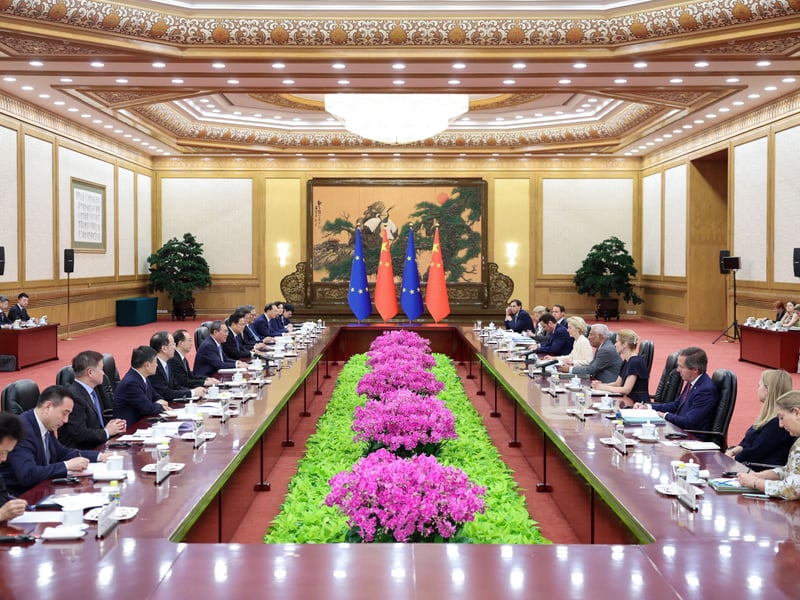
BRUSSELS (CN) — European Union leaders confronted an uncomfortable truth Thursday during their summit with Chinese President Xi Jinping: Europe cannot meet its 2030 climate goals without China, even as Beijing’s dominance over critical materials poses growing economic and security risks.
The paradox defined a one-day meeting that produced a joint climate statement while exposing deep tensions over trade. European Commission President Ursula von der Leyen and European Council President António Costa demanded “rebalancing” of a relationship that has Europe running a 305.8 billion-euro ($338 billion) trade deficit with China in 2024, according to Eurostat data.
The math is unforgiving. China controls 46% of EU rare earth imports overall, 79% of gallium imports and 38% of natural graphite imports, according to Eurostat. For heavy rare earth elements, China maintains complete control: a 100% monopoly, per EU sources.Von der Leyen recently sharpened her rhetoric toward Beijing, publicly demanding greater market access alongside an end to export restrictions on essential materials.
“We know that our trade relationship today needs more balance,” von der Leyen said after meeting Chinese Premier Li Qiang. “Rebalancing is a necessity.”
“The European Union’s trade deficit with China has doubled in the last decade. So we have reached a clear inflection point,” von der Leyen told reporters after the summit.
She emphasized Europe’s approach: “Europe welcomes competition. We like competition, but competition has to be fair.”
China’s export restrictions are part of a broader pattern. The Center for Strategic and International Studies, a Washington D.C.-based think tank, reports Beijing has restricted exports of at least 16 key minerals and alloys as of May, targeting materials essential for products ranging from consumer electronics to military equipment.
“It’s the curse of the European Union,” Antoine Oger, executive director of the Institute for European Environmental Policy, told Courthouse News Thursday. “It’s a very significant market, but it’s very poor in terms of domestic resources.”
“If [the EU has] any chance of meeting its climate objectives, it needs cheap materials from China,” Oger said. “It’s entirely paradoxical. It’s completely contradictory, technically.”
Earlier this month, the EU’s executive branch formally proposed amending the EU Climate Law to enshrine a 90% reduction in carbon emissions compared to 1990 levels. The target would be a crucial stepping stone toward the bloc’s goal of carbon neutrality by 2050 and would require cutting emissions to roughly one-sixth of current levels within 15 years.
Xi pushed back against European criticisms, telling the visiting EU leaders that “the current challenges facing Europe do not come from China,” according to state news agency Xinhua. He urged the EU to “adhere to open cooperation and properly handle differences and frictions” while warning European leaders to “make correct strategic choices.”
Despite this, the summit’s focus on economics left little room for other diplomatic concerns. The EU made only brief mentions of human rights in Xinjiang and Tibet, plus concerns about Taiwan tensions.
Von der Leyen confronted Xi in the news conference: “How China continues to interact with Putin’s war will be a determining factor for our relations going forward.” Costa directly called on Beijing “to use its influence on Russia to respect the U.N. Charter and to bring an end to its war of aggression against Ukraine.”
Climate deal amid trade war
The summit produced one concrete outcome: a joint climate statement that both leaders hailed as significant progress.
“We had a common statement at the end of the EU-China summit, which was not a given just a few hours ago,” Oger noted. “The discussions went somewhere, but it’s solely focused on climate issues.”
According to the official EU news release, the agreement includes a crucial commitment: China pledged to submit for the first time a comprehensive emissions reduction target for 2035 covering “all economic sectors and all greenhouse gas emissions.”
“This is for the first time,” Oger emphasized. “These are significant developments.”
Both sides also committed to “working with all parties to support Brazil in hosting a successful 30th Conference of the Parties to the UNFCCC (COP30).”
The EU noted its share of global emissions dropped to 6% and committed to reducing it to 4% by 2030, while encouraging China to propose ambitious 2035 reduction plans.
But Oger offered a realistic assessment of the agreement’s immediate impact: “We are still in the wishful thinking realm because we don’t have updated [emissions targets]. But it opens the door for future negotiations.“The climate cooperation reflects mutual dependence that extends beyond environmental goals. The EU imported 19.7 billion euros ($21.8 billion) worth of solar panels in 2023, with 98% from China, according to Eurostat.“You need China as a cheap source of materials and products,” Oger explained. “But China very much needs the EU market as an export destination, especially now that the U.S. is somewhat closing its own market.“This creates a “very careful conversation” between the two powers.The official bilateral trade relationship reached 730 billion euros ($807 billion) in 2024. Europe’s manufacturing dependence runs deep, with manufactured goods accounting for 96.7% of total EU imports from China, according to Eurostat.Europe’s high-tech manufacturing sector, valued at 355 billion euros ($393 billion) in 2022, faces mounting pressure. While Europe leads in pharmaceutical production, it trails in electronics-telecommunications manufacturing, creating strategic vulnerabilities.
Climate progress adds urgency to these dependencies. EU data shows the 27-nation bloc achieved a 37% reduction in greenhouse gas emissions below 1990 levels in 2023, but it must reach 55% by 2030.
The timing reflects broader geopolitical shifts. President Donald Trump’s return has led to higher U.S. tariffs for both powers, pushing Beijing to seek closer European ties while Europe remains cautious about appearing too close to China.
China’s approach reflects deeper strategic calculations. Despite appearances of seeking global leadership, Beijing prioritizes domestic economic rebalancing over replacing American influence worldwide, with Chinese leaders focusing on their neighborhood and commercial opportunities rather than global security responsibilities.
European negotiators pushed for immediate processing of rare earth license applications, longer-term export agreements and complete removal of licensing requirements. Chinese officials offered no firm commitments on trade issues.
The joint climate statement included language about “facilitating access” to critical materials, which might indicate Chinese willingness to ease export controls — though the wording remains vague.
Von der Leyen announced a concrete mechanism: “We agreed to have an upgraded export supply mechanism. In other words, if there are bottlenecks, this mechanism can immediately check and solve the problem.”
The summit’s outcome signals EU-China relations are entering a new phase where climate cooperation may provide the only stable foundation for engagement amid growing economic competition. While both sides emphasized potential for collaboration, the fundamental tensions over trade, technology and strategic autonomy remain unresolved.
For European leaders, the challenge is managing relationships with both China and the United States while protecting European economic interests and democratic values.
The climate agreement offers a framework for continued engagement, but as Oger noted, “it leaves the door open, but without many concrete commitments.”
Subscribe to our free newsletters
Our weekly newsletter Closing Arguments offers the latest about ongoing trials, major litigation and rulings in courthouses around the U.S. and the world, while the monthly Under the Lights dishes the legal dirt from Hollywood, sports, Big Tech and the arts.