
 Search Articles


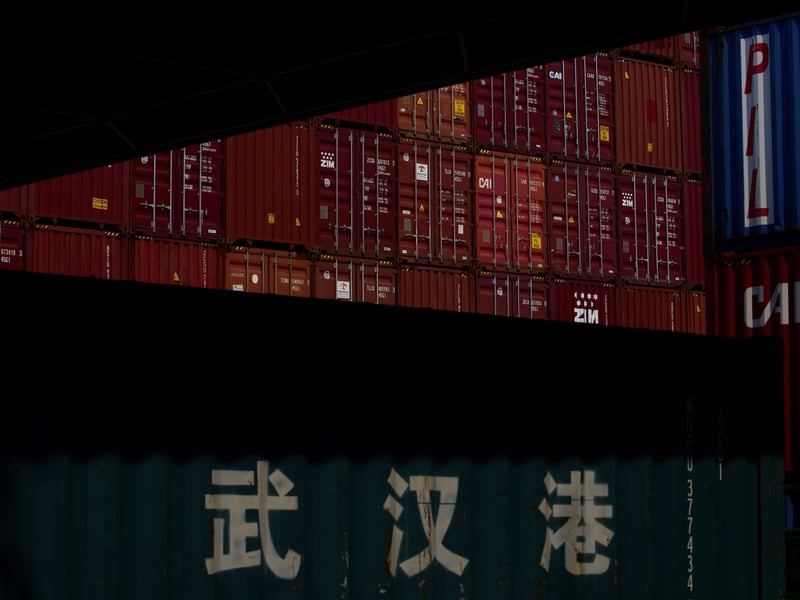
LONDON (AFP) — Chinese exports grew at a slower pace than expected in May, official figures published Monday showed, ahead of talks between Beijing and Washington aimed at easing a grueling trade war.
Imports fell more dramatically than expected last month, with weak domestic consumption in the world’s number two economy highlighted by data earlier in the day revealing another month of falling prices.
The 4.8% year-on-year increase in overseas shipments last month was slower than the 8.1% growth recorded in April, also falling short of the 6% jump that was forecast in a survey of economists by Bloomberg.
It comes as representatives from China and the United States met in London on Monday for another round of high-stakes trade talks that markets hope will ease tensions between the economic superpowers.
Monday’s reading included a 12.7% plunge in exports to the United States compared with April, when U.S. President Donald Trump unveiled his eye-watering tariffs on China.
May’s exports to the United States also represented a year-on-year decline of more than one third — the steepest slide since early 2020.
In contrast, customs data showed shipments to Vietnam increased from the previous month.
Those to other Southeast Asian countries including Malaysia, Thailand, Singapore and Indonesia all declined slightly after soaring in April, the figures indicated.
“The acceleration of exports to other economies has helped China’s exports remain relatively buoyant in the face of the trade war,” wrote Lynn Song, chief economist for Greater China at ING, noting that shipments to Southeast Asian nations were up 14.8% year-on-year.
China’s overall imports in May dropped 3.4% year-on-year, coming up short of the 0.8% decline forecast by the Bloomberg survey.
Zhiwei Zhang, president and chief economist at Pinpoint Asset Management, said the trade outlook “remains highly uncertain.” He pointed to the impact of “frontloading,” when overseas buyers increase shipments ahead of potentially higher tariffs.
Spending slump
Monday’s data added to concerns about the Chinese economy, with a report from the National Bureau of Statistics showing the consumer price index — a key measure of inflation — dropped 0.1% year-on-year in May.
The reading, which was slightly better than expected but marks the fourth straight month of falling prices, comes as Beijing struggles to boost domestic consumption that has been sluggish since the end of the pandemic.
The failure of leaders to kickstart demand threatens their official growth targets and complicates their ability to shield the economy from Trump’s tariff blitz.
While deflation suggests the cost of goods is falling, it poses a threat to the broader economy as consumers tend to postpone purchases under such conditions in the hope of further reductions.
A lack of demand can then force companies to cut production, freeze hiring or lay off workers, while potentially also having to discount existing stock — dampening profitability even as costs remain the same.
Fresh talks
The London talks will be the second set of formal negotiations between the two since Trump launched his global trade blitz on April 2.
They were announced after a phone call last week between Trump and Chinese President Xi Jinping.
China and the United States paused sky-high tariffs after the first round in Geneva in mid-May but failed to reach a sweeping trade deal.
Zichun Huang, China economist at Capital Economics, said Beijing’s export growth was expected to “slow further by year-end” with tariffs “likely to remain elevated.”
A key issue in Monday’s negotiations will be Beijing’s shipments of rare earths that are crucial to a range of goods, including electric vehicle batteries, and which have been a bone of contention for some time.
Customs figures on Monday showed Chinese exports of rare earth minerals rose last month to 6,465 tons from 5,275 tons in April.
But last month’s figure still represented a decline from May last year, when China exported 6,853 tons of rare earths.
—
By PETER CATTERALL Agence France-Presse
Subscribe to our free newsletters
Our weekly newsletter Closing Arguments offers the latest about ongoing trials, major litigation and rulings in courthouses around the U.S. and the world, while the monthly Under the Lights dishes the legal dirt from Hollywood, sports, Big Tech and the arts.