
 Search Articles


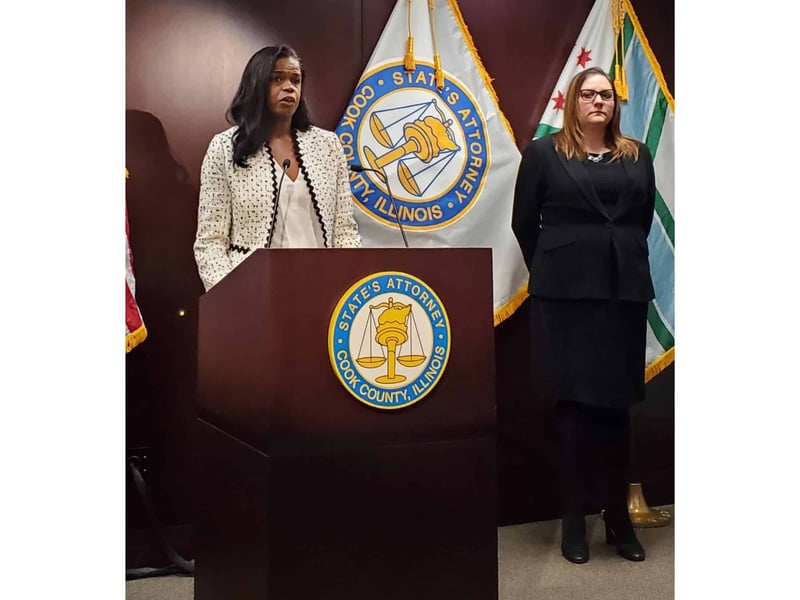
CHICAGO (CN) — Nearly two weeks after Eileen O’Neill Burke took the helm of the Cook County state attorney’s office, Chicago is still wondering how much of her predecessor’s reforms she’ll retain.
Democrat O’Neill Burke handily beat Republican Bob Fioretti in the state’s attorney race in November, taking over from Kimberly Foxx. After eight years in office, Foxx opted not to run again.
Foxx had a reputation as a progressive or reform prosecutor, while O’Neill Burke is known as more law-and-order focused. Despite the stark difference in the characterizations of the two prosecutors, some experts say O’Neill Burke has many of the same priorities as her predecessor.
Throughout her campaign, O’Neill Burke vocally supported the SAFE-T Act and a pretrial fairness act, which eliminated cash bail in Illinois.
Ed Yohnka, the communications director for the Illinois chapter of the American Civilian Liberties Union, said people are too quick to frame these issues as binary when it’s so early in O’Neill Burke’s term.
“I think there has been way too much of sort of trying to cast the progressive versus tough on crime kind of narrative,” Yohnka said.
A representative from O’Neill Burke’s office said in an emailed statement that she is promoting policy changes that prioritize public safety and victims of violent crime, but they did not offer specifics about those policy changes, nor did they mention Foxx.
Foxx’s term as state’s attorney was mired in high profile cases and public scrutiny, but she did report significant criminal justice reforms as she left her position.
Her office overturned nearly 250 wrongful convictions, created programs to offer alternatives for jail terms for non-violent offenses and expunged all 15,000 marijuana case convictions since the drug was legalized.
She faced criticism and had a tense relationship with the police union.
Stephanie Kollmann, a policy director at the Children Family Justice Center at Northwestern University’s Bluhm Legal Clinic, said much of the pushback stemmed her efforts to reform an office rife with problems.
“When Foxx came into office, the state of the Cook County state attorneys office, in particular, had for so many decades the sort of — it’s hard to even put into words — this sort of systemic gridlock and institutional racism that was really embedded in that office,” Kollmann said.
Kollmann said as the first Black woman to serve as the state’s attorney in the history of Cook County, Foxx came under more scrutiny.
Still, she said, Foxx improved transparency and successfully articulated who she wanted to target and why, though Foxx’s critics often drowned out her explanations.
The Chicago policemen’s union backed O’Neill Burke, though she quickly rejected their endorsement as “inappropriate.”
Erica Zunkel, a law professor at the University of Chicago and the director of its Criminal and Juvenile Justice Clinic, said the endorsement probably had some effect on public opinion.
“I do think that the Chicago Police and how their union feels, or how they feel about a particular candidate, I think that always gets into the headlines,” Zunkel said. “What I always come back to is, I think it’s very hard for people to talk about these issues with nuance, and unfortunately these questions of criminal justice policy and how to keep communities safe are complicated.”
Kollmann said she’s hopeful that the transparency and restorative justice reforms will remain, though she said it was too early to characterize O’Neill Burke’s vision for the office.
Some activists and legal workers say that the biggest difference between Foxx and her successor is their rhetoric about people accused of crimes.
O’Neill Burke met staunch criticism from progressives after she decreased the threshold for retail theft felonies. Under Foxx, the threshold for a felony charge of retail theft was $1,000. O’Neill Burke lowered that to $300 soon after her inauguration.
“Putting felonies on people’s records, which will make it more difficult for them to get jobs and housing in the future, doesn’t actually improve community safety,” Matt McLoughlin, a Chicago activist and legal worker, said. “Not to mention the amount of resources that are now going to be getting dedicated to these low level charges, which in the big scheme of things that the office has to handle, I would argue that these retail theft cases are the bottom of the barrel.”
Yohnka agreed that the lower threshold could mean more people face incarceration, but he maintained that it’s too early in O’Neill Burke’s tenure to make any big judgments.
Kollmann noted growing concerns that this new threshold could further burden already overworked public defenders.
“But I think the main concern is for the clients, and who is being targeted for enforcement again is such a question about whose rights are worth pretending and defending and whose interests are being centered,” Kollmann said. “Illinois does have one of the lowest thresholds for retail theft in the country, so it does seem to be a logical response to deemphasize those cases in favor of other things.”
O’Neill-Burke’s amendments to the Cook County detention policy were also met with pushback from progressives. She announced that prosecutors can seek detention for the highest classes of violent offenses, all violent offenses that occur on public transit, any offense that involves the possession or use of an assault weapon, as well as numerous domestic violence/sex offenses and crimes against children.
Zunkel said O’Neill Burke’s election is somewhat representative of the broader political landscape.
“I think the way that the country has been moving, this happened in California in this past election, there is a bit of a swing of the pendulum back to people who are not branding themselves as progressive prosecutors, people who have more small conservative goals for a prosecutor’s office,” Zunkel said.
McLoughlin said the rise in conservatism isn’t necessarily representative of Chicago, noting State Attorney Eric Rinehart’s win in suburban Lake County and State Attorney Marsha Cascio-Hale’s narrow defeat of incumbent Joe Cervantez in suburban Jackson County.
He echoed the sentiments of Yonkha and Kollmann about O’Neill Burke’s vision.
“We have to wait and see,” McLoughlin said.
 Follow @RosenCaitlyn
Subscribe to our free newsletters
Our weekly newsletter Closing Arguments offers the latest about ongoing trials, major litigation and rulings in courthouses around the U.S. and the world, while the monthly Under the Lights dishes the legal dirt from Hollywood, sports, Big Tech and the arts.