
 Search Articles


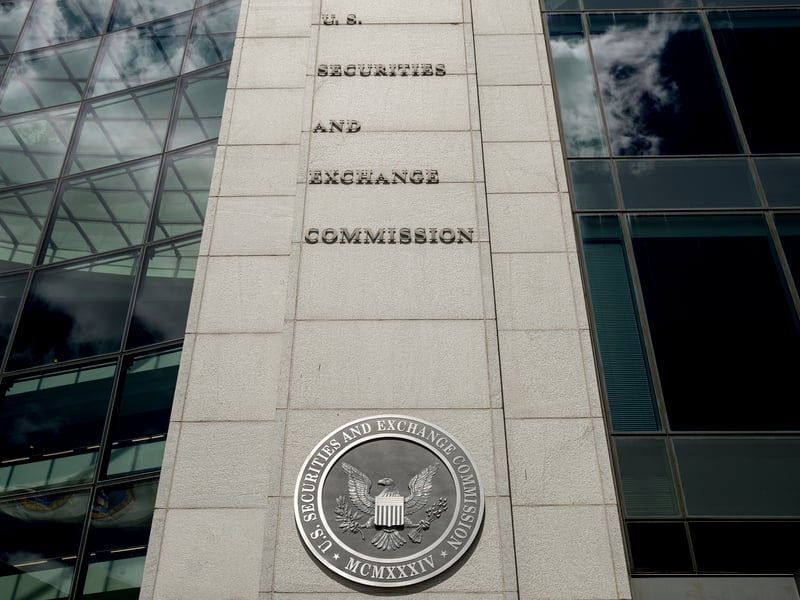
CHICAGO (CN) — Cboe Global Markets Inc. maintained before a Seventh Circuit panel Tuesday that the Securities and Exchange Commission overextended its authority when it tried to regulate one of the Chicago exchange company’s software tools.
Cboe acquired software company Silexx, which operates as an order and execution management system, in 2017. The SEC told Cboe that once it acquired Silexx, the software company would be considered a “facility” of an “exchange” and, as such, subject to regulation.
The SEC was created in 1934 through the Securities Exchange Act, with the express purpose of regulating securities exchanges after the stock market crash that precipitated the Great Depression. “The commission’s jurisdiction over ’exchanges’ is limited — by the terms of the statute — to ‘organization[s], association[s], or group[s] of persons … which ‘constitute, maintain, or provide a market place or facilities for bringing together purchasers and sellers of securities,’” Cboe Inc. noted in its opening brief.
Cboe challenged the SEC’s authority to regulate Silexx and proposed conditions to ensure independent operations between Cboe and Silexx in 2024, which the SEC swiftly rejected. Cboe’s attorney Kelly Dunbar argued before the appellate panel that the commission applied an improper legal test when it determined that Silexx was a “facility” of Cboe’s and thus subject to regulation under the Exchange Act.
“The statute in the SEC regulations ties exchange status to functionality, not corporate affiliation,” Dunbar, an attorney with D.C.-based Wilmer Cutler, said. “And under a functional test, Silexx, the software product at issue here, does not perform an exchange function.”
“The SEC goes astray because it misreads the statute’s group of persons clause, treating that as a proxy for corporate affiliation when what the statute actually requires is that the group together operate a marketplace or a market facility, neither of which Silexx does,” Dunbar continued.
Ezekiel Hill, an attorney on behalf of the SEC, said in his brief arguments before the Seventh Circuit panel that Cboe mischaracterized the statute. He added that Cboe couldn’t point to a single instance where an exchange-affiliated order routing system was deemed not part of an exchange facility.
“The commission noted in its order of review here, where the commissions consider whether exchange-related order routing systems are exchange facilities, it’s concluded that they are, and that’s because of their functionality, which brings them within the facility definition and also their affiliation with the exchange, which makes them a facility of that particular exchange,” Hill said.
The panel also wasn’t wholly convinced how Dunbar squared his characterization of Silexx with the Exchange Act’s statutory requirements.
“What language of the statute are you relying on for the proposition that this test is, well, let’s just say functional rather than formal?” U.S. Circuit Judge Frank Easterbrook, a Ronald Reagan appointee, asked.
Dunbar pointed to section 3(a)(1) of the Exchange Act, which states an organization or group of people is exempt from the definition of the term exchange if it is operated by a national securities association, such as Cboe in this case.
But Easterbrook focused on the particulars of the statute.
“[Section] 3(a)(1) doesn’t define the word facility. It doesn’t contain the word facility,” he said. “That word first appears in 3(a)(2). So how does one say there is some special definition of facility in 3(a)(1), which defines exchange rather than facility?”
Dunbar said his understanding of that portion of the statute was that it identifies “what is a necessary condition to be considered a market facility under 3(a)(1), but not a sufficient [condition].”
“You flogged the word necessary in the brief, too, but I can’t find that either in the statute,” Easterbrook responded. “I’m trying to see how your argument jibes with the actual language of the statute.”
“Your honor, for the sake of this discussion, I think we posit that the facility definition is exceptionally broad - it covers the waterfront,” Dunbar said.
“That’s very common in securities law,” Easterbook rebutted.
U.S. Circuit Judge Thomas Kirsch, a Donald Trump appointee, and U.S. Circuit Judge Joshua Kolar, a Joe Biden appointee, joined Easterbook on the panel. The panel did not indicate when it might rule on the matter.
 Follow @RosenCaitlyn
Subscribe to our free newsletters
Our weekly newsletter Closing Arguments offers the latest about ongoing trials, major litigation and rulings in courthouses around the U.S. and the world, while the monthly Under the Lights dishes the legal dirt from Hollywood, sports, Big Tech and the arts.