
 Search Articles


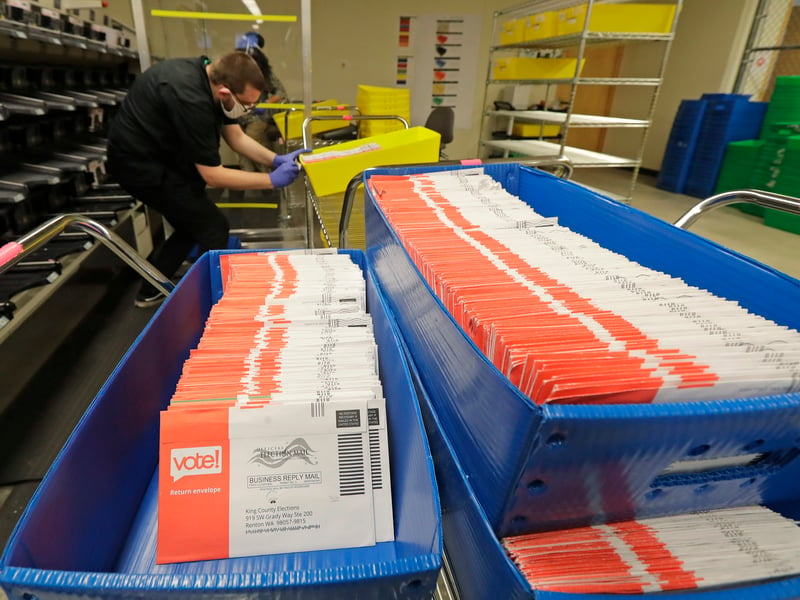
OLYMPIA, Wash. (CN) — As Election Day inches closer, Washington state’s highest court is weighing the constitutionality of the signature verification policy on mail-in ballots.
“The state of Washington infringes and burdens the right to vote with a subjective signature matching process that has operated to deprive more than 170,000 fully qualified Washington voters of the right to vote just since 2016,” Kevin Hamilton, attorney for the Vet Voice Foundation, one of the groups suing the election officials, told the Washington Supreme Court during oral arguments Wednesday morning.
In 2022, a group of political access-geared nonprofits sued Washington state and local voting officials, including Secretary of State Steve Hobbs, arguing that the state’s signature matching procedure, in which election officials verify ballot signatures to make sure they match the signature on file for a voter, burdens voters and disproportionately impacts certain groups.
Specifically, the groups argue that young voters have their ballots rejected at a higher rate than voters over 40; that Asian, Latino and Black voters have their votes rejected at twice the rate of white voters; and that active-duty military personnel and their families stationed out of state have their votes rejected at double the rate of civilian voters.
The state contends its signature verification requirement is constitutional, and any burden imposed by the statute is minimal and outweighed by the interest in keeping elections secure.
In 2023, a King County Superior Court judge rejected both the groups’ and the state officials’ motions for summary judgment, leading to the state Supreme Court to step in on appeal.
“These tens of thousands of ballots are cast by qualified voters who did everything required of them to exercise their right to vote but their ballots were mistakenly rejected by election officials because of their penmanship,” Hamilton said.
Washington has required vote-by-mail since 2011, though counties were permitted to adopt the practice since 2005.
Supreme Court Justice Sheryl Gordon McCloud questioned Hamilton about the figures he cited, noting that half of the ballots tossed due to the signature were cured through the state’s election process.
“To the extent that we can consider factual data in an as-applied challenge, I’m not sure that the inferences you’re drawing are the only inferences you can draw,” McCloud said.
Justice Debra L. Stephens later questioned whether the groups accused election officials of discriminatory intent, which Hamilton clarified was not the argument, but rather an “insult to constitutional injury.”
Karl Smith, attorney for the state defendants, pushed back on those arguments, accusing groups of “inappropriately relying on strict scrutiny in challenging routine regulation of the voting process.”
“Routine regulation that results in 10,000 individuals not having their ballot count?” Justice Mary I. Yu remarked. “How is that not significant?”
Smith clarified that the state’s intent is only to ensure that cast ballots are valid and that new regulations can cure signature discrepancies in just minutes. Further, Smith asserted that Washington has one of the least burdensome voting systems, and changes to how votes are verified would increase the burden on young voters and voters of color, such as requiring photo ID or submitting a fingerprint.
Stephens asked Smith why biometrics, such as requiring fingerprints, wouldn’t be a viable option, noting that there was no evidence on whether it would impact voter turnout. Yu too questioned how this case would impact strict scrutiny review of future challenges to statutes, as Smith argued strict scrutiny needn’t apply to the challenge, but rather a sliding scale of scrutiny.
“If the Legislature adopts some other mechanism for verifying identity, we’re going to be right back here, and they’re going to say ‘Well this is more burdensome, and therefore it fails strict scrutiny,’” Smith said.
Hamilton, on the other hand, argued the court is obligated to adopt a strict scrutiny standard under the text of the state constitution, which states that “all elections shall be free and equal, and no power, civil or military, shall at any time interfere to prevent the free exercise of the right of suffrage.”
“This a burden to voters, no matter what they do,” Hamilton said.
The Supreme Court did not indicate when it would rule.
Subscribe to our free newsletters
Our weekly newsletter Closing Arguments offers the latest about ongoing trials, major litigation and rulings in courthouses around the U.S. and the world, while the monthly Under the Lights dishes the legal dirt from Hollywood, sports, Big Tech and the arts.