
 Search Articles


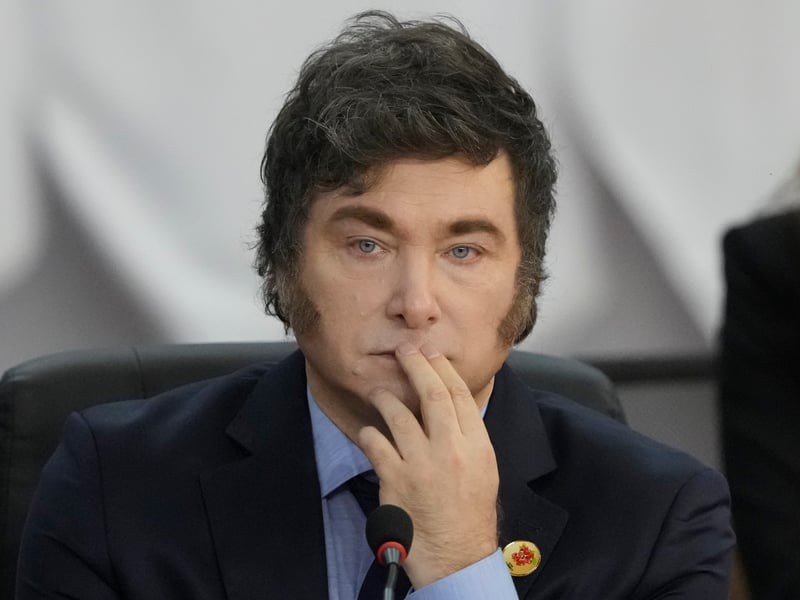
BUENOS AIRES (CN) — A year ago, libertarian economist Javier Milei took office in Argentina, shaking the country’s political and financial system. Formerly a TV pundit, Milei won the 2023 election by promising to turn the country of 47 million upside down — starting with slashing the state to its minimum and, therefore, guaranteeing a fiscal balance the previous administrations had failed to achieve.
During the last trail of his campaign, he rallied with a real chainsaw, a metaphor for what he planned to do with public spending. Some of his promises were achieved — he’s reduced public spending by 30% by cutting the number of ministries from 24 to 8 and eliminating departments such as Education, Social Development, Women, Genders and Diversity, and Health.
His administration terminated over 30,000 public sector contracts, halted almost all public works and reduced transfers to provincial governments, as well as introduced sweeping deregulation by repealing more than 300 regulations, facilitating privatizations of state-owned enterprises like the country’s main energy company YPF and the national postal service, Correo Argentino.
Additionally, Milei enforced strict fiscal austerity, slashing government spending on infrastructure, education and health care to achieve a budgetary surplus, while pursuing reforms to promote a market-driven economy.
A few months ago, while presenting his 2025 plan to Congress, he described the cornerstone of the proposal — achieving a zero fiscal deficit — as “a truth neglected in Argentina” and “the first truth of macroeconomics.” In recent years, Argentina has faced significant challenges in stabilizing its economy, driven by economic mismanagement, the effects of the pandemic, global conflicts and a $44 billion debt agreement with the International Monetary Fund from 2018. This debt, the largest loan in IMF history, has become a looming threat to successive administrations.
Matías Vernengo, a professor of economics at Bucknell University and director of the Bucknell Institute for Public Policy, said that despite the government’s glee with the outcome of Milei’s first year in office, the stats are not very promising for Argentines. “Unemployment and poverty are increasing, the austerity is having a terrible social impact — but we also have to look at the future of the economy, because President Milei is slashing public investments, which has a pretty negative effect in the long term,” he said.
Poverty in Argentina stands at 50%, and extreme poverty has risen to over 13% according to recent stats. While unemployment remains below 10%, Vernengo highlights that more than 35% of employed workers are poor — meaning that the purchasing power of their salaries barely covers their most basic needs.
“They’re building a country that’s only profitable for a few,” he said.
Milei’s economic administration of Argentina has received praise from U.S. President-elect Donald Trump and billionaire Elon Musk, who have said they hope to impose similar changes in the United States during Trump’s incoming administration. Milei has shared with them on several occasions the details of how he shaped the Ministry of Deregulation and State Transformation, which resembles Musk’s advisory commission for Trump — the Department of Government Efficiency, or DOGE.
The Argentine ministry has reviewed to modify or eliminate over 4,000 laws in Argentina, including some like rental and aviation laws.
Although some of the changes have made lives easier for many, with the elimination of red tape and bureaucratic processes across all areas of social life (including paperwork for divorce), the effects of the austerity policies are becoming increasingly visible as many struggle to find basic public aid in areas in which — although, many times, erratically — state-run institutions provided services and resources they took for granted.
The battle against ‘woke’
Social worker Daniela Zalazar was laid off from the “144 hotline,” a 24-hour public and free service for people seeking help due to gender-based violence. For years, she and her team aided hundreds of women seeking immediate help or advice to face the violence they experienced. But shortly after Milei took office, the program was dismantled down to 30% of its capacity — and people like Zalazar didn’t make the cut.
“Sometimes we’d speak for a few minutes to guide the person, but I’ve also spent hours on the phone,” she said. “We also helped with health issues, and situations where children were involved, too.” Different from 911, the 144 hotline worked alongside other institutions — hospitals, social programs, the judiciary — to provide comprehensive aid to women and LGBT people.
Zalazar recalled one time when she and her team saved a woman’s life when the woman managed to connect with 144 for a few seconds while hiding with her two small children from her husband and kidnapper. “That’s what we were there for,” she said. “The impact [of dismantling the 144 line] is huge, there are people’s lives on the line.”
Gender-based policies and those aimed at the LGBT community were some of the first to undergo the incumbent government’s hack. The elimination of the Ministry of Women, Gender and Diversities, created in 2019 to address gender-based violence and promote equality, was eliminated at the start of the Milei government. Although it represented less than 1% of the federal budget, the president has expressed he saw similar policies as “unnecessary expenditures.”
His administration had a similar approach to cultural public institutions, like the National Institute for Film and Visual Arts (INCAA). In March, the government withdrew all state funding for the institution, virtually paralyzing it from promoting national film and eliminating funding for independent projects. By cutting off all resources, programs like the globally prestigious Mar del Plata International Film Festival were severely affected.

“The new authorities say that they’re looking after Argentines’ money,” said Vanessa Ragone, head of the Argentine Film National Chamber. “But, in fact, the local film production is blatantly paralyzed — and the only few movies still being produced are working with funding prior to Milei’s arrival.”
Ragone believes that the policy has been the lack of administration of public resources, instead of an austere or measured administration. “Anything that seems ‘woke’ is permanently attacked,” she said. “We’re losing the idea of cultural sovereignty, the value of our cultural goods, leaving it all to the market’s sake.”
Education and health
Alejandro Lipcovich, who works in the administration of Garrahan Hospital, the biggest children’s hospital in the country, said that the almost 5,000 workers there have seen their salaries drop by nearly 40% in value since last year. Now, most of them make less than $1,000 a month working long shifts that are physically and emotionally draining, sometimes in palliative or oncologic care with kids.

“Since Milei’s arrival last year, the government froze new hires in the public sector, so whenever someone resigns for a better job we can’t replace them,” he said. “We’re losing our professionals, which is damaging the functioning of the hospital.”
Nicolás Alejo Lavagnino, a part of the Iberoamerican Center of Research in Science, Tech and Innovation, which researches public policies in those areas, said that the budget for public universities was cut by over 30% compared to last year. “It’s over 31% of a drop in salaries,” he said. “That means that schools are struggling to face their most basic work tasks.”
While salaries make up 85% of the public universities’ budget, the rest goes to finance the functioning of the institutions, which, according to Lavagnino, is also at stake.
Science Magazine recently described the current status of the sector as a “scienticide.”
“Many professors and researchers quit their positions because they can’t make ends meet, while many students drop out of school too,” Lavagnino said. “And the infrastructure is getting affected, too — from equipment to basic construction needs.”
Vernengo expressed concern that insufficient investment in universities and research could harm the country’s global standing over time. “The private sector alone cannot make the investments needed to sustain progress in science and technology,” he stated. “These budget cuts are undermining Argentina’s productive capacity, reducing it to a mere exporter of commodities, which limits both economic diversity and inclusivity.”
During the Conservative Political Action Conference in Argentina this past week, many U.S. political figures like Ben Shapiro, Lara Trump and Matt Schlapp praised Milei’s slashing of public institutions so far, celebrating the Trump and Musk promise to do the same after they arrive in the White House next year.
“Argentina is retaking its place as a global leader,” Shapiro said. “This country has finally stood up and said, ‘it’s time for the chainsaw,’ and Javier Milei understands the power of freedom.”
The room erupted in applause.
 Follow @luciacholakian
Subscribe to our free newsletters
Our weekly newsletter Closing Arguments offers the latest about ongoing trials, major litigation and rulings in courthouses around the U.S. and the world, while the monthly Under the Lights dishes the legal dirt from Hollywood, sports, Big Tech and the arts.