
 Search Articles


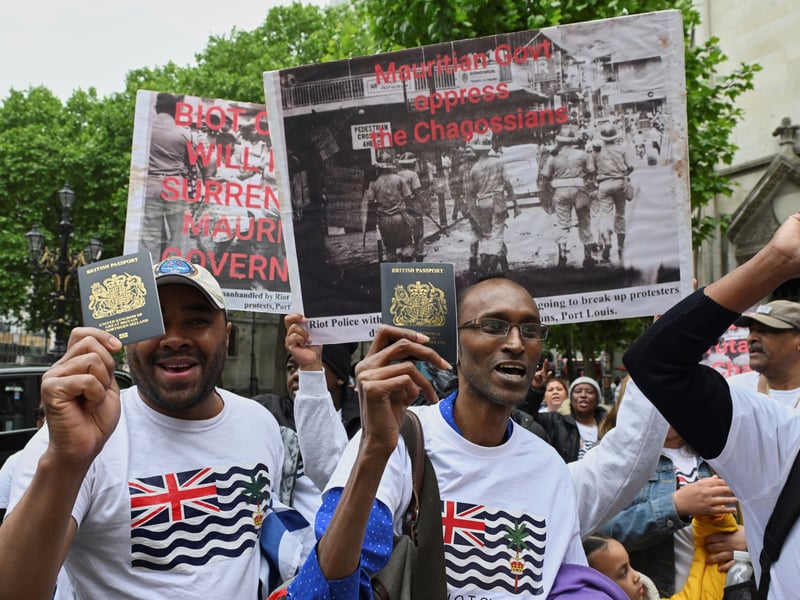
MANCHESTER, England (CN) — The U.K.’s landmark agreement to transfer sovereignty of the strategic Chagos Islands to Mauritius while retaining a 99-year lease on its military base has left many Chagossians fearing they have once again been sidelined.
Signed hours after a High Court judge overturned a last-minute legal challenge May 22, the deal secures U.K.-U.S. control of the Diego Garcia military base, which officials say is crucial to Western military operations in the Indian Ocean.
Prime Minister Keir Starmer stressed that the country had to “act now” in securing a deal.
Speaking from the U.K.’s military headquarters, Starmer said: “If we did not agree this deal, the legal situation would mean that we would not be able to prevent China or any other nation setting up their own bases on the outer islands or carrying out joint exercises near our base.”
Prime Minister of Mauritius Navin Ramgoolam hailed the deal as “the last chapters in the process of decolonization of Mauritius.” Speaking in a televised broadcast, Ramgoolam said: “This is the culmination of a battle waged by the Mauritian authorities for more than 60 years.”
He added that it was “total recognition of our sovereignty on the Chagos, including Diego Garcia.”
In 1965, the U.K. split the Chagos Archipelago from Mauritius, an island nation off the southeastern African coast, before forcibly expelling Chagossians from their homes to allow for the construction of a military base on Diego Garcia.
U.S. Secretary of State Marco Rubio praised the agreement, saying that Trump “expressed his support for this monumental achievement" and confirmed continued U.S. operations from Diego Garcia, which serves as a launchpad for missions in the Middle East and Asia-Pacific.
The Trump administration’s approval caught the British right wing off guard.
According to Peter Clegg, professor of politics at the University of the West of England, Bristol, politicians and commentators on the right “went full in criticizing the proposed agreement, feeling confident their position would be supported by the U.S.” and strengthened their relationship with MAGA.
“But clearly this did not happen, and the legitimate and significant concerns the U.K. government had, both under Labour and Conservatives, were enough to persuade the Trump administration to support the agreement,” he said.
Clegg believes that while the British right miscalculated the view of the White House, “they are also playing a longer game domestically,” part of a wider narrative to make Labour look like they don’t defend British interests.
The U.K.’s weakened diplomatic position following Brexit also played a role.
Pre-Brexit, the U.K. received support from the EU, which tends to defend its members’ definition of sovereignty. No longer part of the European bloc, it lost broad support during key votes at the U.N. General Assembly, with almost all EU countries abstaining, leading to an International Court of Justice opinion that the U.K. “had an obligation” to complete the decolonization of Mauritius.
While the deal returns the sovereignty of the islands to Mauritius, any future resettlement program for Chagossians will exclude Diego Garcia, the largest of the islands.
A divided Chagossian community
Olivier Bancoult, head of the Chagos Refugees Group, called it a “historic day,” and expressed hope that future generations will finally walk on the land their families were forced to leave.
“Today, children will be able to know the place where their parents and grandparents were born,” he said.
Others are far less optimistic.
Chagossian Voices, a grassroots organization led by the diaspora, doesn’t support the deal.
“We are deeply concerned that both governments have chosen to negotiate our future without us,” said Frankie Bontemps, who is chair of the organization.
“This exclusion reflects a long-standing pattern of marginalization, and unless urgently addressed, it risks perpetuating the same injustices that led to our forced displacement more than 50 years ago,” he said.
A strategic geopolitical calculation
According to Clegg, a key subtext for the treaty was China’s growing interest in the Indian Ocean.
In 2017, China set up its first overseas military base in Djibouti, giving the country access to the Horn of Africa, which is en route to the Suez Canal, a key strategic location for global trade.
“Without an agreement, U.K. sovereignty would have been increasingly questioned and ignored,” said Clegg, allowing other countries to exploit the lack of legal clarity.
Clegg noted that despite Mauritius’ expanding economic ties with China, its closest security relationship remains with India.
India, which views the Indian Ocean as a strategic priority amid China’s growing regional influence, welcomed the deal, “with Mauritius as an important counterweight to increased Chinese interests,” he added.
“The Indian Ocean will be an increasingly contested region,” said Clegg, “but the agreement over Chagos will solidify India’s influence — at least in the medium-term — and provide that certainty for the U.K.-U.S. base, which will also help to constrain China’s reach.”
Financial incentives but resettlement doubts
As part of the agreement, the U.K. will pay Mauritius $222 million annually for the first three years, followed by $162 million annually until year 13, indexed to inflation thereafter.
It will also establish a $54 million Chagossian trust fund and contribute $60 million annually for 25 years toward Mauritian development.
However, none of this money is explicitly earmarked for resettlement. The deal states that Mauritius is “free to implement” a resettlement program on the islands except for Diego Garcia.
Clegg said the U.K. should nevertheless play a role in assisting Chagossians living in Britain who wish to return, including by coordinating with Mauritius and through the funding that has been agreed.
But with no clarity yet on any future resettlement, many Chagossians feel they’ve been overlooked.
“Rather than empowering Chagossians, this process appears to treat us as political footnotes in a geopolitical bargain,” said Bontemps. “The core issues of our struggle — the right of return, land restitution, reparations, and recognition of our status as an indigenous people — remain unaddressed.”
For Bontemps, any agreement must place Chagossians at its center, “not merely as observers, but as co-authors of decisions about our homeland. Without this, there can be no legitimate or lasting resolution.”
 Follow @jayfranklinlive
Subscribe to our free newsletters
Our weekly newsletter Closing Arguments offers the latest about ongoing trials, major litigation and rulings in courthouses around the U.S. and the world, while the monthly Under the Lights dishes the legal dirt from Hollywood, sports, Big Tech and the arts.