
 Search Articles


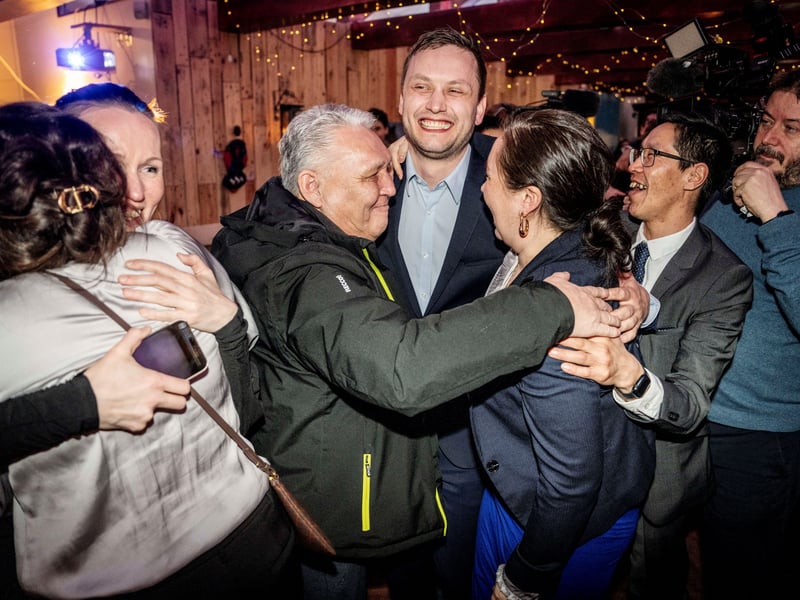
(CN) — For the first time in Greenlandic history Demokraatit, a center-right social liberal party with clear priorities in shrinking public spending and boosting the business sector, grabbed pole position in upcoming government coalition negotiations.
“We did not expect the election to have this outcome. We are very happy. Even though the election is over, the politics start now,” said Jens-Frederik Nielsen, chairman of Demokraatit, in the party leadership round broadcasted live on Greenlandic public service channel KNR on Wednesday.
“Greenland needs us to stand together in a time of great interest from outside. There is a need for unity, so we will enter into negotiations with everyone,” the 33-year-old chairman said.
There were no opinion polls during the Greenlandic election campaign, making it very difficult to predict the outcome of the election. Out of 40,369 possible votes, Demokraatit won 8,563, securing almost 30% of the total count and ten out of 31 seats in the parliament — the biggest ever for a party that won just over 9% of the votes at the previous election in 2021.
“It is no surprise that Demokraatit would win more votes,” said Ole Wæver, a political science professor at the University of Copenhagen, “but it is surprising that they won that much.”
The second-biggest party, Naleraq, secured 24.5% of the tally, an increase of 12.5% compared to 2021.
Both parties served as opposition in the latest term and agreed on independence from Denmark, but at very different paces.
Naleraq, considered a populist party by observers and commentators, campaigned for independence from its former colonizer within the next three years, while Demokraatit wants to develop a strong business sector before declaring Greenland a sovereign nation. Both parties look skeptical of President Donald Trump’s recent takeover propositions.
“Outside of Greenland, many eyeballed Naleraq, as they could have changed the playing field completely, and Copenhagen will likely feel relieved over the outcome,” Wæver said.
He said the differences between Demokraatit and the current government are better aligned with a more gradual path to independence. That’s one reason Demokraatit might form a coalition without Naleraq, which has proved steadfast in political negotiations, offering little compromise.
A new era
The voting marks a new era for Greenland, which has been dominated by the center-left wing for decades.
The present government coalition of social democrats Siumut and leading left-wing Inuit Ataqatigiit with Greenland Prime Minister Múte Bourup Egede received a gut punch from voters when they lost roughly 15% each of the tally. That made Siumut the fourth-biggest party in parliament, and Inuit Ataqatigiit the third.
State welfare and business opportunities related to fishing, tourism and mining were all debated in this year’s election campaign. These topics often follow the question of independence from Denmark, as the Nordic country, together with a smaller portion from the European Union, covers over a third of Greenland’s yearly state budget.
Gradually obtaining independence from Denmark means less funding from the former colonizer in times when Greenland’s budget is in need of increase to sustain decent welfare for its citizens.
A strategy to ensure full independence from Denmark is no new topic for Greenlandic politicians, but observers and researchers note that President Trump’s recent remarks about taking control over the world’s biggest island have escalated the debate on the relationship with Denmark. The U.S. attention has provided Greenland more leverage to negotiate its role within the Danish commonwealth.
Egede, along with a vast majority of politicians, has declined Trump’s takeover propositions multiple times, repeating the mantra that Greenlanders want to be neither Americans nor Danes — but are open for business.
“We deserve to be treated with respect, and I don’t think the American president has done that lately since he took office,” Egede said in an interview with Danish broadcaster DR on Monday.
The comment is a sharp counter to the American interest in Greenland this year, which for a long time was an intriguing prospect for Greenlandic politicians.
Trump’s pledge to take control of Greenland “one way or the other” in his joint address to Congress last week made Greenlandic eyeballs roll as Republicans in the room laughed — an incident many Greenlanders consider a big show of disrespect.
“We cannot for sure know whether America’s remarks on Greenland had an impact on Greenland’s election, but there are signs that it has worked counterproductive to the U.S. relation,” Wæver said.
“This result is an opportunity for Denmark to get its act together and negotiate with a part that acts serious and sensible to work on coming steps for Greenlandic independence,” he said.
 Follow @LasseSrensen13
Subscribe to our free newsletters
Our weekly newsletter Closing Arguments offers the latest about ongoing trials, major litigation and rulings in courthouses around the U.S. and the world, while the monthly Under the Lights dishes the legal dirt from Hollywood, sports, Big Tech and the arts.