
 Search Articles


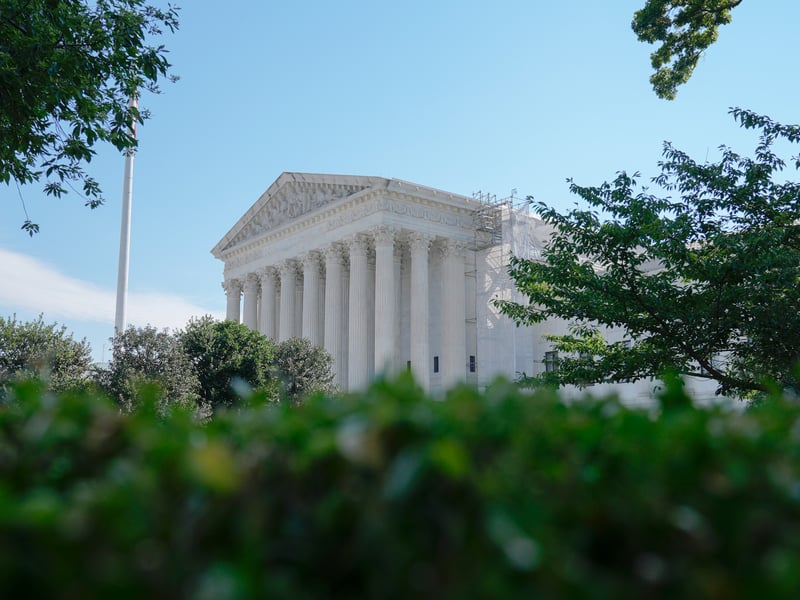
WASHINGTON (CN) — After a failed drug test cost him employment, a truck driver routed a narrow road at the Supreme Court Tuesday to bring a racketeering case against the company that sold him supposedly THC-free medicinal drops.
“If you’re harmed when you lose a job, then you’ve been injured in your business, haven’t you?” Justice Elena Kagan, a Barack Obama appointee, asked.
Trucker Douglas Horn suffered a serious accident in 2012 that left him with chronic shoulder and back pain. Medication and physical therapy offered little relief, so Horn turned to medicinal marijuana.
Horn bought Red Dice’s hemp-based wellness product Dixie X CBD Dew Drops, which were marketed as containing 0% THC — the psychoactive ingredient in marijuana. After researching Dixie X, Horn concluded that Dixie X’s lack of THC complied with his employer’s drug use policy.
In October 2012, Horn was fired after failing a random drug test that came back positive for THC. He suspected that Dixie X was to blame and sent the drops for testing by an independent lab. The results came back positive for THC.
Horn filed a complaint against Red Dice’s parent company Medical Marijuana for various state claims and federal racketeering. Horn’s civil Racketeer Influenced and Corrupt Organizations claim asked for $10 million in damages for his lost wages.
Civil RICO claims are limited to injuries to a business or property. Horn framed his job loss as a business injury because Dixie X’s 0% THC marketing led to his loss of employment.
“Can loss of employment ever constitute an injury in business?” Justice Clarence Thomas, a George H.W. Bush appointee, asked.
Several justices including Justice Sonia Sotomayor, an Obama appointee, seemed to think it did.
“The harm is not ingesting the drugs,” Sotomayor said. “That’s the personal injury. The harm is from being fired.”
But others on the bench sided with Medical Marijuana, which argues Horn’s claim is personal injury and therefore prohibited under RICO. Justice Brett Kavanaugh, a Donald Trump appointee, said Horn’s argument could disrupt the line between state and federal injury claims.
“That would mean that every state tort personal injury suit in which you’re seeking lost wages or medical expenses can be now brought under RICO and seek treble damages,” Kavanaugh said.
In just one of many hypotheticals posed during Tuesday’s arguments, Medical Marijuana said that if a mobster assaulted a car wash owner to pressure him to do business with the mob, the car wash owner would have a business injury under RICO because he was forced to work with the mob instead of cheaper competitors. Lisa Blatt, an attorney with Williams & Connolly representing the company, said the assault was a personal injury not applicable under RICO.
“I think it does run up against the constitutional principle of federalism, that their view does cannibalize all of state tort law,” Blatt said. “Every slip and fall to a mislabel now is a RICO case.”
Several justices shared Blatt’s concern but others suggested that connecting injuries to business or property harm would weed out inappropriate claims.
“The proximate cause requirement is going to do some of the work that some of us might fear will be needed if we agree with your interpretation of ‘injury to business or property,’” Justice Samuel Alito, a George W. Bush appointee, told Horn’s attorney.
Easha Anand, an attorney with the Stanford Supreme Court Litigation Clinic representing Horn, said the proximate cause requirement’s heavy burden had successfully kept product liability cases involving property damage in state courts.
“Petitioners’ rule has nothing to do with the oven that burns the house or the washing machine that floods the basement,” Anand said. “That’s all the other aspects of RICO are keeping that case out.”
The slew of hypotheticals continued Tuesday’s second argument session to decide if U.S. citizen Amina Bouarfa can challenge the denial of her Palestinian husband’s visa.
“If I tell my daughter that she may have dessert after dinner every night, she has discretionary authority to decide whether to have dessert,” Colleen Sinzdak, assistant to the solicitor general at the Justice Department said. “As a practical matter, she is going to eat dessert every single night.”
The government’s hypothetical refers to whether visa denials based on sham marriage findings are discretionary or mandatory.
After the government revoked Ala’a Hamayel’s granted visa petition after finding that his previous marriage aimed to avoid immigration laws, Bouarfa said she was entitled to judicial review because sham marriage denials are mandatory — unlike discretionary decisions which can’t be challenged.
Bouarfa said her reading of the statute was backed up by the government’s practice of always denying petitions connected to previous sham marriages. The justices wrestled with whether the denials were coincidental or represented a stated government practice.
“Your daughter would be able to tell you, ‘I have a policy of having dessert,’” Justice Elena Kagan, a Barak Obama appointee, said in a continuation of Sinzdak’s hypothetical.
The government can use the sham marriage bar to deny a visa at any time. While Hamayel can file another application, he would lose years spent on his first application.
“I understand the logic of the government’s position is that it is allowed to violate the Constitution with impunity in the context of revocation and that it is fine because you can go ahead and refile later,” Samir Deger-Sen, an attorney with Latham & Watkins representing Bouarfa said.
But Deger-Sen said that delay was significant for visa applicants who sometimes wait decades for green card approvals.
“Suddenly having your petition revoked and going back to the beginning and starting again,” Deger-Sen said. “That is a life-altering, life-destroying result. So there are real stakes in this case.”
Both of Tuesday’s arguments elicited nonideological splits across the high court bench, making their outcomes unclear. The justices will issue rulings in both cases in the coming months.
 Follow @KelseyReichmann
 Follow @kelseyreichmann.bsky.social
Subscribe to our free newsletters
Our weekly newsletter Closing Arguments offers the latest about ongoing trials, major litigation and rulings in courthouses around the U.S. and the world, while the monthly Under the Lights dishes the legal dirt from Hollywood, sports, Big Tech and the arts.