
 Search Articles


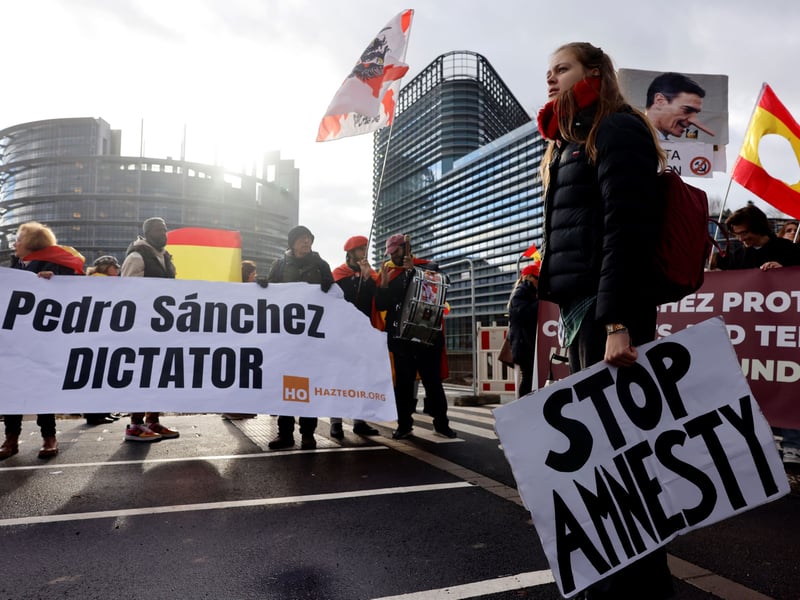
(CN) — Spain’s sweeping Catalan amnesty ran into one of its first major EU-level tests Thursday with two fresh legal opinions signaling that Europe’s top court may ultimately accept the law’s political bargain — but only within the guardrails of EU rules that cannot be bent, even for reconciliation.
Taken as a pair, the opinions sketch the same bottom line. An amnesty meant to calm a long-running constitutional crisis can hold, but only if it keeps clear limits in place and does not wipe out accountability for serious human rights abuses, bend EU terrorism rules or dilute protections for EU funds and judicial independence. Put simply, Brussels is open to political reconciliation, just not at the expense of the core obligations every member state signs up to under EU law.
The opinions come from Advocate General Dean Spielmann, who was asked to weigh in on two linked challenges testing the reach of Spain’s new amnesty law, which Madrid says will “normalize” Catalonia’s political and institutional landscape after years of unrest.
One case asks whether the amnesty can stretch far enough to cover acts that Spanish prosecutors once labeled as terrorism, particularly when those incidents caused no serious injuries. The other involves money and whether the law can wipe away financial liability proceedings tied to the misuse of public funds during the independence push.
In both cases, Spanish judges pressed the European Court of Justice for guidance: can a sweeping political reset at home live comfortably alongside EU rules on terrorism, public money and judicial independence, or do the two inevitably collide?
A clearer way to see what’s at stake is to go back to how the amnesty came about in the first place. Catalonia’s independence push burst into open conflict in 2017 after regional leaders pressed ahead with a referendum Spain’s courts had already declared unconstitutional. The vote set off mass protests, clashes with police and a wave of criminal cases for sedition, public disorder, misuse of public funds and, in some instances, terrorism-related offences. Some leaders fled abroad while others were jailed.
By 2024, Spain’s minority government was struggling to hold on and needed Catalan parties to stay afloat. As part of that deal, Madrid agreed to pass an amnesty covering a wide range of acts tied to the independence movement between 2011 and 2023. Supporters framed it as a long-overdue step toward political reconciliation. Critics countered that it was a political trade-off that risked sweeping away serious claims instead of confronting them.
The law, which entered into force on Jun. 11, 2024, casts a deliberately wide net. It sweeps in everything from organizing the unofficial referendums in 2014 and 2017 to related protests, administrative decisions and, in some cases, the handling of public funds. At the same time, it draws sharp red lines — crimes tied to personal gain are out, as are serious human rights violations including terrorism that caused significant harm.
Those limits matter most in the terrorism-related case. The defendants, linked by prosecutors to Catalonia’s CDR network, a loose grassroots movement accused of coordinating disruptive protests, and to a smaller ERT cell said to have toyed with incendiary materials and plans to hit sensitive sites, argued the amnesty should cover them because no one was seriously hurt.
Spielmann took a steady, no-drama approach. He said EU law does not object to amnesties as such, but it does draw firm lines when terrorism cases enter the picture. An amnesty cannot become a shortcut that lets governments dodge their basic duties under international and EU law.
For him, the key test is simple: national judges still have to look closely at the facts and decide whether the conduct crossed the EU’s “serious harm” threshold. If it did, the amnesty cannot make the case disappear.
And that, he said, is where the real work happens. The law’s text is not enough on its own; what matters is how rigorously Spain’s courts apply its exclusions case by case. The amnesty may promise political calm, but its survival depends on whether its day-to-day application holds up under genuine judicial scrutiny.
In the financial accountability case, Spain’s audit court wanted to know whether the amnesty lets officials walk away from paying back public money they misused during Catalonia’s independence push. The officials had been accused of diverting or improperly authorizing domestic public funds between 2011 and 2017, but the case file contained no indication that EU budget funds were involved.
Spielmann didn’t deny the political heat around the amnesty, but he kept the legal point tight. Brussels only steps in, he said, when a pardon risks warping the EU’s own financial safeguards. Everything else is for Spanish judges to sort out. They still have plenty of room to weigh the evidence and decide whether any spending tied to EU funds should be covered or carved out. And in this case, he hinted, nothing in the file shows those red lines were crossed, meaning the national courts remain perfectly free to police financial accountability on their own.
Matteo Bonelli, an associate professor of EU law at Maastricht University, said the two opinions reflect a deliberately cautious stance. “The main point in the two cases is similar: the decision to adopt an amnesty belongs to a member state,” he noted, adding Spielmann acknowledged the political sensitivity of the issue and “a broad margin of discretion to the member states.”
At the same time, he said, EU law still imposes “external limits” on national amnesties — from human rights standards and the European Convention on Human Rights to rules on protecting EU financial interests and ensuring judicial independence.
“The approach of the advocate general follows a clear logic, recognizing the sensitivity of the questions and avoiding an excessive interference of EU law in national political processes, while still reminding member states that they must ensure compliance with EU law obligations,” he said.
The Spanish public prosecutor and the two associations that brought the proceedings did not immediately respond to requests for comment.
While Thursday’s opinion isn’t legally binding, the court often follows this kind of advice. If it does so here, the amnesty itself will probably clear the EU bar — but its day-to-day use could face much tighter guardrails, especially where human rights, terrorism-linked acts or public money come into play.
Courthouse News reporter Eunseo Hong is based in the Netherlands.
Subscribe to our free newsletters
Our weekly newsletter Closing Arguments offers the latest about ongoing trials, major litigation and rulings in courthouses around the U.S. and the world, while the monthly Under the Lights dishes the legal dirt from Hollywood, sports, Big Tech and the arts.