
 Search Articles


BRISTOL, England (CN) — Five years ago, Britain’s city streets fell quiet. As traffic vanished during Covid-19 lockdowns, the air cleared, cyclists and pedestrians took the streets back from cars, and politicians around the world hailed a once-in-a-generation chance to reorient urban life toward a greener future.
At the pandemic’s height in 2020, Britain began establishing about 130 “low-traffic neighborhoods” or LTNs, clusters of residential streets closed to through traffic.
Within months, there were around 100 LTNs in London, covering about 5% of the city’s population. Others rolled out in other U.K. cities, including Oxford, Newcastle, Birmingham, Bath, Manchester and Bristol.
Leaders from across the spectrum seemed to be on board. Conservative then-Prime Minister Boris Johnson, himself an avid cyclist, said his government was doing “everything we can” to encourage “cycling to work or walking safely to school.” Sadiq Khan, London’s Labour Party mayor, likewise proclaimed that “the future of travel in London must involve more walking and cycling.”
Then came the backlash in the form of postpandemic politics — an incendiary polycrisis of inflation, war, anti-establishment populism and global instability.
Anger mounted as lockdowns lifted. Drivers discovered familiar streets were blocked. Taxis, ambulances, firetrucks and delivery vehicles wound up lost.
Today, the same bollards and planters that symbolized civic renewal are feeding this maelstrom.
“In the beginning, it was not so heavily politicized,” Jamie Furlong, a transport expert at the University of Westminster, said in a phone interview from his home in London. “It received a lot of national attention, and other cities [beyond London] have tried to implement the schemes, but largely unsuccessfully.”
As opposition mounted, the U.K. shifted into reverse. Across the country, about 20 low-traffic experiments have been scaled back or dismantled altogether.
Things got ugly: Bollards were ripped out, protesters blocked roads, government vehicles were vandalized and civil servants received death threats. There were also lawsuits, including a high-profile case this year in which Britain’s High Court sided with a group of LTN opponents living in London’s West Dulwich neighborhood.
The backlash also proved fertile ground for right-wing populists. Nigel Farage, leader of the party Reform UK, cast LTNs as a “war on motorists.” The party pledged to end the war and scrap other green policies. They were soon rewarded at the ballot box, sweeping local elections in May.
“It is almost an attempt to drive people out of cars,” Farage thundered on GB News, Britain’s version of Fox News.
“We’re being pushed too far,” he barked. “We’re being told to bow down before the god of net zero.”
Free Our Streets, a national group that has campaigned alongside Farage against traffic restrictions, did not return messages seeking comment, nor did local groups opposed to these schemes. Reform UK likewise did not return messages seeking comment from Courthouse News.
It isn’t just Reform UK: Anti-LTN politics have made it into the mainstream.
By September 2023, then-Prime Minister Rishi Sunak of the Conservative Party had come out against them, saying he was “slamming the brakes on the war on motorists” and “stopping hair-brained”schemes like LTNs and low-emission zones. Even after trouncing the Conservative Party in general elections in 2024, current Labour Party Prime Minister Keir Starmer has shown little appetite for building new LTNs.
In Newcastle and London, LTNs were noisily taken out. In East London, Lutfur Rahman, a controversial Bangladesh-born businessman previously banned from public office over corruption charges, was reelected mayor of Tower Hamlets on a promise to end local LTNs, which he soon did. Rahman’s actions were upheld by the High Court last December.
Even in Bristol — Britain’s only major city run by the Green Party — officials have faced delays, protests and petitions as they try to implement two LTNs. In a sign of the changing political winds, Bristol officials rebranded the projects as “livable neighborhood” plans, a term now favored over “low-traffic neighborhoods” because it doesn’t directly take aim at cars.
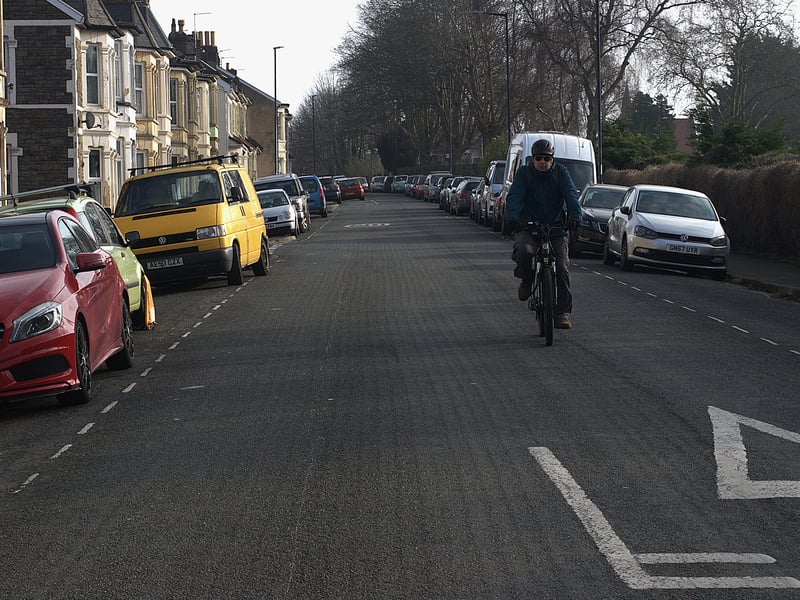
On an overcast morning earlier this year, Beth Oakley, a 36-year-old social worker, cycled to work along Beaufort Road in East Bristol.
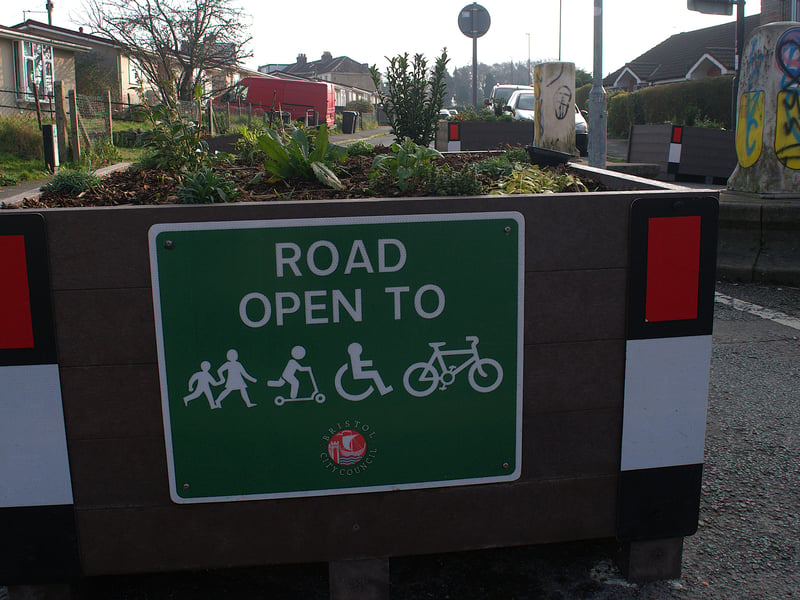
In the city’s first experiment with an LTN, this once-busy street was turned into a bike path.
Pausing her commute to speak with Courthouse News, she remembered how the road had been “a rat run for cars” — unsafe, loud and choked with exhaust.
“I think it’s really beneficial,” she said of the changes. “I’ve seen a lot more people on their bikes.”
Her 20-minute trip to work has become a small daily pleasure, reminding her why she supports the city’s plans even as tempers flare.
“There was obviously quite a lot of pushback in the beginning,” she said. “People are still wedded to their cars, I think, so it will take time.”
Just around the corner, longtime Bristol resident Andrew Stocker, a film and television location scout in his 60s, offered a very different view. He shook his head at the same road-blocking planters Oakley praised.
“It’s been a nightmare,” he said. “Before all these closures came in, I used to be able to go down to the shops, shop and come back within five, 10 minutes.” Not so anymore. “I went shopping the other week. It took me one hour and 10 minutes.”
Stocker acknowledged Beaufort Road had sometimes turned into a “rat run,” a term for streets that commuters use to escape traffic on a main road. But he opposed the decision to close it off entirely to through traffic, which he argued only worsened congestion on nearby roads.
For Stocker, the road closures felt like a bureaucratic assault on common sense.
“They’ve made it quite difficult for everybody, because there are no other ways through,” he said.
This clash between Oakley’s optimism and Stocker’s frustration encapsulates a bigger cultural divide over cars in Britain. And what began as an urban-planning fix has become a generational, political and even moral battle.
“It’s pretty clear that translating environmental policy into practical municipal administration, operating within significant fiscal constraints and general public service expectations, is a huge challenge,” Thom Oliver, a public policy expert at the University of the West of England in Bristol, wrote in an email.
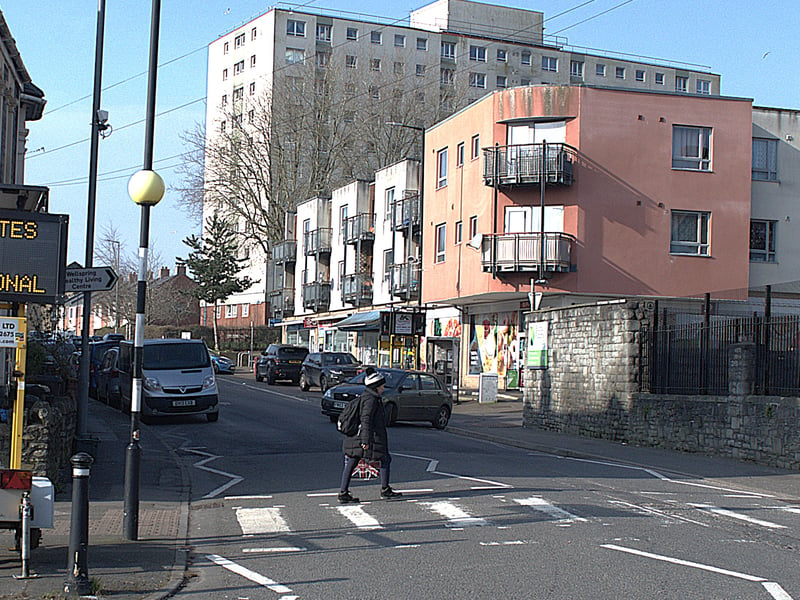
In East Bristol, this LTN pilot project was blocked when it reached Barton Hill, a working-class neighborhood of public tower blocks, row houses and small shops.
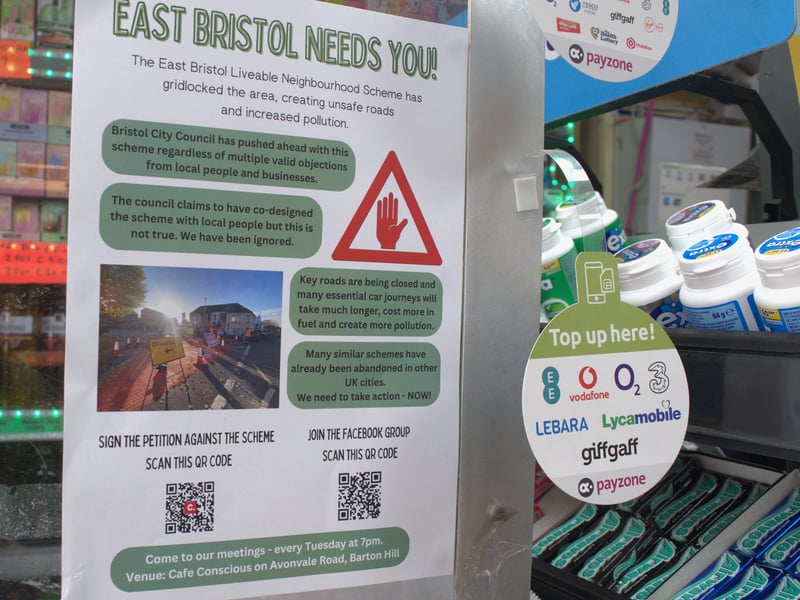
Protests broke out when workers tried to install road closures along Avonvale Road, a thoroughfare leading toward the city center. Petitions drew thousands of signatures. Officials hit the pause button and delayed closing off more roads.
Like elsewhere in the country, opposition sometimes veered into conspiratorial thinking. Katrina Rhenals, a 49-year-old Barton Hill resident who opposed the closures, speculated that planners were trying to prepare the neighborhood for gentrification and development.
“There was no problem with traffic here before, and then they created more traffic problems,” Rhenal said. “There’s no pollution problem to sort out.”
Transportation policy might seem at first glance like a wonky and uncontroversial subject. But it overlaps with topics that many people feel strongly about, according to Ersilia Verlinghieri, a researcher at the University of Westminster who studies LTNs.
“The car is more than a mode of transport: It’s a symbol of independence and [a] moral right,” she said. “Many people opposing these schemes talk in terms of freedom, while supporters talk about care, well-being, and the common good. That’s why the debate feels moral, even existential.”
Even so, Verlinghieri traces much of the fury over LTNs to the way they were implemented: quickly, and during a global pandemic. She said poor communication by officials led to misunderstandings over what might have otherwise been popular goals, from reducing air population to creating better spaces for walking and cycling.
The rationale for reducing traffic remains compelling. With more pedestrians and cyclists and fewer drivers, road injuries fell dramatically in London LTNs, research from the University of Westminster found. And while one main critique of LTNs is that they simply shuffle traffic elsewhere, evidence suggests overall vehicular traffic has generally tapered off over time.
“It takes a little while for people to adjust travel behavior,” Furlong said.
Fewer cars means less pollution, and “we know that active travel has such high health benefits,” Verlinghieri said. She argues a vocal minority of LTN haters has obscured the fact that most Britons either support or feel neutral. Still, poor implementation has fueled controversy — and as evidence in the U.K. and beyond suggests, it didn’t have to be that way.
Some of the first LTNs in the U.K. cropped up in London about 10 years ago, during the mayorship of Boris Johnson. Johnson branded them “mini-Hollands,” in reference to the famously bikeable country.
In the outer-city boroughs of Waltham Forest, Enfield and Kingston, longterm investment turned car-clogged streets into pedestrian- and cyclist-friendly boulevards, complete with pocket parks, new crossings, and cycle “superhighways.” For British planners, they’re the gold standard and remain a source of inspiration.
“At the time, it was quite radical,” Furlong explained. “There was some controversy over it, but the councils persisted, and they implemented cycle lanes on the main roads.”
Another inspiring example comes from Barcelona’s famous experiment with “superblocks.”
In the Spanish city, planners reoriented the street grid, leaving major thoroughfares to cars while creating room on smaller interior streets for amenities like playgrounds and parks. The scheme has been a popular success, with the superblock idea now expanding to other European cities like Milan.
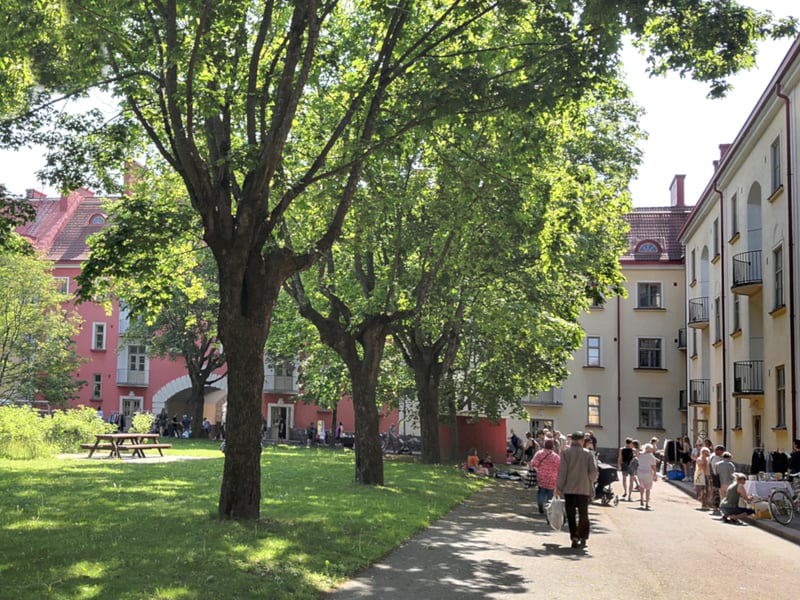
Crucially, in Barcelona, planners added amenities before closing off cars to traffic. The U.K. did the opposite — a fact Verlinghieri says helps explain the opposition.
In the chaos of the pandemic, Britain closed off streets at minimal cost, believing that neighborhoods would naturally be transformed. But the result is that some LTNs have all the drawbacks of reduced driving routes with fewer of the quality-of-life benefits.
In Barcelona, “they changed the physical environment — trees, seating, color — and then adjusted traffic,” Verlinghieri explained. “In the U.K., we did the opposite: closed roads first [and] beautified later, if ever.”
Another consequence of Britain’s pandemic-era rollout of LTNs: There was less room for public input, with councils largely relying on online platforms to gauge citizen feedback.
Outside consultants were hired. This led many Brits to bitterly view LTNs as the brainchild of well-off cycling elites.
“There is almost like an othering of cyclists as a group,” Furlong said. “They are seen as kind of undeserving of this transport infrastructure.” He says Britain’s right-wing press jumped on this aspect of the controversy, churning out countless articles about dangerous, entitled cyclists. And yet he says the same media outlets pay little attention to the (much greater) dangers of driving.
Amid the partisan clash over walkable neighborhoods, LTNs have mostly been erected in left-leaning areas run by the Labour and Green parties. The national Green Party did not respond to press requests from Courthouse News, nor did the local Green Party that controls the Bristol City Council.
Evidence suggests that Bristol leaders — while not giving up on LTNs — are taking note of the backlash and adjusting their approach. In an attempt to win over opponents, they’ve adopted a slower, more consultative model for a new liveable neighborhood scheme in working-class South Bristol.
Even so, opposition is stiff. Petitions continue to draw thousands of signatures, anti-LTN stickers have appeared on streets, and public meetings have devolved into theater.
In East Bristol, most residents still seem to back the road closures — though reluctance about expressing opinions is surprisingly common.
“It is very divisive in this area, unfortunately,” said Emma, who declined to give her last name while talking about the contentious topic.
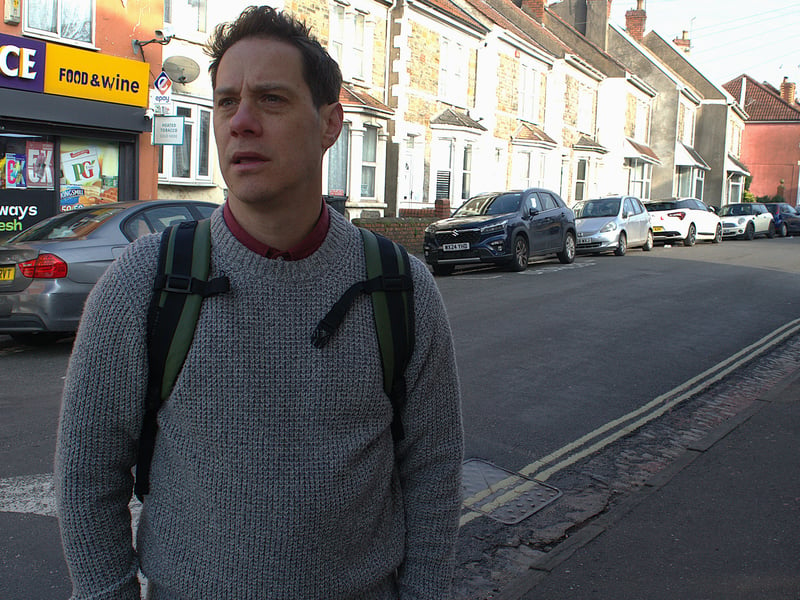
Emma, a 55-year-old East Bristol resident who was out for a walk, described her views as both pro- and anti-.
“Naturally, I would be pro-,” she explained. “Last year, my car died, and I decided not to get another one because I knew I was living in this area. I’m quite an ecological person, so I walk everywhere now and I’m loving it.” But she said local officials were doing a poor job of listening to resident concerns or involving them in the process, irritating residents who might have otherwise been supportive.
“It’s a real shame,” she said. “The way it’s been done, it has put people off.” As a result, “the areas of opinions are so entrenched,” making consensus ever more difficult.
Emma furrowed her brow, as if considering how to best summarize her ambivalent feelings.
“Ultimately, we have to do this,” she said. “Climate change is a thing. Bristol has to embrace these things.” But in a city defined by leftist politics and trade unions, she said public officials must better involve residents or continue to face stubborn opposition.
“Please listen,” she said. “Get it right.”
For some East Bristol residents, local LTNs have simply been a success.
Pietro Herrera, a 45-year-old advertising professional, listed off the many benefits he saw in them. His children could walk to school without fear of cars. The air quality was better. Birdsongs were audible. It was easier to get downtown on bike.
“It’s a nicer place to live,” Herrera said. “There’s a genuine sense of community now. People are coming out, having barbecues on the road.”
Courthouse News reporter Cain Burdeau is based in the European Union.
 Follow @cainburdeau
Subscribe to our free newsletters
Our weekly newsletter Closing Arguments offers the latest about ongoing trials, major litigation and rulings in courthouses around the U.S. and the world, while the monthly Under the Lights dishes the legal dirt from Hollywood, sports, Big Tech and the arts.